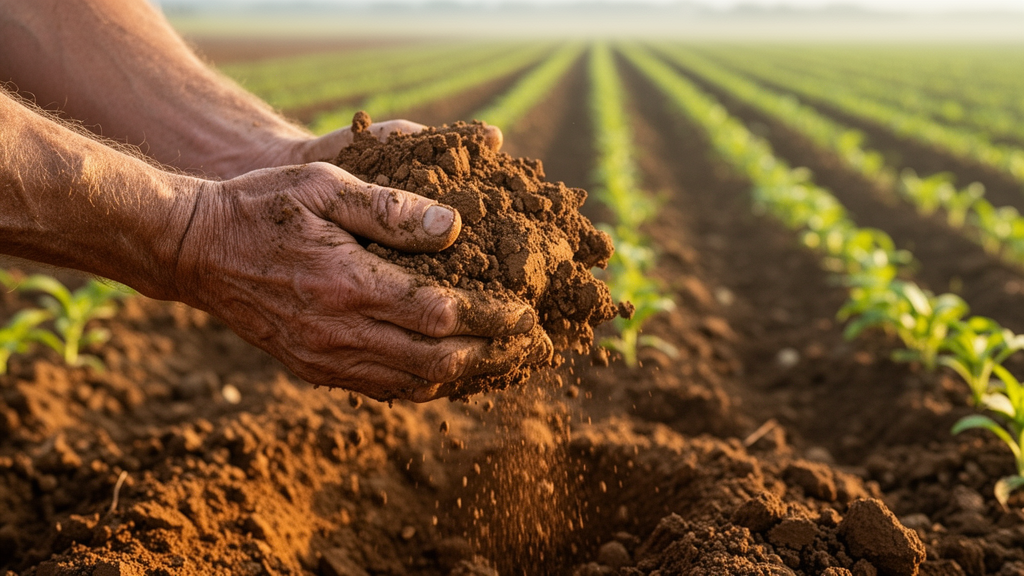
Potassium is the nutrient crops drink almost as greedily as nitrogen. It makes up roughly half a percent to four percent of plant dry tissue, drives enzymatic activity, cell development and osmotic balance, and yet it has lived for decades in the shadow of nitrogen and phosphorus in both research budgets and fertilizer programs. Now a greenhouse study of three alkaline Mediterranean agricultural soils suggests that the standard soil test used to guide potassium fertilization may be missing a huge part of the story. Over thirteen months of intensive alfalfa production, plants extracted two to nearly four times more potassium than the conventional exchangeable-potassium test predicted, with between half and three-quarters of all the potassium they absorbed drawn from mineral reservoirs that agronomists have long treated as effectively unavailable on farming timescales.
The study, led by Shikma Zaarur of the Hebrew University of Jerusalem together with colleagues at the Agricultural Research Organization’s Volcani Institute, the Geological Survey of Israel and Ben-Gurion University of the Negev, was designed to simulate the relentless potassium drain of intensive agriculture. The team filled ten-liter pots with three contrasting alkaline soils from Israel: a clayey soil from the coastal plains, a loess sandy loam from the western Negev, and a red sandy soil from Rehovot. Peruvian alfalfa, one of agriculture’s most potassium-hungry crops, was sown in April 2024 and harvested sixteen times over roughly thirteen and a half months, with each cut removing potassium from the system. All essential nutrients except potassium were supplied through drip irrigation, so potassium was the only element expected to become limiting in the unfertilized treatments. A parallel set of pots received potassium chloride fertilizer, split into two applications.
Soil potassium exists in a hierarchy of reservoirs that differ enormously in size and accessibility. The smallest, potassium dissolved in the soil solution, represents only about 0.1 to 0.2 percent of total soil potassium, but it is the only pool plants can absorb directly. The exchangeable pool, one to two percent of the total, consists of potassium adsorbed onto clay surfaces and some interlayer sites, and it is what the standard ammonium acetate extraction measures. Below that sits interlayer potassium, locked between the sheets of 2:1 clay minerals such as illite and illite-smectite, which can account for up to ten percent of total soil potassium. Finally, structural potassium, hosted in micas and potassium feldspar, makes up 90 to 98 percent of the total and is considered almost inert. Fertilizer recommendations worldwide treat the exchangeable pool as the soil’s capacity to feed a crop, effectively ignoring everything beneath it.
The mass-balance results shattered that assumption. In the unfertilized pots, cumulative potassium uptake reached about 7.3 grams per pot in both the clayey and loess soils and 4.4 grams in the red sandy soil, while the initial exchangeable potassium plus the small background input from irrigation water could account for only a fraction of those amounts. Total uptake was 2.0 to 3.9 times greater than the estimated supply from exchangeable potassium and natural inputs. Non-exchangeable pools supplied 67 percent of uptake in the clayey soil, 50 percent in the loess, and a striking 74 percent in the red sandy soil. Direct measurements of total soil potassium at the end of the trial confirmed the depletion: total potassium fell from 88 to 75 grams per pot in the clayey soil, from 75 to 65 in the loess, and from 31 to 28 in the red sandy soil, with the rhizosphere cores showing even greater losses than the mass balance predicted.
To trace where the missing potassium came from, the researchers exploited a geochemical fingerprint. Rubidium substitutes for potassium in mineral structures because the two ions carry the same charge and nearly the same radius, but different minerals incorporate rubidium in different proportions, giving each mineral source a characteristic potassium-to-rubidium ratio. As plants depleted the exchangeable pool, its potassium-to-rubidium ratio shifted dramatically toward the signature of the fine clay fraction in all three soils. In the loess soil the ratio plunged from 3664 at the start to 284 by the eighth harvest; in the red sandy soil it fell from 547 to 154 within the same period. The exchangeable pool was converging on the composition of the clay minerals themselves, indicating that illite and illite-smectite interlayers, not potassium feldspar, were the dominant suppliers.
The mineralogy of each soil also governed how much the crop responded to added fertilizer. In the clay-rich soil, where abundant mixed-layer illite-smectite buffers the soil solution, fertilization produced only a marginal and statistically insignificant biomass gain of 5.3 percent across sixteen harvests. The loess soil responded with a significant 5.5 percent increase, but only from the eleventh harvest onward, once the plants had drained the readily available potassium. The potassium-poor red sandy soil responded earliest and most strongly, with fertilization boosting cumulative biomass by 13.5 percent, significant at most harvests from the third cut onward. This pattern mirrors decades of puzzling field observations in which crops on alkaline soils showed little or no yield response to potassium fertilizer despite soil tests suggesting deficiency.
Perhaps the most provocative finding concerns the speed of mineral weathering. Using a first-order approximation, the team calculated the illite dissolution rate needed to sustain the observed potassium release. If all the non-exchangeable potassium had come from illite, between roughly 17 and 34 grams of the mineral would have had to weather in each pot over a single year. That translates to dissolution rates of about 10 to the minus 11 to 10 to the minus 12 moles per square meter per second, depending on assumed grain size, which is two to three orders of magnitude faster than natural illite weathering rates and far above laboratory rates measured at neutral pH. The implication is that intensive cropping creates a biological sink that pulls mineral dissolution forward, accelerating weathering of potassium-bearing clays to rates relevant to a single growing season, a phenomenon usually assumed to require millennia.
The mechanism likely lies in the rhizosphere. Alfalfa, with its enormous biomass and repeated cutting schedule, can remove around 200 kilograms of potassium per hectare annually. As roots strip potassium from the soil solution, chemical equilibria shift, and the researchers suggest that root exudation of organic acids may further enhance potassium release from interlayer sites. Consistent with this, recent work has shown that alfalfa roots can trigger significant potassium release from micaceous interlayers within just four months. The exchangeable pool in the study soils did not simply drain to zero; instead it stabilized at a dynamic minimum, a steady state where the rate of mineral release matched the rate of plant removal. That minimum differed for each soil and was controlled by mineral composition and plant demand, meaning the exchangeable test captures only a snapshot of a moving target.
The practical consequences are substantial. If exchangeable potassium tests underestimate plant-available potassium by a factor of two to four in these alkaline Mediterranean soils, then fertilization recommendations built on those tests risk both unnecessary applications on clay-rich soils, where the mineral buffer is strong, and potentially misleading deficiency diagnoses elsewhere. The authors note that the degree of underestimation is likely governed by the abundance of potassium-bearing clay phases, particularly illite and illite-smectite, which are common in eastern Mediterranean soils partly because of mineral-rich dust inputs. Long-term field experiments in Israel, spanning roughly thirty years, have similarly reported little response to potassium fertilization in cotton and wheat grown on soils with comparable clay mineralogy, lending field-scale support to the greenhouse findings.
The study does not mean potassium fertilization can be abandoned. Plants in the unfertilized pots eventually developed classic deficiency symptoms, including chlorosis, necrotic leaf margins and stunted growth, and tissue potassium concentrations fell below the roughly 1.1 percent sufficiency threshold for alfalfa by the end of the trial in all soils. Rather, the message is that the exchangeable test reflects only one slice of a dynamic system in which clay minerals act as both sink and source, fixing potassium when supply is abundant and releasing it when demand is high. Accurate potassium management, the researchers argue, requires methods that account for the mineralogical buffering capacity of soils, ensuring that potassium is applied where it is genuinely needed and conserved where the ground itself can keep feeding the crop.
Subject of Research: Non-exchangeable potassium release from clay minerals sustaining plant potassium uptake in alkaline Mediterranean agricultural soils
Article Title: Non-exchangeable K sustains plant K uptake in alkaline Mediterranean soils
Article References: Zaarur, S., Erel, R., Bier, A. K., Rivlin, A., Nahari, I., Morag, N., Yeshno, E., & Naon, L. (2026). Non-exchangeable K sustains plant K uptake in alkaline Mediterranean soils. Plant and Soil. https://doi.org/10.1007/s11104-026-09118-x
Image Credits: AI Generated
DOI: 10.1007/s11104-026-09118-x
Keywords: potassium, soil fertility, clay minerals, illite, illite-smectite, mineral weathering, alfalfa, fertilization, Mediterranean soils, exchangeable potassium, K/Rb ratio, plant nutrition
Cite Scienmag News
Alan Morgan. (October 8, 2026). Hidden Potassium Reserves in Clay Soils Quietly Feed Crops and Upend Fertilizer Advice. Scienmag. https://scienmag.com/hidden-potassium-reserves-in-clay-soils-quietly-feed-crops-and-upend-fertilizer-advice/
Alan Morgan. "Hidden Potassium Reserves in Clay Soils Quietly Feed Crops and Upend Fertilizer Advice." Scienmag, 8 October 2026, https://scienmag.com/hidden-potassium-reserves-in-clay-soils-quietly-feed-crops-and-upend-fertilizer-advice/. Accessed 8 October 2026.
Alan Morgan. "Hidden Potassium Reserves in Clay Soils Quietly Feed Crops and Upend Fertilizer Advice." Scienmag. October 8, 2026. https://scienmag.com/hidden-potassium-reserves-in-clay-soils-quietly-feed-crops-and-upend-fertilizer-advice/