


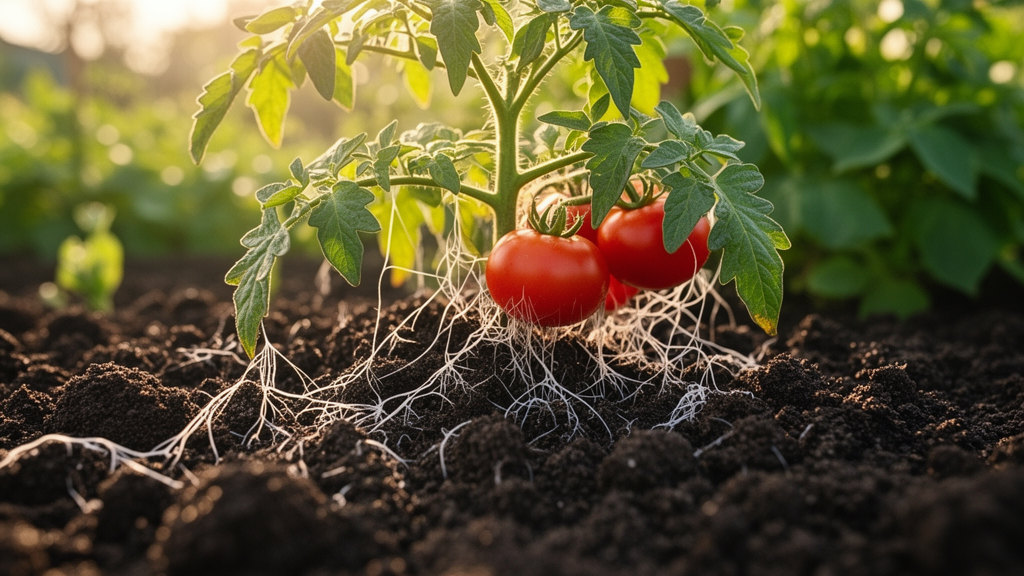
Beneath every healthy tomato plant lies a hidden negotiation. Arbuscular mycorrhizal (AM) fungi, ancient symbionts that colonize the roots of most land plants, trade soil nutrients for plant sugars, and in many cases they also prime the plant’s immune system against attackers. For decades, researchers have screened these fungi one species at a time, hoping to identify champion strains for biofertilizers and biological control products. A new study published in Plant and Soil now delivers a sobering and fascinating message: what a fungus does alone tells you remarkably little about what a community of fungi will do together.
The research, led by Natascha V. Weinberger of the Hawkesbury Institute for the Environment at Western Sydney University together with colleagues at the University of Adelaide and partner institutions, set out to test whether multi-species AM fungal communities produce additive, synergistic, or antagonistic effects on tomato growth and disease resistance relative to their constituent single isolates. The team worked with tomato plants of the compact cultivar Micro-Tom, inoculating them with five individual AM fungal isolates or with six carefully designed community combinations, and then challenging half of the plants with Rhizoctonia solani, a devastating root pathogen responsible for damping-off and root rot in crops worldwide.
What makes the study methodologically distinctive is its use of high-throughput phenotyping. Rather than relying on a single endpoint harvest, the researchers grew their plants on the conveyor-belt imaging system at The Plant Accelerator, part of the Australian Plant Phenomics Network. Three cameras captured one top-view and two side-view RGB images of every plant daily, generating more than 3,300 observations per trait across the experiment. From these images the team derived the projected shoot area, a reliable proxy for aboveground biomass, and the absolute growth rate, which captures how quickly biomass accumulates between days. This temporal resolution proved crucial, because static endpoint measurements can mask the dramatic dynamics that unfold in the days immediately after a pathogen strikes.
The five isolates spanned two major AM fungal families with contrasting reputations. Funneliformis mosseae and two isolates of Rhizophagus irregularis belong to the Glomeraceae, a family previously associated with strong pathogen protection, while Gigaspora margarita and Scutellospora calospora belong to the Gigasporaceae, better known for promoting host growth. Prior work by the same group had classified F. mosseae and R. irregularis WFVAM 23 as effective at inducing so-called Mycorrhiza-Induced Resistance, or MIR, whereas the two Gigasporaceae isolates had been rated ineffective. The community treatments were built with these reputations in mind: a HIGH MIR pairing of the two protective isolates, a LOW MIR pairing of the two ineffective ones, a MIR plus GROWTH mix combining protection with growth promotion, a HIGH COL pairing of strong colonizers, an ISOLATES treatment mixing two strains of the same species, and a DIVERSITY treatment containing all five isolates.
When the researchers analyzed growth in the absence of the pathogen, the results largely defied the simple logic that more fungi should mean more benefit. Only one community, the MIR plus GROWTH combination of F. mosseae and G. margarita, consistently outperformed both of its constituent single isolates, qualifying as synergistic and showing the highest absolute growth rate during the early phase of the experiment. Three other mixtures behaved additively, tracking the intermediate or lower range of their components. Strikingly, the HIGH MIR pairing and the five-species DIVERSITY community performed closest to the weakest individual isolate, an antagonistic outcome suggesting that competition among fungi for root colonization sites, or shifts in how plants allocate carbon to their partners, can erode the benefits that each species provides alone.
The disease experiments produced the study’s biggest surprise. Five of the six community treatments reduced the biomass losses caused by Rhizoctonia solani compared with non-mycorrhizal infected controls. The HIGH MIR community, combining the two previously validated protective isolates, delivered synergistic protection, with pathogen-challenged plants reaching biomass levels comparable to uninfected controls. But the real shock came from the LOW MIR community, which paired the two Gigasporaceae isolates previously classified as incapable of inducing resistance. Together, these two individually ineffective fungi protected tomato plants almost as completely as the best protective pairing, allowing infected plants to match the biomass of their uninfected counterparts.
This outcome demolishes the intuitive hypothesis that combining two effective isolates yields strong resistance while combining two weak ones yields none. The community effect, the authors conclude, is not simply an average of individual performances. Complex interactions such as competition, resource partitioning, and possibly the timing of root colonization appear to shape the final result in ways that single-isolate screening cannot capture. Even the ISOLATES treatment, mixing two strains of the same R. irregularis species, showed an unexpected burst of accelerated growth immediately after pathogen addition, a transient compensatory response visible only in the daily growth-rate data and invisible in final biomass figures.
The temporal dimension added further nuance. The researchers observed that the most successful community owed its high final biomass to rapid early growth rather than late-stage acceleration, while antagonistic communities showed depressed growth rates in the later phases of the experiment. Immediately after pathogen inoculation, almost all communities conferred some degree of protection, but the magnitude and duration of that protection varied widely. The MIR plus GROWTH community, despite its impressive performance without the pathogen, suffered an immediate and near-complete cessation of growth once Rhizoctonia arrived, revealing that its resistance mechanism was profoundly ineffective at maintaining post-infection growth. A fungus combination that excels in comfort can collapse under attack.
The authors are candid about the limitations of their work. Endpoint colonization assessments confirmed successful fungal establishment but likely underestimated earlier colonization because AM fungal structures naturally decline in mature roots, and early colonization dynamics were not directly measured. The simplified sand-and-soil growth medium, the specific set of isolates, and the controlled greenhouse environment all mean the findings may not translate directly to field soils with their far richer microbial communities. High functional variability within and among AM fungal species, and the sensitivity of outcomes to inoculum propagation and environmental conditions, further caution against overgeneralization. The researchers also note that mixed inoculations are often dominated by a single fungal species, meaning plant responses may reflect the dominant taxon rather than the collective contribution of the community.
Nevertheless, the implications for agriculture are substantial. Commercial mycorrhizal inoculant products are typically developed and marketed on the strength of single-isolate performance data, yet this study demonstrates that such data are an unreliable guide to how products containing multiple species will behave. For glasshouse tomato production, where targeted use of AM fungi could support plant health and reduce fungicide dependence, the message is that community composition, not just diversity, determines function, and that promising combinations must be tested as communities, under pathogen pressure, and over time. The study also carries a broader ecological lesson: in the root zones of our crops, the whole is genuinely different from the sum of its parts, and sometimes two fungi that fail alone succeed spectacularly together.
Subject of Research: Effects of multi-species arbuscular mycorrhizal fungal communities on tomato growth and resistance to the root pathogen Rhizoctonia solani
Article Title: Community-level AM fungal interactions lead to unexpected growth and disease outcomes in tomato
Article References: Weinberger, N. V., Cibils-Stewart, X., Brien, C., Jewell, N., Berger, B., Cavagnaro, T. R., Salomon, M. J., Zhang, H., Plett, J. M., & Powell, J. R. (2026). Community-level AM fungal interactions lead to unexpected growth and disease outcomes in tomato. Plant and Soil. https://doi.org/10.1007/s11104-026-08655-9
Image Credits: AI Generated
DOI: 10.1007/s11104-026-08655-9
Keywords: arbuscular mycorrhizal fungi, tomato, Rhizoctonia solani, mycorrhiza-induced resistance, high-throughput phenotyping, fungal communities, plant-microbe interactions, biological control, Glomeraceae, Gigasporaceae, plant pathology, soil ecology
Cite Scienmag News
Morgan Morrow. (October 8, 2026). Fungal Teams in Soil Defy Expectations, Reshaping Tomato Growth and Disease Defense. Scienmag. https://scienmag.com/fungal-teams-in-soil-defy-expectations-reshaping-tomato-growth-and-disease-defense/
Morgan Morrow. "Fungal Teams in Soil Defy Expectations, Reshaping Tomato Growth and Disease Defense." Scienmag, 8 October 2026, https://scienmag.com/fungal-teams-in-soil-defy-expectations-reshaping-tomato-growth-and-disease-defense/. Accessed 8 October 2026.
Morgan Morrow. "Fungal Teams in Soil Defy Expectations, Reshaping Tomato Growth and Disease Defense." Scienmag. October 8, 2026. https://scienmag.com/fungal-teams-in-soil-defy-expectations-reshaping-tomato-growth-and-disease-defense/


