


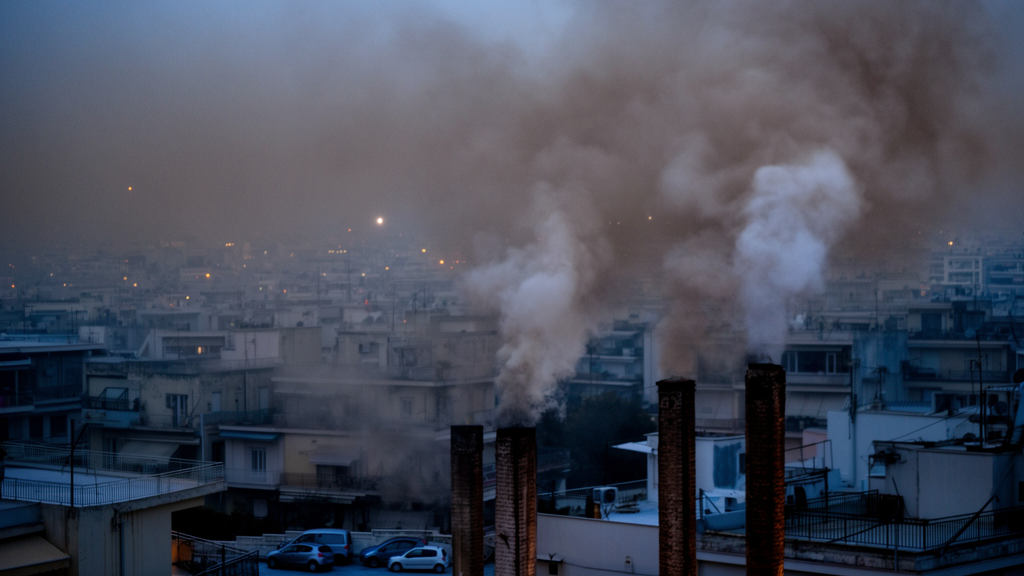
Fine particulate pollution has long been treated as a problem with a single obvious culprit: traffic-clogged city centers. But a sweeping new study of Greek air quality, conducted under the PANhellenic infrastructure for Atmospheric Composition and climatE chAnge (PANACEA) initiative, tells a more complicated and more surprising story. Across five Greek cities, researchers found that while vehicle exhaust certainly matters, the single largest and most variable driver of fine particle pollution is something far older and more domestic: burning wood and other biomass to heat homes in winter. The findings, published as a preprint in Aerosol Research and currently under peer review, carry significant implications not just for Greece but for any country where economic pressures have pushed households back toward wood stoves.
The research team, led by Stefanos Papagiannis and Evangelia Diapouli of the National Centre for Scientific Research Demokritos, together with colleagues from Democritus University of Thrace, the National Observatory of Athens, the University of Crete, and the Institute of Chemical Engineering Sciences in Patras, assembled one of the most comprehensive chemical portraits of Greek urban air to date. The team collected more than 545 individual 24-hour PM2.5 filter samples across Athens, Ioannina, Patras, Volos, and Xanthi, three cities representing urban background conditions and others spanning urban and rural settings. Sampling took place during summer campaigns from June to August 2019 and winter campaigns from December 2019 to February 2020, supplemented by an earlier extended campaign at the Athens Thissio station running from December 2018 to August 2019. This paired seasonal design is what allowed the researchers to disentangle what changes between summer and winter, and why.
PM2.5 refers to particles smaller than 2.5 micrometers across, roughly thirty times thinner than a human hair. These particles are small enough to bypass the body’s natural defenses in the nose and throat, penetrating deep into the lungs and even crossing into the bloodstream. Decades of epidemiological work have linked chronic PM2.5 exposure to cardiovascular disease, stroke, respiratory illness, and premature death. What makes PM2.5 scientifically tricky is that it is not a single pollutant but a chemical cocktail: sulfates, nitrates, sea salt, mineral dust, elemental carbon soot, and thousands of organic compounds, each arriving from a different source. To manage the problem, regulators need to know which sources contribute how much, and that is precisely the question this study set out to answer with chemical precision.
Every filter sample was subjected to a full battery of laboratory analyses. The researchers measured major and trace elements using techniques capable of quantifying metals down to nanogram levels, water-soluble ions such as sulfate, nitrate, ammonium, chloride, potassium, and sodium, and the carbonaceous fraction of the particles, split into organic carbon and elemental carbon. Each of these chemical markers acts like a fingerprint. Potassium, for example, is a classic tracer of wood smoke; nickel and vanadium point to heavy fuel oil combustion; sodium and chloride betray sea spray; iron, calcium, and aluminum indicate crustal mineral dust. Elemental carbon with specific organic tracers flags diesel exhaust. By measuring dozens of species on every sample, the team built a chemical fingerprint for the air of each city in each season.
The statistical engine of the study was Positive Matrix Factorization, or PMF, a widely used receptor-modeling technique that takes the full matrix of chemical concentrations and mathematically decomposes it into a small number of source profiles and their time-varying contributions. Crucially, the team applied PMF separately at each site using a harmonized protocol, ensuring that the source categories identified in Ioannina were directly comparable to those in Athens or Xanthi. The analysis resolved seven distinct source categories across the entire network: biomass burning, heavy oil combustion, industrial emissions, mineral dust, sea salt, secondary sulfates and organics formed in the atmosphere from gaseous precursors, and vehicular traffic. This harmonization across sites is what transforms a set of local studies into a genuine national picture.
The results reveal striking spatial and temporal variation. Biomass burning contributed anywhere from 16.2 percent to 50.9 percent of PM2.5 depending on the site, making it the most dominant and most variable single source in the network. Vehicular traffic ranged from 9.7 percent to 27.6 percent, secondary sulfates and organics from 7.1 percent to 33.0 percent, mineral dust from 4.8 percent to 16.4 percent, heavy oil combustion from 2.5 percent to 15.1 percent, industrial emissions from 3.3 percent to 14.4 percent, and sea salt from 1.6 percent to 11.7 percent. No two cities showed the same source mix. Coastal sites carried a heavier sea salt signature, industrialized areas showed their local plumes, and inland cities in winter were dominated by the unmistakable chemical signature of residential wood smoke.
The concentration data are equally sobering. Campaign-average PM2.5 concentrations in Ioannina and Volos remained above 25 micrograms per cubic meter, a level that points to severe air pollution burdens and a high risk of non-compliance with European air quality standards. Ioannina, a city ringed by mountains in northwestern Greece, sits in a basin where winter temperature inversions trap cold, smoke-laden air close to the ground, and the new source apportionment confirms that wood burning is the dominant culprit there. Volos, though coastal, shows a similar winter pattern. These are not megacities; they are mid-sized regional centers, which makes the severity of their pollution all the more notable and suggests the problem is structural rather than a function of urban scale.
Perhaps the most important conceptual finding is the interplay between local and regional pollution. The study demonstrates that while the regional background, the pollution transported across broad areas of the eastern Mediterranean from distant sources and secondary atmospheric formation, strongly influences baseline PM2.5 levels everywhere, it is localized human activity that pushes cities over the edge during winter. In practical terms, a Greek city cannot fully control what the regional atmosphere delivers, but it can control what its own residents burn. The dominance of biomass burning, particularly for residential heating, means that targeted local interventions, from stove replacement programs to cleaner heating subsidies and burn bans on high-pollution nights, could deliver disproportionate improvements in winter air quality compared with measures aimed at traffic alone.
The Greek context gives these findings a poignant economic dimension. Following the financial crisis and subsequent increases in heating oil taxes, many Greek households switched to wood-burning stoves and fireplaces as a cheaper alternative, a phenomenon sometimes described as a return to traditional heating under economic duress. This study provides some of the clearest quantitative evidence yet of the atmospheric consequences of that shift. It also serves as a warning for other European countries facing high energy prices: the chemistry of the atmosphere records policy and economic decisions with unfailing accuracy. As Europe tightens its air quality standards in line with updated World Health Organization guidelines, the PANACEA dataset offers exactly the kind of source-resolved evidence that national and municipal authorities will need to design effective, city-specific clean air strategies rather than one-size-fits-all regulations that miss the real emitters.
Subject of Research: Chemical speciation and source apportionment of PM2.5 fine particulate pollution in Greek urban and suburban areas
Article Title: Chemical Speciation and Source Apportionment of PM2.5 in Greek Urban and Suburban Areas: Insights from the PANACEA Initiative
Article References: Papagiannis, S., Diapouli, E., Vasilatou, V., Gini, M., Kourtidis, K., Kaltsonoudis, C., Tsagkaraki, M., Grivas, G., Liakakou, E., Bougiatioti, Α., Mihalopoulos, N., & Eleftheriadis, K. (2026). Chemical Speciation and Source Apportionment of PM 2.5 in Greek Urban and Suburban Areas: Insights from the PANACEA Initiative. https://doi.org/10.5194/ar-2026-35
Image Credits: AI Generated
DOI: 10.5194/ar-2026-35
Keywords: PM2.5, air pollution, biomass burning, Greece, PANACEA, source apportionment, Positive Matrix Factorization, chemical speciation, residential heating, wood smoke, urban air quality, aerosol research
Cite Scienmag News
Russell Cooper. (October 8, 2026). Wood-Burning Stoves, Not Traffic, Drive Greece’s Winter Air Pollution Crisis. Scienmag. https://scienmag.com/wood-burning-stoves-not-traffic-drive-greeces-winter-air-pollution-crisis/
Russell Cooper. "Wood-Burning Stoves, Not Traffic, Drive Greece’s Winter Air Pollution Crisis." Scienmag, 8 October 2026, https://scienmag.com/wood-burning-stoves-not-traffic-drive-greeces-winter-air-pollution-crisis/. Accessed 8 October 2026.
Russell Cooper. "Wood-Burning Stoves, Not Traffic, Drive Greece’s Winter Air Pollution Crisis." Scienmag. October 8, 2026. https://scienmag.com/wood-burning-stoves-not-traffic-drive-greeces-winter-air-pollution-crisis/


