


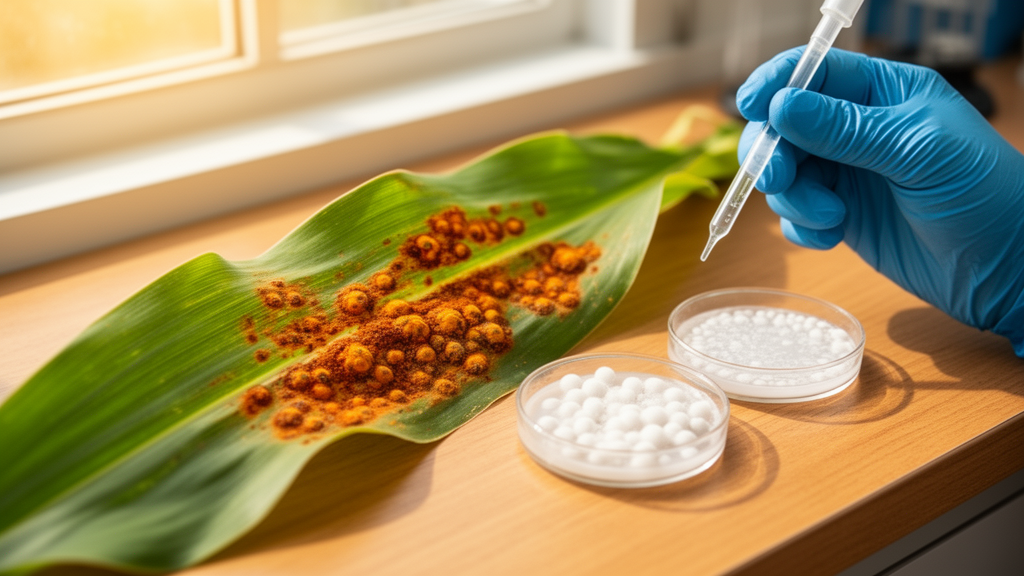
Southern corn rust, a devastating foliar disease caused by the fungal pathogen Puccinia polysora, has long been one of the most stubborn threats to maize production around the world. Outbreaks can sweep through fields with alarming speed, turning lush green leaves into rust-colored, withering tissue and cutting yields dramatically. For decades, farmers have leaned heavily on synthetic chemical fungicides to keep the disease in check, but that dependence has come at a cost, fueling concerns about environmental damage, residues in the food chain, and the steady evolution of resistant pathogen strains. Now, a team of researchers in China has taken a major step toward a greener alternative, identifying and characterizing two endophytic fungi that live quietly inside maize plants and can dramatically suppress the disease under controlled conditions.
The study, conducted by Yuejin Peng, Qingqing Liu, Yangshan Hu, Junmin Liang, Ziqian Yang and Lujia Yang, and published in BMC Plant Biology, focused on two fungal isolates recovered from maize: Purpureocillium lilacinum strain PL6 and Beauveria bassiana strain YC-1. Both species are well known in agricultural circles, particularly Beauveria bassiana, which has a long history as an insect-killing fungus used in biological pest control. What makes the new work notable is the combination of approaches the team brought to bear. Rather than simply testing whether the fungi could fight rust, the researchers combined morphological observation, molecular phylogenetic identification, whole-genome sequencing, laboratory bioassays and insect pathogenicity tests to build a comprehensive picture of what these organisms are and what they can do.
The genomic work formed the technical backbone of the study. Using Illumina sequencing, the team assembled draft genomes of 36.68 megabases for PL6 and 33.05 megabases for YC-1. These genome sequences allowed the researchers to peer into the genetic machinery that might underpin the fungi’s beneficial properties. Annotation with the dbCAN3 pipeline, a standard tool for identifying genes encoding carbohydrate-active enzymes, revealed 187 such genes in PL6 and 137 in YC-1. Carbohydrate-active enzymes, often abbreviated as CAZymes, are proteins that break down or modify complex carbohydrates, and in plant-associated fungi they are frequently involved in colonizing plant tissue, degrading pathogen cell walls, or establishing endophytic lifestyles within host plants.
Perhaps even more intriguing were the secondary metabolite biosynthesis gene clusters predicted by the antiSMASH algorithm. The analysis identified 34 such clusters in PL6 and 32 in YC-1, including clusters associated with polyketide synthases, nonribosomal peptide synthetases and terpene biosynthesis. These gene families are responsible for producing some of the most biologically active natural compounds known to science, including antibiotics, toxins and signaling molecules. In biocontrol fungi, secondary metabolites often serve as the chemical weapons that suppress competing pathogens or subvert insect hosts. The abundance and diversity of these clusters in both strains suggests a rich reservoir of unexplored chemistry that could be harnessed for agricultural applications, and it gives researchers a genetic roadmap for future work on identifying the specific compounds involved.
The greenhouse-scale bioassays delivered the headline results. The researchers applied the fungi through root-drench inoculation, a delivery method in which a liquid suspension of the beneficial fungus is applied to the soil around the plant roots, allowing the endophyte to colonize the plant from within. Under the controlled conditions used in the study, both strains restricted the development of southern corn rust. At 24 days post-inoculation, disease incidence remained below 4 percent in plants treated with PL6, while plants treated with YC-1 showed disease incidence of approximately 21 percent. In the untreated control group, by contrast, nearly 48 percent of plants had developed the disease by the same time point.
To quantify disease progression more rigorously, the team calculated the area under the disease progress curve, or AUDPC, a standard epidemiological measure that integrates disease severity over time rather than relying on a single snapshot. The AUDPC dropped from 87.12 in the untreated control to 20.92 following YC-1 treatment and 10.58 following PL6 treatment. Those figures translate into reductions of 76.0 percent and 87.9 percent respectively, a striking level of protection for a disease that typically demands repeated fungicide applications. The magnitude of the PL6 effect in particular suggests that this strain could be a serious candidate for development as a commercial biocontrol agent, although the authors are careful to note that the results come from controlled conditions and that field performance remains to be demonstrated.
What elevates the study beyond a straightforward disease-suppression trial is its dual-purpose angle. Because Beauveria bassiana is already celebrated as an entomopathogenic fungus, the researchers also tested whether their isolates could attack insect pests, specifically fifth-instar larvae of Spodoptera frugiperda, the fall armyworm, another globally feared maize pest. In 10-day bioassays, larval survival was approximately 73 percent with YC-1 and 83 percent with PL6, corresponding to mortality of roughly 27 percent and 17 percent respectively. YC-1, as expected for a species with a strong entomopathogenic pedigree, proved the more lethal of the two against the caterpillars, while PL6 was clearly the stronger rust suppressor. The finding that a single fungal resource could contribute to managing both a foliar rust disease and a lepidopteran pest is precisely the kind of multifunctionality that integrated pest management programs prize.
The concept of endophyte-mediated biocontrol is gaining momentum across plant pathology. Endophytic fungi inhabit the internal tissues of plants, often without causing any symptoms, and in many cases they confer benefits to their hosts, ranging from enhanced stress tolerance to induced systemic resistance against pathogens. When an endophyte establishes itself inside a plant, it can prime the plant’s own defense signaling pathways, including those mediated by salicylic acid and jasmonic acid, two key hormones in plant immunity. It can also compete directly with pathogens for space and resources, or produce antimicrobial compounds in situ. The rich arsenal of secondary metabolite gene clusters documented in PL6 and YC-1 hints that such chemical warfare may be part of the mechanism at work, though the study’s genomic characterization stops short of confirming which specific compounds are deployed during rust suppression.
The implications for maize farming could be significant. Southern corn rust has been expanding its reach in recent years, aided by warming climates and long-distance spore dispersal, and growers in affected regions often face the prospect of multiple fungicide sprays per season. A biological approach based on root-drench inoculation with endophytic fungi could reduce that chemical load, fit neatly into organic and low-input production systems, and offer a tool against fall armyworm at the same time. The genome-reported nature of the two strains is also an asset for regulatory and development pipelines, because whole-genome sequences help clarify strain identity, screen for unwanted virulence or toxin genes, and support quality control in commercial production. The work was supported by the National Natural Science Foundation of China, the Natural Science Foundation of Yunnan Province and the Yunnan Provincial Department of Education Scientific Research Fund Project.
There remain important caveats and next steps. The disease and insect assays were performed under controlled laboratory and greenhouse conditions, and real-world fields present far more variable environments, competing microbes, and pathogen pressures. The moderate insect mortality observed, particularly for PL6, suggests these strains would likely serve as components of an integrated management strategy rather than stand-alone silver bullets. Nevertheless, the combination of strong rust suppression, documented genomes, abundant biosynthetic potential and demonstrated activity against a major pest makes PL6 and YC-1 a compelling proof of concept. As agriculture searches for ways to sustain productivity while weaning itself off synthetic chemistry, studies like this one show that the answers may already be living inside the crops themselves, waiting to be sequenced, understood and deployed.
Subject of Research: Genomic characterization of endophytic fungi as biocontrol agents against southern corn rust and fall armyworm in maize
Article Title: Genomic characterization and biocontrol potential of the endophytic Purpureocillium lilacinum PL6 and Beauveria bassiana YC-1 against southern corn rust
Article References: Peng, Y., Liu, Q., Hu, Y., Liang, J., Yang, Z., & Yang, L. (2026). Genomic characterization and biocontrol potential of the endophytic Purpureocillium lilacinum PL6 and Beauveria bassiana YC-1 against southern corn rust. BMC Plant Biology. https://doi.org/10.1186/s12870-026-10090-y
Image Credits: AI Generated
DOI: 10.1186/s12870-026-10090-y
Keywords: Purpureocillium lilacinum, Beauveria bassiana, southern corn rust, Puccinia polysora, endophytic fungi, biological control, maize, whole-genome sequencing, secondary metabolites, Spodoptera frugiperda, fall armyworm, plant pathology
Cite Scienmag News
Alan Morgan. (October 8, 2026). Two Endophytic Fungi Show Powerful Genome-Backed Defense Against Southern Corn Rust. Scienmag. https://scienmag.com/two-endophytic-fungi-show-powerful-genome-backed-defense-against-southern-corn-rust/
Alan Morgan. "Two Endophytic Fungi Show Powerful Genome-Backed Defense Against Southern Corn Rust." Scienmag, 8 October 2026, https://scienmag.com/two-endophytic-fungi-show-powerful-genome-backed-defense-against-southern-corn-rust/. Accessed 8 October 2026.
Alan Morgan. "Two Endophytic Fungi Show Powerful Genome-Backed Defense Against Southern Corn Rust." Scienmag. October 8, 2026. https://scienmag.com/two-endophytic-fungi-show-powerful-genome-backed-defense-against-southern-corn-rust/


