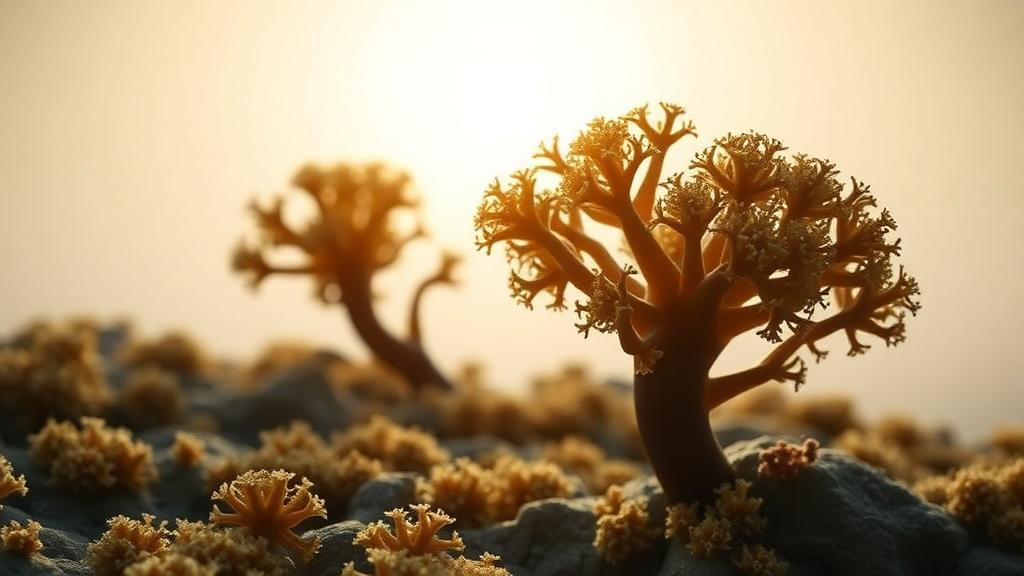
Deep in the lineage of green algae that gave rise to all land plants, a humble freshwater organism is quietly rewriting what scientists thought they knew about biological timekeeping. Chara braunii, a branched charophyte alga often described as a living window into plant evolution, has been caught performing a daily dance that persists even when the lights never go out. Researchers report that the alga’s delicate branchlets open and close in a roughly 24-hour cycle, and that this rhythm continues under constant, dim illumination—hallmarks of an internal circadian clock operating in one of the closest living relatives of land plants.
The discovery matters because the evolutionary origin of endogenous, self-sustaining rhythms has long been murky. Complex transcriptional clock networks are well characterized in flowering plants, built from interlocked feedback loops involving genes such as CCA1, LHY, TOC1, GIGANTEA, and the evening complex components ELF3, ELF4, and LUX. But when and how such temporal coordination emerged during the transition from aquatic algae to terrestrial flora has remained an open question. Chara braunii, whose genome was fully sequenced in 2018, occupies a pivotal phylogenetic position near the base of the streptophyte lineage, making it an ideal organism in which to probe the deep history of plant circadian biology.
The research team cultivated Chara braunii from germinated oospores and grew young thalli under a regular 14-hour light, 10-hour dark cycle. Using a custom-built imaging chamber fitted with LED strips and a smartphone camera capturing frames every ten minutes, they tracked the angle between each branchlet and its basal node over three consecutive days. The results were striking: every morning, about an hour after lights came on, the branchlets began to unfurl from a nearly vertical position, opening to angles between 130 and 180 degrees by midday. As evening approached, they folded back toward vertical, settling at angles between 90 and 110 degrees. Statistical analysis with the JTK_CYCLE algorithm confirmed significant rhythmicity with a consistent midday peak, and all eight biological replicates remained significant after correction for multiple testing.
Crucially, the team then transferred the algae to continuous light to see whether the rhythm would persist without any external day-night signal. The answer depended dramatically on brightness. Under continuous regular light of 30 micromoles of photons per square meter per second, the branchlets initially closed, then partially reopened and settled into a stable, semiopen position. No statistically significant circadian oscillation could be detected. But under continuous dim light at half that intensity, the rhythmic opening and closing continued for the full 60-hour recording period, with highly significant periodicity. In other words, the alga’s internal rhythm did not vanish under constant conditions—it was masked or damped by brighter light, a phenomenon also documented in Arabidopsis, where continuous light suppresses rhythmic outputs despite an intact clock.
The researchers propose a plausible physical mechanism for this irradiance effect. Under dim light, a sufficient brightness gradient may persist between the upper and lower sides of each branchlet, maintaining the differential elongation that earlier studies in other Chara species suggested drives bending. Under brighter light, photons may penetrate more effectively through the chloroplast layer, erasing the asymmetry between the two sides of the branchlet. With more uniform illumination, growth becomes more even, and the visible oscillation disappears. The authors caution, however, that branchlet angle is a geometric readout that cannot distinguish growth-driven changes from reversible, turgor-driven movements, and both processes may contribute to the observed rhythm.
The team also examined how the alga acclimates physiologically to continuous illumination. Pigment analysis revealed that chlorophyll a, chlorophyll b, and carotenoid concentrations rose significantly under dim continuous light after 36 hours, consistent with a classic low-light acclimation response that boosts light-harvesting capacity. By 60 hours, absolute pigment levels had declined again, leaving only the chlorophyll a to chlorophyll b ratio elevated. Photosynthetic parameters measured by pulsed-amplitude modulation chlorophyll fluorometry—including maximum electron transport rate, the initial slope of the photosynthesis-irradiance curve, and the light saturation point—showed no detectable temporal variation across days or times of day, suggesting that rhythmic regulation of photosynthesis in this organism, if present, is process-specific rather than global.
Metabolite profiling added another layer of insight. Using liquid chromatography tandem mass spectrometry, the researchers quantified 35 primary metabolites across three sampling points after transfer to continuous light. Under dim light, metabolites related to carbon and nitrogen metabolism accumulated steadily, with malate, fumarate, nicotinate, and glutamate significantly elevated at 36 hours, and malate, fumarate, nicotinate, and alanine remaining high at 60 hours. Under brighter continuous light, changes were smaller and more transient: serine, phenylalanine, and alpha-aminobutyrate rose at 36 hours, while pyruvate declined by 60 hours. The serine increase likely reflects intensified photorespiration, a hallmark of metabolic stress, while the persistent accumulation of TCA-cycle intermediates under dim light suggests enhanced anabolic activity. The divergence between treatments points to an altered carbon-nitrogen balance at higher irradiance and hints that continuous bright light decouples metabolic outputs from temporal control.
Perhaps most intriguingly, a phylogenetic survey of the Chara braunii genome revealed homologs of several major land-plant clock-associated gene families, though with strikingly incomplete conservation. The REVEILLE family is represented by a single protein carrying the characteristic MYB DNA-binding domain but lacking the full architecture of CCA1 or LHY. A putative PRR homolog retains only the CCT domain and cannot be classified as a canonical PRR. GIGANTEA is well conserved in Chara and other late-diverging streptophytes, while the evening complex components ELF3, ELF4, and LUX are all present and broadly conserved. Notably, no canonical ZEITLUPE ortholog with both LOV and Kelch domains was found—only a related ADAGIO-family F-box protein—suggesting that light-input pathways in Chara differ fundamentally from those of flowering plants.
Together, these findings sketch a compelling picture: an endogenous regulatory component capable of driving circadian branchlet movements existed in the streptophyte ancestors of land plants, but its observable output is modulated by light intensity, and its molecular machinery was assembled from parts that only partially overlap with the canonical angiosperm clock. The co-occurrence of attenuated rhythmic movement and a distinct metabolic profile under brighter continuous light provides a framework for future mechanistic work, even though the present data cannot establish a causal link between the two. For evolutionary biologists, the message is tantalizing: the seeds of the plant circadian clock were already sown in aquatic algae, long before the conquest of land, waiting for brighter light—or better experiments—to reveal their full rhythm.
Subject of Research: Circadian regulation of branchlet movement and irradiance-dependent acclimation in the charophyte alga Chara braunii
Article Title: Circadian Oscillations in Branchlet Angle and Irradiance‐Dependent Acclimation in Chara braunii Under Continuous Light
Article References: Maidel, A.-M., Kurtović, K., Heise, C. M., Vosolsobě, S., Petrášek, J., Timm, S., & Schubert, H. (2026). Circadian Oscillations in Branchlet Angle and Irradiance‐Dependent Acclimation in Chara braunii Under Continuous Light. Plant Direct, 10(10), Article e70194. https://doi.org/10.1002/pld3.70194
Image Credits: AI Generated
DOI: 10.1002/pld3.70194
Keywords: Chara braunii, circadian clock, charophyte algae, branchlet movement, continuous light, irradiance acclimation, chlorophyll, metabolomics, streptophyte evolution, plant physiology, circadian rhythm, clock genes
Cite Scienmag News
Juliet Wilcox. (October 7, 2026). Ancient Alga Keeps Beating Its Daily Rhythm Even When the Sun Never Sets. Scienmag. https://scienmag.com/ancient-alga-keeps-beating-its-daily-rhythm-even-when-the-sun-never-sets/
Juliet Wilcox. "Ancient Alga Keeps Beating Its Daily Rhythm Even When the Sun Never Sets." Scienmag, 7 October 2026, https://scienmag.com/ancient-alga-keeps-beating-its-daily-rhythm-even-when-the-sun-never-sets/. Accessed 7 October 2026.
Juliet Wilcox. "Ancient Alga Keeps Beating Its Daily Rhythm Even When the Sun Never Sets." Scienmag. October 7, 2026. https://scienmag.com/ancient-alga-keeps-beating-its-daily-rhythm-even-when-the-sun-never-sets/