


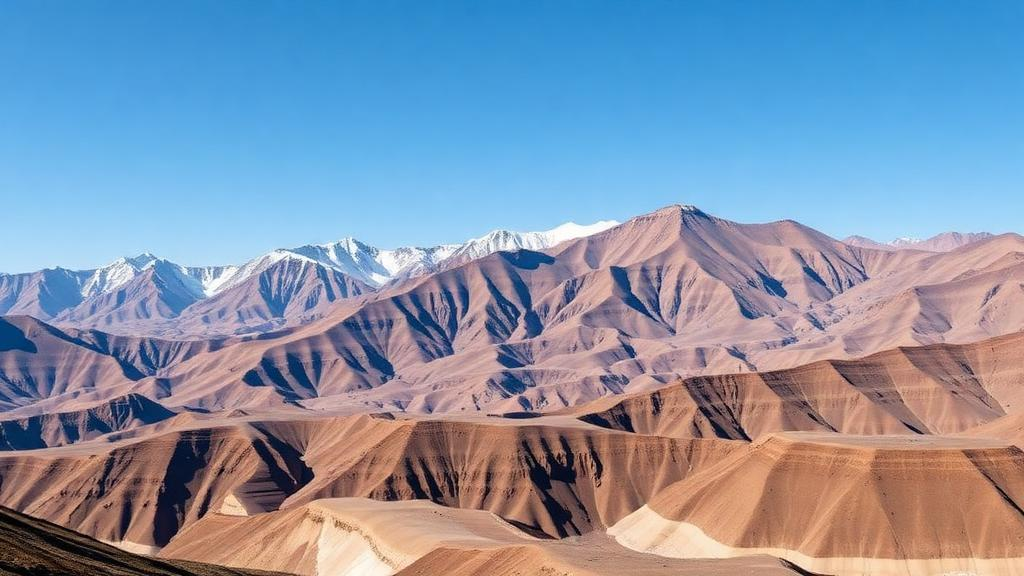
On the roof of the world, where glaciers feed the headwaters of Asia’s greatest rivers and fragile alpine ecosystems cling to thin soils, drought is far more than a meteorological curiosity. A new study published in Theoretical and Applied Climatology argues that scientists have been looking at drought in Xizang, the Tibetan region of China, through an incomplete lens. For decades, drought research has overwhelmingly blamed deficits in total precipitation, treating the amount of rainfall as the decisive variable. But a team of researchers from Sichuan Agricultural University, led by Yinhong Kang and Zihua Cao together with Tiefeng Ni and Guixiong Wu, has now shown that the way precipitation is concentrated in time matters just as much, and that the most important physical controls on drought in this rugged landscape are elevation and the temporal clustering of rainfall rather than raw rainfall totals alone.
The study, published on 7 October 2026 as article 688 in volume 157 of the journal, tackles a stubborn methodological problem. Conventional linear statistics, the workhorse of classical drought attribution, simply cannot capture the nonlinear, threshold-like ways in which drought responds to its environment across terrain that swings from deep river valleys to summits above 5000 meters. To break through that limitation, the team turned to machine learning, pairing the eXtreme Gradient Boosting algorithm, better known as XGBoost, with SHapley Additive exPlanations, or SHAP, a technique borrowed from cooperative game theory that assigns each input variable its fair share of credit for every single prediction the model makes. The combination allowed the researchers not only to predict drought variability but to open up the black box and see which levers were actually being pulled.
The evidence base spans half a century. Drawing on daily precipitation records from meteorological stations across Xizang for the period 1971 to 2022, the researchers computed two complementary indices. The first was the Standardized Precipitation Index, or SPI, the most widely used metric of meteorological drought, which expresses precipitation anomalies as standardized departures from the long-term climatological norm at multiple time scales. The second was the Precipitation Concentration Index, or PCI, which measures how unevenly rainfall is distributed through the year. A low PCI indicates precipitation spread relatively evenly across months, while a high PCI signals a regime in which most of the year’s water arrives in a few violent bursts separated by long dry spells. It is precisely this temporal structure, the authors argue, that conventional drought studies have neglected.
Before any machine learning was applied, the team ran spatiotemporal diagnostics on the five decades of records, and the results sketch a region in climatic transition. Most of Xizang shows a widespread wetting tendency, consistent with a growing body of evidence that a warming climate is accelerating the hydrological cycle over the Qinghai-Tibet Plateau, boosting evapotranspiration and precipitation recycling. Yet the picture is not uniformly benign. Along the southern margins of the region, conditions conducive to compound drought-flood events have intensified. In other words, the same areas may face an increased likelihood of both flooding and drought, as rainfall arrives in increasingly concentrated episodes that overwhelm the landscape’s capacity to store water, leaving it exposed during the intervening dry periods. This wet-get-wetter-but-also-parched dynamic is one of the most consequential and counterintuitive findings of modern plateau hydroclimatology.
The predictive modeling itself delivered moderate but meaningful skill. The XGBoost models achieved coefficients of determination, or R-squared values, ranging from 0.31 to 0.52 across annual and seasonal scales, with the strongest performance in central and eastern Xizang. In a region of such complex topography and sparse station coverage, where drought is shaped by interactions among terrain, monsoon circulation, and local convection, capturing a third to a half of the variance in drought variability is a respectable result. More importantly, the goal was never pure prediction but attribution, and it is in the attribution that the study makes its most provocative contribution.
SHAP analysis revealed something that should unsettle the field: the apparent dominance of total precipitation in drought models is largely an illusion. Because the Standardized Precipitation Index is mathematically derived from precipitation totals, any model that includes both is guaranteed to find total precipitation important, a definitional coupling rather than a physical discovery. Once the researchers accounted for this artifact, the genuinely meaningful physical drivers emerged clearly. Elevation and precipitation concentration stood out as the primary factors modulating drought across Xizang, with large-scale atmospheric circulation patterns playing a secondary, seasonally dependent role.
The elevation finding is particularly striking. The SHAP attribution identified a threshold near 4000 meters, below which drought risk is amplified. This elevation dependence makes physical sense in the context of plateau climatology. Lower-lying valleys and basins in Xizang tend to be drier, warmer, and more exposed to evaporative demand, while higher elevations benefit from orographic precipitation and moisture recycling fed by the region’s glaciers and snowpack. Previous research has documented elevation-dependent warming and precipitation trends across the Qinghai-Tibet Plateau, and this study adds drought vulnerability to the list of high-altitude phenomena that do not scale linearly with terrain. For water-resource planners, the implication is that the zones most susceptible to drought are not the remote icy summits but the populated, cultivable valleys beneath the 4000-meter line.
Precipitation concentration, meanwhile, displayed a conditional nonlinear association with drought, meaning its effect on drought risk depends on where it sits in its own distribution and how it interacts with other variables. When rainfall is highly concentrated, intense downpours run off quickly rather than recharging soils and streams, so even years with normal total precipitation can slide into drought conditions. Conversely, more evenly distributed rainfall sustains soil moisture through the growing season even when totals are modest. This mechanism helps explain why the southern margins of Xizang, where concentration has been increasing, face heightened compound drought-flood risk: the same clumping of rainfall that produces flood hazards simultaneously sets the stage for the droughts that follow.
The study’s methodological honesty is as notable as its findings. The authors explicitly flag the definitional coupling between total precipitation and SPI, refusing to dress up a mathematical artifact as a physical mechanism. They also acknowledge the moderate predictive skill of their models and the seasonally dependent, secondary nature of the atmospheric circulation signals, which include teleconnections such as the El Nino-Southern Oscillation and the North Atlantic Oscillation that have long been known to influence plateau rainfall. This restraint matters, because explainable machine learning is spreading rapidly through the hydrological sciences, and studies that fail to separate statistical coupling from genuine causation risk misleading the field. By demonstrating how to do this carefully, the Xizang analysis offers a template for drought attribution in other complex mountain regions, from the Andes to the Hindu Kush.
The practical stakes are high. Xizang’s ecosystems are among the most ecologically fragile on Earth, and its river basins supply water to billions of people downstream. Accurate mechanistic understanding of drought is essential for agricultural production, socioeconomic development, and ecosystem conservation across the region, and the authors position their findings as a scientific reference for drought early-warning systems and water-resource management in fragile alpine environments. If drought early-warning systems in the region can incorporate precipitation concentration and elevation thresholds alongside traditional rainfall deficits, they may gain the lead time that farmers, herders, and reservoir operators need. And as climate change continues to reshape precipitation regimes across the Third Pole, the lesson of this study generalizes: it is not just how much water falls from the sky, but when, and where on the mountain, that determines whether the plateau thrives or withers.
Subject of Research: Nonlinear drivers of meteorological drought, including precipitation concentration and elevation, across Xizang quantified with XGBoost and SHAP
Article Title: Roles of precipitation concentration in modulating meteorological drought across Xizang: Insights from XGBoost-SHAP
Article References: Kang, Y., Cao, Z., Ni, T., & Wu, G. (2026). Roles of precipitation concentration in modulating meteorological drought across Xizang: Insights from XGBoost-SHAP. Theoretical and Applied Climatology, 157(10), Article 688. https://doi.org/10.1007/s00704-026-06622-z
Image Credits: AI Generated
DOI: 10.1007/s00704-026-06622-z
Keywords: drought, Xizang, Tibetan Plateau, precipitation concentration, XGBoost, SHAP, Standardized Precipitation Index, machine learning, hydroclimate, elevation threshold, compound drought-flood, climate change
Cite Scienmag News
Teresa Odom. (October 7, 2026). Machine Learning Reveals Hidden Drivers of Drought on the Tibetan Plateau. Scienmag. https://scienmag.com/machine-learning-reveals-hidden-drivers-of-drought-on-the-tibetan-plateau/
Teresa Odom. "Machine Learning Reveals Hidden Drivers of Drought on the Tibetan Plateau." Scienmag, 7 October 2026, https://scienmag.com/machine-learning-reveals-hidden-drivers-of-drought-on-the-tibetan-plateau/. Accessed 7 October 2026.
Teresa Odom. "Machine Learning Reveals Hidden Drivers of Drought on the Tibetan Plateau." Scienmag. October 7, 2026. https://scienmag.com/machine-learning-reveals-hidden-drivers-of-drought-on-the-tibetan-plateau/


