


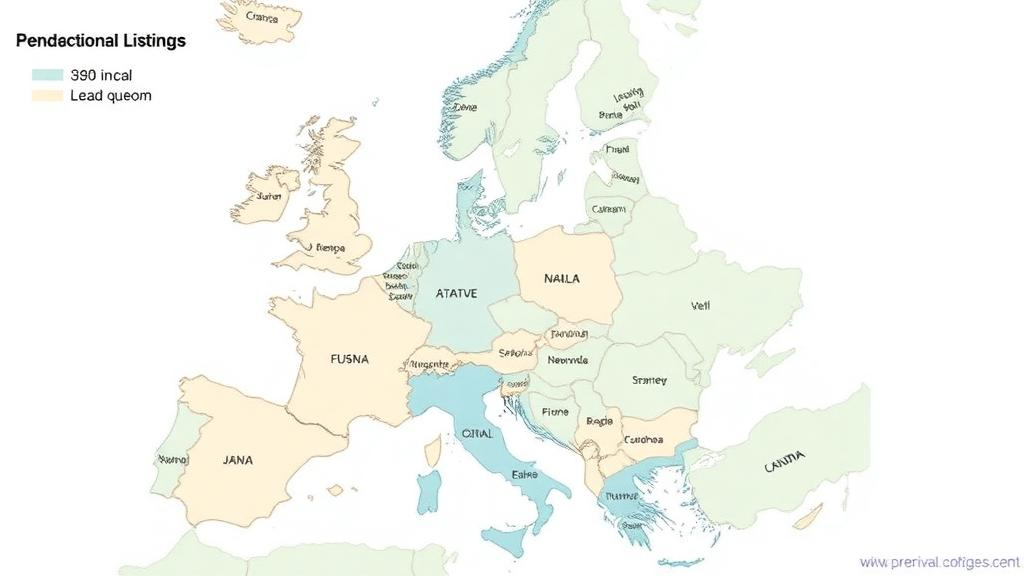
A sweeping analysis of more than 22 million property listings across 30 European countries has revealed the true scale of the continent’s housing affordability crisis, and the numbers are stark. Nearly half of people earning an average income in Europe can only afford to buy the equivalent of a one-bedroom apartment or studio flat, while 39 percent of Europeans cannot even afford to rent a property of that size. The study, published in the peer-reviewed Journal of Maps by researchers at TU Wien in Austria, translates raw housing market data into vivid, municipality-level maps that show exactly where ordinary earners have been priced out of adequate living space. The findings arrive amid mounting evidence that house prices in Europe have risen faster than incomes for more than a decade, a divergence that has quietly reshaped who can live where, and on what terms, across the continent.
The methodology behind the study is what gives its conclusions their geographic precision. The researchers drew on property listings gathered by the ESPON HOUSE4ALL project, a European initiative covering 30 countries, and combined this with financial data to calculate how many square metres of floor space an average regional income could actually buy. Rather than treating affordability as a simple price threshold, the team computed the affordable floor area for each region, accounting for both owned and privately rented homes, and analysed the relationship between property size and listed price. The resulting maps reveal the geography of affordability at a municipal level, exposing hotspots where the gap between earnings and housing costs has become so severe that standard family homes are effectively out of reach for average earners.
The headline figures are sobering. Around 44 percent of Europe’s urban population, roughly two in five city dwellers, lives in a city where less than 50 square metres of property, approximately the size of a small one-bedroom flat or studio apartment, can be purchased on an average income. The picture is scarcely better at the continental scale: more than 70 percent of the European population lives in regions where a thirty-year mortgage would only buy up to 75 square metres, again assuming an average income. In practical terms, this means that for the majority of Europeans, the dream of a family-sized home bought with a standard long-term mortgage has slipped beyond the financial horizon, forcing difficult trade-offs between location, space and financial security.
The geography of unaffordability is far from uniform, and the maps expose pronounced hotspots where the crisis is most acute. Areas around Paris, Berlin and Madrid rank among the urban locations most affected, with densely populated towns and cities bearing the brunt of the squeeze. The researchers found that affordability challenges exist within nearly all of the countries investigated, but with important differences in character. Some countries display a wide range of affordability levels from one region to another, while in others housing remains persistently out of reach for both newcomer buyers and renters on an average income. Portugal, Poland and the Netherlands are among the nations identified as highly unaffordable, a finding that challenges any assumption that the crisis is confined to Europe’s wealthiest economies.
Lead author Franziska Sielker, Professor of Urban and Regional Research at the Institute of Spatial Planning at TU Vienna, described the pattern as a warning signal for the continent. According to the study’s authors, the maps reveal pronounced hotspots of unaffordability that point to a substantial housing affordability crisis in the making, one that already disproportionately affects newcomers to the property market as well as people who change location frequently for personal or professional reasons. The problem, she noted, spans capital regions, major urban centres, coastal zones and tourism-intensive alpine areas, and is compounded by large rural supply gaps in rental markets. In other words, the crisis is not simply a big-city phenomenon but a systemic condition with distinct regional expressions.
One of the study’s most striking insights concerns the spillover effect. Urban centres suffer most from high housing prices relative to income, and this is true despite the fact that urban residents typically earn more than their rural counterparts. The result is what the researchers describe as clearly visible spillovers into neighbouring regions, as priced-out households look further afield for affordable homes, pushing up demand and prices in surrounding municipalities. This dynamic means that affordability pressure radiates outward from metropolitan cores, transforming once-accessible commuter belts and satellite towns into extensions of the unaffordable zone. It is precisely this pattern, the researchers argue, that makes metropole regions the places where housing policy solutions are most urgently needed.
Tourism emerges as a second, distinct driver of the crisis. The maps show that housing in tourist hotspots such as coastal and mountain regions is less affordable than in other areas, as second homeowners and short-term rental operators compete with local residents for a limited stock of properties. In these destinations, the study suggests, local people are being priced out of the market by buyers and renters who do not depend on the local economy for their income. The researchers point to a specific policy option for such regions: intervening directly in the short-term rental and second home markets, for example by restricting the conversion of residential properties into tourist accommodation. This would target the mechanism, rather than the symptoms, of tourism-driven unaffordability.
Co-author Dr Selim Banabak, a University Assistant at TU Vienna, emphasised that the severity of the challenge is underestimated for most of the population, and that the problem has two sides: the cost side and the income side. Closing the gap, he argued, requires policymakers to be aware of both dimensions simultaneously. That framing matters because it rules out simplistic solutions. Building more housing addresses the cost side, but without attention to stagnant or unevenly distributed incomes, affordability can remain out of reach even where supply expands. Conversely, income support without corresponding supply measures risks simply feeding through into higher prices. The study’s municipal-level maps are designed to give policymakers the granular evidence needed to calibrate responses to local conditions rather than applying one-size-fits-all national policies.
Like all large-scale analyses, the study carries important limitations that shape how its findings should be interpreted. The researchers relied on approximate listing prices rather than actual sale prices, meaning the figures capture asking prices rather than final transaction values. The broad municipal-level data also misses neighbourhood-by-neighbourhood differences within individual municipalities, which can be substantial in large cities. Furthermore, the analysis looks only at housing prices and does not consider other financial barriers to homeownership, such as down payment requirements, which can prevent people from buying homes even where monthly mortgage payments would technically be affordable. These caveats do not undermine the central finding, but they suggest the true picture of exclusion from homeownership may be even harsher than the maps indicate.
What the study ultimately delivers is a continental baseline for a debate that has, until now, been dominated by national statistics and anecdote. By converting 22 million listings into a common metric, the affordable floor area on an average regional income, the researchers have made housing deprivation comparable across borders, from Lisbon to Warsaw to the alpine valleys. The maps make visible a slow-motion emergency: a Europe where, for nearly half of average earners, the housing market offers only the smallest of homes, and where for two in five city residents even a studio flat lies beyond their rental budget. As prices continue to outpace incomes, the researchers’ call for urgent, spatially targeted housing policy, spanning supply, income and tourism regulation, reads less like a recommendation and more like a timetable.
Subject of Research: Housing affordability across Europe based on analysis of 22 million property listings
Article Title: Europe facing housing affordability crisis, continental study of more than 22 million property listings suggests
Article References: Europe facing housing affordability crisis, continental study of more than 22 million property listings suggests. (n.d.). Original publication
Image Credits: AI Generated
DOI: Not provided
Keywords: housing affordability, Europe, property listings, housing crisis, TU Wien, urban policy, rental market, mortgage affordability, tourism, ESPON HOUSE4ALL, spatial planning, housing maps
Cite Scienmag News
Violet Maxwell. (October 7, 2026). Map of 22 Million Listings Reveals Half of Europeans Can Only Afford a Studio Flat. Scienmag. https://scienmag.com/map-of-22-million-listings-reveals-half-of-europeans-can-only-afford-a-studio-flat/
Violet Maxwell. "Map of 22 Million Listings Reveals Half of Europeans Can Only Afford a Studio Flat." Scienmag, 7 October 2026, https://scienmag.com/map-of-22-million-listings-reveals-half-of-europeans-can-only-afford-a-studio-flat/. Accessed 7 October 2026.
Violet Maxwell. "Map of 22 Million Listings Reveals Half of Europeans Can Only Afford a Studio Flat." Scienmag. October 7, 2026. https://scienmag.com/map-of-22-million-listings-reveals-half-of-europeans-can-only-afford-a-studio-flat/


