


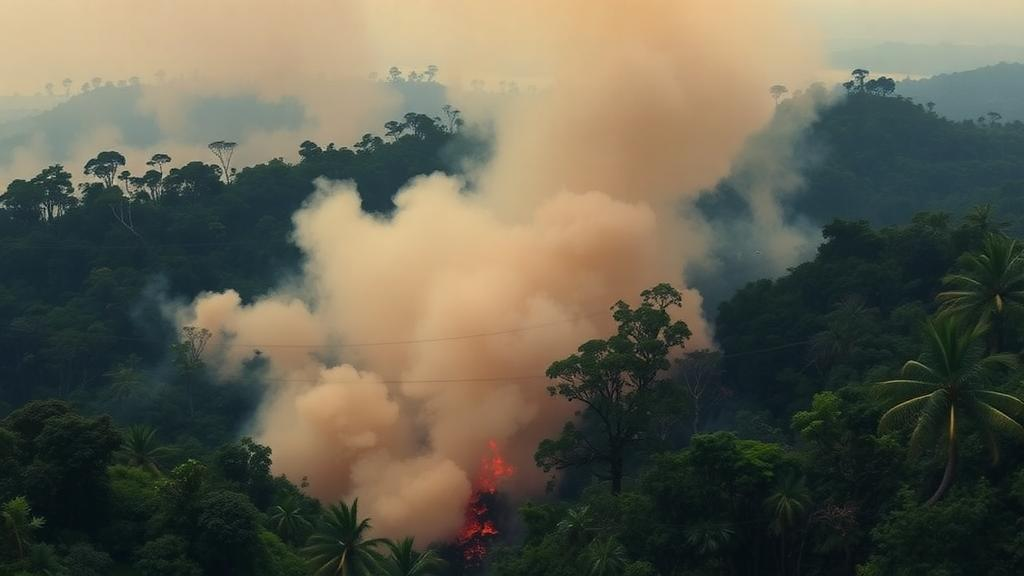
The Amazon rainforest has long been described as one of the planet’s great carbon sinks, drawing vast quantities of carbon dioxide out of the atmosphere and locking it away in wood, leaves and soil. A new peer-reviewed study, published in the journal Communications Earth & Environment, reveals that this vital service is being quietly undermined by an invisible pollutant generated by the very fires that ravage the forest. Ground-level ozone formed from wildfire emissions is damaging the leaves of surviving trees and reducing their capacity to photosynthesize, cutting the Amazon’s carbon uptake by an amount equivalent to roughly 24 percent of the carbon released by the fires themselves. The finding, from researchers at the University of Exeter, ETH Zurich and James Cook University, exposes a hidden carbon loss that has not previously been factored into assessments of the region’s climate impact.
Ground-level ozone is not emitted directly by fires. Instead, it is a secondary pollutant, formed when reactive gases produced by combustion react chemically in the presence of sunlight. In the lower atmosphere, ozone is harmful to human health and, crucially, interferes with the physiology of plants. When ozone enters leaf tissue through the same microscopic pores that trees use to absorb carbon dioxide, it damages cells and impairs photosynthesis. For a forest already stressed by drought and fire, this additional burden means that the trees that survive a blaze are less able to resume their role as carbon absorbers in the months and years that follow. The result is a double blow to the climate: fires release carbon dioxide directly when biomass burns, and the ozone they generate suppresses the ability of the remaining forest to capture and store that gas.
The research team quantified this effect using nearly three decades of observations and a global vegetation model, tracking how ozone damage evolved between 1997 and 2024 alongside patterns of fire activity and drought. Their analysis shows that the impact of fire-driven ozone is strongest during major droughts, when hot, dry conditions simultaneously fuel more fires and leave vegetation more vulnerable to pollution damage. Alarmingly, three of the most extreme Amazon droughts of the past three decades — in 1997/98, 2015/16 and 2023/24 — all occurred during El Niño events, the warm phase of a natural, recurring global climate cycle. While El Niño is not caused by human activity, climate change means it now sits atop rising baseline temperatures, making it more likely to push global temperatures to record highs and intensify extreme weather.
Lead author Dr Flossie Brown, of ETH Zurich, emphasized that the problem extends well beyond the flames themselves. Forest fires do not just release carbon dioxide when they burn, she explained; they also contribute to the rise in ground-level ozone, a pollutant that damages the leaves of surviving trees and reduces their ability to keep absorbing carbon afterwards. According to the study, this hidden effect is equivalent to around a quarter of the carbon released by the fires themselves — a significant loss to the Amazon’s carbon budget that had not previously been considered. In other words, every hectare of burned forest inflicts a further, largely unmeasured penalty on the intact forest around it, eroding the region’s capacity to recover the carbon that has been lost.
The drought years examined in the study each left a distinct signature in the data, but the most recent event stands out starkly. Ozone damage during the 2023/24 drought nearly doubled compared with the average of the previous decade, a jump that coincided with record fire activity across the basin. Dr Brown warned that, given a comparably strong El Niño appears to be developing again this year, the researchers are concerned that history could repeat itself. Forecasters have indicated that the emerging El Niño has the potential to become one of the most intense on record, raising the prospect of another major spike in this hidden carbon loss. If drought conditions and fire activity mirror those of 2024, the ozone-driven suppression of photosynthesis could once again strip a substantial fraction of the Amazon’s remaining carbon uptake capacity at precisely the moment it is most needed.
The mechanics of this damage are rooted in the chemistry of the tropical atmosphere. Wildfires release a cocktail of precursor gases, including nitrogen oxides and volatile organic compounds, which react under the intense sunlight of the tropics to produce ozone near the ground. Unlike the stratospheric ozone layer that shields the Earth from ultraviolet radiation, ground-level ozone is a pollutant. In plants, it enters through stomata — the tiny pores on leaf surfaces that regulate gas exchange — and triggers oxidative stress that damages cellular machinery. Stressed trees may close their stomata to limit ozone uptake, but doing so also restricts the influx of carbon dioxide, directly reducing photosynthesis. Over large areas and extended periods, this physiological impairment translates into measurably lower carbon uptake across the forest, compounding the losses from drought stress and fire mortality.
What makes the new findings particularly consequential is that the ozone effect operates on surviving forest rather than burned land. Conventional carbon accounting for wildfires focuses on the immediate emissions from combustion and the slower losses from tree death and decomposition. The ozone penalty, by contrast, is invisible in satellite images of smoke and scorched earth, yet it accumulates across vast swathes of intact forest downwind of burning areas. By combining long-term observational records with a global vegetation model, the researchers were able to isolate this signal and express it in carbon budget terms, showing that the atmosphere suffers significantly more damage from each Amazon fire season than direct emissions alone would suggest.
There is, however, a clear and actionable message embedded in the research. Almost all fires in the Amazon are started by people, whether through deliberate land clearance or through agricultural burning that escapes into standing forest. The worst ozone damage is concentrated in the so-called Arc of Deforestation, the frontier zone where agricultural land is expanding into the rainforest. Professor Stephen Sitch, of the University of Exeter, stressed that this means the extra ozone damage described in the study is largely preventable. Reducing deforestation and forest degradation would cut direct fire emissions, but the study shows it would also protect the Amazon from this secondary, invisible source of carbon loss. The same policy lever, in other words, addresses both problems at once.
Co-author Dr Alexander Cheesman, of James Cook University, argued that the findings demonstrate why air pollution, land-clearing and climate change cannot be treated as separate problems when determining the future of the Amazon. These impacts interact and need to be considered together, he said, but that interaction also means solutions may deliver multiple benefits. Policies that tackle deforestation and degradation address both the carbon dioxide released directly by fires and the ozone pollution quietly eroding what is left of the forest’s ability to soak that carbon back up. In a region where the margin between sink and source grows thinner with each drought, such co-benefits could prove decisive.
As the developing El Niño raises the specter of another record fire season, the study serves as a timely reminder that the true climate cost of Amazon fires is greater than the smoke plumes suggest. The research was funded by the Natural Environment Research Council, partly via the GW4+ Doctoral Training Partnership, and the underlying paper is entitled Fire-derived ozone and intensifying droughts undermine the Amazon carbon sink. Its central conclusion is stark: every fire season in the Amazon now carries a hidden surcharge, paid not in flames but in the diminished photosynthesis of the trees that survive. Protecting the world’s largest rainforest, the authors make clear, requires confronting not only the fires themselves but the polluted air they leave behind.
Subject of Research: Fire-derived ground-level ozone pollution and drought reducing carbon uptake in the Amazon rainforest
Article Title: Wildfire ozone pollution weakening Amazon's ability to absorb carbon
Article References: Wildfire ozone pollution weakening Amazon's ability to absorb carbon. (n.d.). Original publication
Image Credits: AI Generated
DOI: Not provided
Keywords: Amazon rainforest, ozone pollution, wildfires, carbon sink, El Niño, drought, deforestation, climate change, photosynthesis, Communications Earth & Environment, Arc of Deforestation, ground-level ozone
Cite Scienmag News
Russell Cooper. (October 7, 2026). Wildfire ozone pollution weakening Amazon’s ability to absorb carbon. Scienmag. https://scienmag.com/wildfire-ozone-pollution-weakening-amazons-ability-to-absorb-carbon/
Russell Cooper. "Wildfire ozone pollution weakening Amazon’s ability to absorb carbon." Scienmag, 7 October 2026, https://scienmag.com/wildfire-ozone-pollution-weakening-amazons-ability-to-absorb-carbon/. Accessed 7 October 2026.
Russell Cooper. "Wildfire ozone pollution weakening Amazon’s ability to absorb carbon." Scienmag. October 7, 2026. https://scienmag.com/wildfire-ozone-pollution-weakening-amazons-ability-to-absorb-carbon/


