


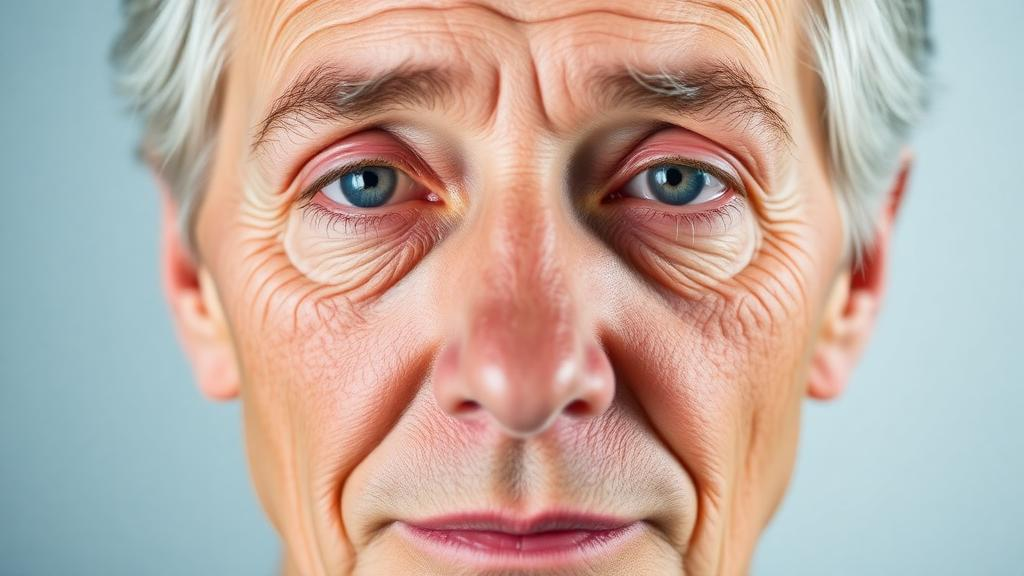
Why do some people look older than their years while others seem to defy the calendar? A large-scale study published in BMC Medicine has now traced the biology behind that question, using genetic and molecular data from 435,078 participants in the UK Biobank to map the causal networks that underlie self-perceived facial aging. The research, led by Zhaoman Wan, Tianyao Chu and colleagues, combines Mendelian randomization, colocalization and multi-omics integration to show that the face we present to the world is not merely a cosmetic surface but a readable output of systemic inflammation and lipid metabolism, with sharply different patterns in men and women.
Self-perceived facial aging is an unusual phenotype in aging research. Unlike chronological age, which advances uniformly for everyone, perceived age reflects a composite of biological wear and psychosocial experience. People who report looking older than their peers often carry visible markers of accelerated biological decline, and clinicians have long suspected that the face acts as a kind of mirror for internal health. What has been missing is a rigorous causal framework: most previous studies could only report correlations between appearance and molecular markers, leaving open the possibility that both were driven by confounders such as smoking, sun exposure or socioeconomic status.
The new study addresses that gap by exploiting genetic variants as natural experiments. In Mendelian randomization, variants that influence a modifiable exposure, such as the circulating level of a blood protein, are used as instruments to test whether that exposure causally affects an outcome, in this case perceived facial aging. Because alleles are randomly assigned at conception, this design largely sidesteps the confounding that plagues observational studies. The team went further, applying bidirectional Mendelian randomization to test causality in both directions, colocalization to confirm that the same genetic signal drives both traits rather than two linked variants, and summary-data-based Mendelian randomization to integrate expression quantitative trait loci, methylation quantitative trait loci, protein quantitative trait loci covering 2,923 proteins, and nuclear magnetic resonance metabolomics covering 256 metabolic traits.
The scale of the integration is what makes the analysis distinctive. Blood eQTLs reveal which genetic variants alter gene expression, mQTLs capture epigenetic regulation through DNA methylation, pQTLs quantify how variants shape circulating protein abundance, and NMR metabolomics measures hundreds of lipids and small molecules in a single blood draw. By layering these datasets on top of genome-wide association results for perceived aging, the researchers could trace a chain of evidence from DNA through RNA, protein and metabolite to the observable phenotype, and then ask which links in that chain survive causal testing.
The answer they uncovered centers on inflammation. Nine inflammatory proteins emerged as a core network significantly associated with self-perceived facial aging, including tumor necrosis factor, a master regulator of inflammatory signaling, and PD-L1, an immune checkpoint molecule best known for its role in cancer immunology. These are not obscure molecular players; they sit at the heart of the body’s response to infection, tissue damage and chronic stress. The finding that genetically influenced levels of these mediators are tied to how old a person perceives themselves to look suggests that low-grade systemic inflammation leaves a visible signature on the face.
From inflammation, the causal trail leads to metabolism. The nine inflammatory mediators were shown to influence a distinct profile of 137 systemic aging-associated metabolites, the majority of which are lipids, including low-density lipoprotein, the particle commonly implicated in cardiovascular disease. The researchers describe this as an inflammation-lipid metabolism axis driving perceived facial aging: inflammatory signaling reshapes the lipid landscape of the blood, and that reshaped lipid profile is what correlates with looking older. This axis is biologically plausible, since chronic inflammation is known to perturb hepatic lipid handling, alter lipoprotein composition and promote oxidative modification of lipids, processes that simultaneously damage skin structure and vascular health.
Perhaps the most striking results come from the stratified analyses, which revealed that the molecular drivers of perceived aging differ profoundly between the sexes and across life stages. In men, dysregulation of low-density lipoprotein and phospholipids predominated during midlife, specifically between the ages of 55 and 65. In women, by contrast, inflammatory signaling and disruptions of lipid transport peaked between 45 and 55, the peri- and post-menopausal window. This sex-dimorphic architecture implies that the same visible sign of aging, a face that looks older than its years, can arise from different molecular routes depending on sex and age, and it aligns with the well-documented metabolic and inflammatory shifts that accompany the menopausal transition in women and midlife metabolic decline in men.
Beyond mapping the networks, the team translated their findings into a practical tool: a 23-feature Perceived Aging score built from immune-metabolic signatures. When validated, the score correlated with self-perceived facial aging and, importantly, showed patterns distinct from conventional biological age indices such as PhenoAge and the Klemera-Doubal Method biological age estimate. It also showed associations with incident cardiovascular outcomes. That distinctness matters. Existing biological clocks are designed to estimate overall physiological decline, but perceived aging appears to capture aspects of systemic aging that are partly independent of those measures, suggesting the face encodes information that standard clocks miss.
The study also employed Differential Expression-Sliding Window Analysis, or DE-SWAN, to examine how the relevant molecular signals change across the lifespan. Rather than treating aging as a single linear process, this approach slides a window across age and detects where molecular expression shifts abruptly, revealing that the biology of perceived aging is not constant over time but concentrated in specific life phases, consistent with the sex-specific trajectories described above. The method reinforces the paper’s central message: aging is a dynamic, staged process whose molecular drivers turn on and off at different points in life.
The implications extend in several directions. For aging biology, the work provides causal evidence that perceived facial aging is anchored in measurable immune and metabolic pathways, elevating a subjective self-report into a phenotype with defined molecular correlates. For medicine, the overlap between the inflammation-lipid axis and cardiovascular risk factors hints that looking older may sometimes flag underlying cardiometabolic vulnerability, potentially motivating earlier screening. For the growing industry of biological age testing, the study suggests that a complementary metric focused on perceived aging could capture dimensions of healthspan that existing clocks overlook. The authors note that their findings support the inflammation-lipid metabolism axis as a molecular correlate of perceived aging and that self-perceived facial aging may capture aspects of systemic aging partly distinct from conventional biological age measures. As with all Mendelian randomization work, the estimates depend on the validity of the genetic instruments, and the phenotype itself is self-reported, so future studies will need to test whether the same networks predict objectively assessed facial aging and hard clinical endpoints over time. But the map drawn here, from regulatory variants through inflammatory proteins to circulating lipids and the face in the mirror, offers one of the most detailed causal pictures yet of why some of us look older than others, and it points toward the possibility that the aging face, read carefully, may be one of the most accessible windows into the body’s internal clock.
Subject of Research: Causal genetic and immune-metabolic determinants of self-perceived facial aging in the UK Biobank
Article Title: Causal inference maps the sex-dimorphic genetic architecture and inflammatory-metabolic networks underpinning perceived aging in UK Biobank
Article References: Wan, Z., Chu, T., Liang, Y., Wang, Y., Sun, X., Xie, Z., Zhang, X., Jiang, T., Wu, A., Chen, R., & Zhang, P. (2026). Causal inference maps the sex-dimorphic genetic architecture and inflammatory-metabolic networks underpinning perceived aging in UK Biobank. BMC Medicine. https://doi.org/10.1186/s12916-026-05204-0
Image Credits: AI Generated
DOI: 10.1186/s12916-026-05204-0
Keywords: perceived aging, UK Biobank, Mendelian randomization, inflammation, lipid metabolism, TNF, PD-L1, sex dimorphism, biological age, metabolomics, cardiovascular risk, multi-omics
Cite Scienmag News
Juliet Wilcox. (October 5, 2026). How Your Face Ages: Genes, Inflammation and Blood Fats Reveal the Biology of Looking Older. Scienmag. https://scienmag.com/how-your-face-ages-genes-inflammation-and-blood-fats-reveal-the-biology-of-looking-older/
Juliet Wilcox. "How Your Face Ages: Genes, Inflammation and Blood Fats Reveal the Biology of Looking Older." Scienmag, 5 October 2026, https://scienmag.com/how-your-face-ages-genes-inflammation-and-blood-fats-reveal-the-biology-of-looking-older/. Accessed 5 October 2026.
Juliet Wilcox. "How Your Face Ages: Genes, Inflammation and Blood Fats Reveal the Biology of Looking Older." Scienmag. October 5, 2026. https://scienmag.com/how-your-face-ages-genes-inflammation-and-blood-fats-reveal-the-biology-of-looking-older/


