


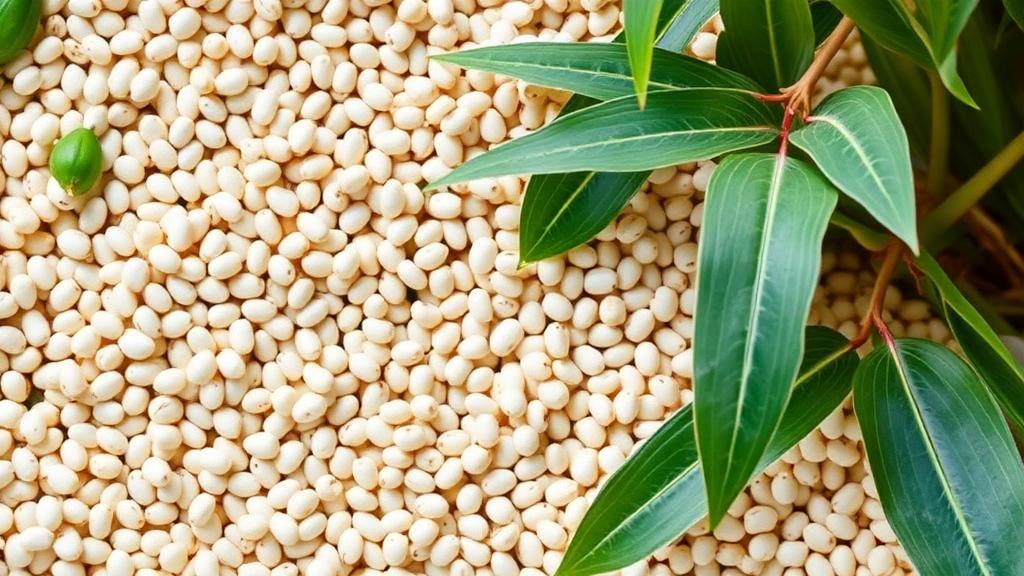
Soybean is already one of the world’s most important protein crops, but a team of plant biotechnologists in India believes its seeds can be made considerably more nutritious with a single, precisely aimed cut to the genome. Working with the soybean cultivar JS335, researchers led by Muthukrishnan Arun at Bharathiar University in Coimbatore used CRISPR/Cas9 gene editing to disable a gene called GmMYB100, a molecular brake on the production of isoflavones. The result, reported in the journal 3 Biotech, was a striking rise in the seed content of daidzein and genistein, the two best-known soy isoflavones, compounds that have been linked in numerous studies to cardiovascular, bone and potential anti-cancer benefits in humans.
The logic of the experiment rests on a long-standing observation about how plants control their secondary metabolism. Isoflavonoids are built through a branched phenylpropanoid pathway, and the flow of metabolites through that pathway is governed by transcription factors, proteins that switch suites of biosynthetic genes on or off. Earlier work had shown that GmMYB100, an R2R3-type MYB transcription factor, acts as a negative regulator of flavonoid biosynthesis in soybean. In other words, when the gene is active, it suppresses the expression of enzymes that make isoflavones. Remove the brake, the researchers reasoned, and the pathway should run faster, accumulating more of the valuable end products in the seed.
To test that idea, the team designed a single guide RNA, the molecular address label that directs the Cas9 nuclease to a specific DNA sequence, targeting the first exon of GmMYB100. The guide RNA was cloned into the plant expression vector pHSE401, which carries the Cas9 gene along with the hptII marker used to select transformed cells. The construct was then delivered into soybean embryogenic tissue using Agrobacterium tumefaciens strain EHA105, the workhorse delivery vehicle of plant transformation. This approach is well established for soybean, a crop that has historically been more recalcitrant to genetic manipulation than rice or tomato, making each successful editing pipeline a technical achievement in its own right.
Confirming that the editing had actually worked required several layers of molecular characterization. The researchers first verified that the Cas9 and hptII genes had stably integrated into the genomes of the regenerated T0 plants, the first generation grown from edited cells. They then sequenced the target region of GmMYB100 and looked for the telltale signatures of Cas9 activity: insertion and deletion mutations, or indels, at the cut site. Because Cas9 repairs are often frameshift mutations, they typically scramble the reading frame of the gene and destroy the function of the resulting protein. Finding indels at the target site in the recovered plants confirmed that GmMYB100 had been successfully knocked out.
The payoff came when the team measured isoflavone levels in the seeds of the edited lines. Compared with non-transformed control plants, the edited T0 soybeans accumulated 2.85 times more daidzein and 1.23 times more genistein. The asymmetry between the two compounds is itself informative. Daidzein and genistein sit at related branch points of the isoflavonoid pathway, and the different magnitudes of increase suggest that releasing the GmMYB100 brake redirects metabolic flux unevenly across the network, favoring the branch leading to daidzein. Such differential responses are common in metabolic engineering and highlight why measuring individual metabolites, rather than total isoflavones alone, matters when evaluating an edited crop.
To understand how the metabolite changes arose, the researchers performed quantitative reverse-transcription PCR on immature cotyledons, mature cotyledons and whole seeds, the tissues where isoflavones accumulate during grain development. The analysis revealed significant upregulation of the major isoflavone biosynthetic genes across these tissues, consistent with the enhanced metabolite accumulation. This coherence between transcript levels and metabolite levels is important: it indicates that the phenotype is not an artifact of measurement or of stress responses to tissue culture, but a genuine rewiring of the seed’s metabolic program following loss of the repressor.
The study fits into a rapidly growing body of work using CRISPR/Cas9 not to fight disease or pests, but to upgrade the nutritional and industrial quality of crops. Similar strategies have produced high-oleic rice, elevated gamma-aminobutyric acid in rice grains, boosted beta-carotene in banana fruit, enriched lycopene in tomato, raised resistant starch in rice and increased seed oil content in rapeseed. In soybean specifically, previous efforts to raise isoflavones relied on overexpressing biosynthetic genes or transcriptional activators, or on RNA interference to silence competing pathway branches. The new work demonstrates that simply removing a negative regulator can achieve a comparable outcome with a smaller genetic footprint.
That smaller footprint matters for regulation and public acceptance. Because the edit consists of small indels in an endogenous gene, with no foreign DNA necessarily retained after segregation, lines derived from such editing can, in principle, be indistinguishable from natural variants. The researchers note that disrupting GmMYB100 relieves negative regulation of the isoflavonoid biosynthetic pathway and establishes the gene as an effective target for CRISPR/Cas9-mediated metabolic engineering. In soybean, where outcrossing is limited and transgene containment has been a practical concern, a strategy that relies on knocking out a native repressor is an attractive alternative to transgenic overexpression approaches.
The health context gives the work its broader resonance. Soy isoflavones are phytoestrogens, plant compounds that interact with estrogen receptors, and epidemiological and clinical studies have associated their consumption with improved cardiovascular risk markers, particularly in women during early menopause, as well as with antioxidant and possible anti-metastatic effects in laboratory models. Soybean is a dietary staple across much of Asia and a ubiquitous ingredient in processed foods and animal feed worldwide, so even modest increases in seed isoflavone content could translate into meaningful shifts in population-level intake. The authors also point to isoflavones’ role in plant defense, where they contribute to resistance against pathogens, suggesting the edit could carry agronomic as well as nutritional benefits.
There are, of course, steps between a T0 greenhouse plant and a farmer’s field. The edited plants in this study are the first generation after transformation, and the stability of the mutations, the consistency of the isoflavone trait across subsequent generations, and any effects on yield, seed composition or stress tolerance all remain to be characterized. The researchers were supported by the Department of Science and Technology, Government of India, through its Women Scientist-A program and its FIST infrastructure scheme. Their work, published online on 30 August 2026, adds GmMYB100 to the short but growing list of repressor genes whose removal has unlocked higher levels of health-promoting compounds in staple crops, and it offers breeders a practical, precise template for building a more nutritious soybean one targeted mutation at a time.
Subject of Research: CRISPR/Cas9 knockout of the GmMYB100 transcription factor to enhance isoflavone biosynthesis in soybean seeds
Article Title: CRISPR/Cas9-mediated targeted mutagenesis of GmMYB100 to increase isoflavone content in soybean seeds
Article References: Vidya, N., Saravanan, K., Halka, J., Kowsalya, K., Preetha, J. S. Y., Anand, M., Vaz, M. A. A., Appunu, C., Gurusaravanan, P., Dibyajyoti, P., & Arun, M. (2026). CRISPR/Cas9-mediated targeted mutagenesis of GmMYB100 to increase isoflavone content in soybean seeds. 3 Biotech, 16(9), Article 399. https://doi.org/10.1007/s13205-026-05033-1
Image Credits: AI Generated
DOI: 10.1007/s13205-026-05033-1
Keywords: soybean, CRISPR/Cas9, GmMYB100, isoflavones, daidzein, genistein, genome editing, metabolic engineering, transcription factor, Agrobacterium tumefaciens, seed nutrition, Glycine max
Cite Scienmag News
Juliet Wilcox. (October 4, 2026). CRISPR Knockout of a Single Gene Supercharges Soybean’s Health-Boosting Isoflavones. Scienmag. https://scienmag.com/crispr-knockout-of-a-single-gene-supercharges-soybeans-health-boosting-isoflavones/
Juliet Wilcox. "CRISPR Knockout of a Single Gene Supercharges Soybean’s Health-Boosting Isoflavones." Scienmag, 4 October 2026, https://scienmag.com/crispr-knockout-of-a-single-gene-supercharges-soybeans-health-boosting-isoflavones/. Accessed 4 October 2026.
Juliet Wilcox. "CRISPR Knockout of a Single Gene Supercharges Soybean’s Health-Boosting Isoflavones." Scienmag. October 4, 2026. https://scienmag.com/crispr-knockout-of-a-single-gene-supercharges-soybeans-health-boosting-isoflavones/


