


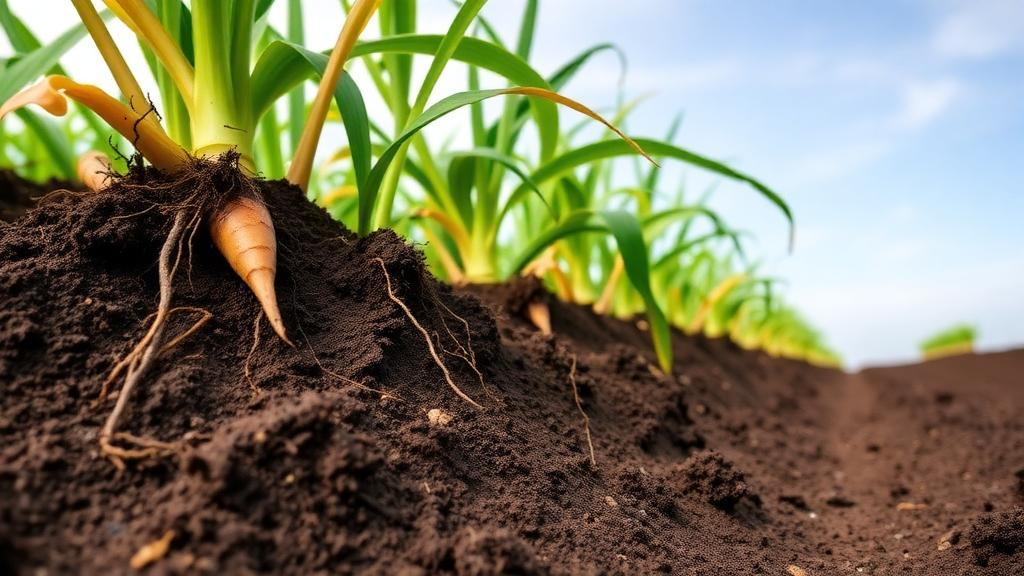
Beneath every sugarcane field lies an invisible workforce of bacteria and fungi that quietly decides whether the crop thrives or struggles. A sweeping new analysis of global research has now mapped, in unprecedented detail, how farming choices—from fertiliser regimes to intercropping and straw management—reshape these underground communities. The findings, published as a scoping review in the journal Discover Soil, suggest that the road to sustainable sugarcane production is far more complicated than simply swapping one practice for another. Instead, the soil microbiome responds to a tangled web of factors that include the specific crop variety planted, whether experiments are run in fields or greenhouses, and even which soil compartment scientists choose to sample.
The research team, led by Mahlatse Ellias Moremi of the South African Sugarcane Research Institute alongside colleagues from the Agricultural Research Council, followed the Preferred Reporting Items for Systematic Reviews and Meta-Analyses (PRISMA) guidelines to sift through the literature. An initial database search across Scopus, Web of Science, PubMed and ScienceDirect yielded 536 records, which the authors narrowed down through independent screening to 42 eligible studies. From these, they catalogued a remarkable 146 bacterial genera and 95 fungal genera, classifying each according to three functional roles: nutrient solubilisation, pathogen suppression, and plant pathogenicity. This functional lens matters because the balance among these groups ultimately determines whether a soil supports crop growth or harbours disease.
The review arrives at a critical moment for a crop with enormous global significance. Sugarcane underpins more than 75 percent of world sugar production and roughly 40 percent of biofuel output, with Brazil, China and India dominating the supply. African nations contribute 5.6 percent of global production, led by South Africa, where the crop supports employment and food security while contributing to several United Nations Sustainable Development Goals, including Zero Hunger and Affordable and Clean Energy. Yet conventional practices such as pre-harvest burning, intensive tillage and long-term monocropping have been linked to soil degradation, nutrient imbalances and declining yields. The new synthesis provides the most comprehensive picture yet of how these pressures ripple through the microbial world.
Among the bacterial genera, a clear set of dominant players emerged. Sphingomonas, reported in 17 field studies, topped the list, followed by Bradyrhizobium with 14 reports, Bacillus with 13, and Gemmatimonas with 10. Streptomyces and Acidothermus each appeared in nine studies. These taxa are far from random arrivals: Sphingomonas, Bradyrhizobium and Bacillus are well documented for their roles in nitrogen fixation, nutrient cycling, disease suppression and plant growth promotion. On the fungal side, Talaromyces, Fusarium, Curvularia and Mortierella dominated the field-study records, while Fusarium, Trichoderma and Penicillium were the most frequently reported genera in greenhouse experiments. Notably, this roster spans the full functional spectrum, from beneficial solubilisers to notorious pathogens.
One of the most striking revelations concerns a mismatch between what lives in sugarcane soils and what the biotechnology industry sells. Commercial phosphorus-solubilising products are overwhelmingly built around Bacillus strains and the arbuscular mycorrhizal fungus Funnelformis. Yet the review shows that indigenous sugarcane soils are naturally dominated by a different suite of potent solubilisers, most notably Sphingomonas and Bradyrhizobium. The authors argue that this native phosphorus-mobilising potential represents a largely untapped resource, and that next-generation biofertilisers tailored to sugarcane systems might do better to harness these locally adapted taxa rather than relying on exotic inoculants that face fierce competition from established native communities.
The review also exposes how strongly experimental context shapes results. When the authors compared microbial responses across field and greenhouse settings, they found that Sphingomonas was the only genus consistently reported in both environments for intercropping studies—and even then, its response flipped, increasing in field conditions while decreasing in the greenhouse. The explanation likely lies in the stability of controlled environments, which favour microbial colonisation and metabolite production, versus the environmental variability of real fields, where moisture extremes, nutrient heterogeneity and resource competition constrain colonisation. The practical implication is sobering: greenhouse results cannot be straightforwardly extrapolated to the field, and robust conclusions demand integration across experimental scales.
Soil compartment added another layer of complexity. Under some treatments, such as nitrogen, phosphorus and potassium fertilisation combined with straw return, genera like Bryobacter, Bradyrhizobium and Sphingomonas showed consistent abundance patterns in both bulk soil and the rhizosphere, the narrow zone of root influence. Under other conditions, including sugarcane-wheat rotations and sugarcane-peanut intercropping, the same genera diverged sharply between compartments. Time mattered too: Fusarium abundance remained unaffected by organic amendments at 50 days but declined significantly after 100 days, indicating that some management effects only emerge after prolonged soil-microbe interactions. Any single snapshot, the authors caution, risks missing the true dynamics of these communities.
Crop genotype proved to be a decisive moderating factor throughout the synthesis. The widely grown variety ROC22 suppressed bacterial genera such as Acidothermus and Gemmatimonas while enriching fungal genera like Talaromyces and Mortierella, whereas the newer variety Z9 produced the opposite trend for Trichoderma. In one study, the effects of intercropping on Sphingomonas, Acidothermus and Gemmatimonas were completely reversed when comparing wild-type and genetically modified sugarcane. Arbuscular mycorrhizal fungal communities likewise shifted in a variety-specific manner under green cane harvesting. Because most genera responded to the interaction between variety and management rather than to either factor alone, the authors conclude that breeding strategies and microbiome research must be developed hand in hand.
The main management practices themselves produced a patchwork of outcomes. Excessive inorganic nitrogen generally suppressed overall microbial abundance, while moderate nitrogen and potassium applications promoted beneficial genera such as Acidothermus, Bradyrhizobium, Bacillus and Nitrospira. Organic inputs like vinasse enriched Burkholderia and Sphingomonas but depleted Bacillus, and combining molasses with urea and potassium chloride enhanced Bacillus while reducing Sphingomonas. Biofertiliser effects were exquisitely sensitive to strain composition, application rate and nitrogen context: a consortium containing Trichoderma asperellum and Bacillus subtilis enriched Bradyrhizobium and Trichoderma, while specialised consortia dominated by Methylobacterium depleted both Bacillus and Burkholderia. Intercropping outcomes depended heavily on the companion crop, with sugarcane-soybean systems enriching Bryobacter, Nitrospira, Penicillium and Trichoderma, and sugarcane-peanut systems promoting Acidothermus and Bradyrhizobium. Meanwhile, green cane harvesting promoted a broader range of beneficial taxa than straw return alone, and the deep-tillage technique known as Fenlong-ridging increased Bradyrhizobium and Talaromyces while reducing Sphingomonas, Penicillium and Curvularia.
Underlying these variable responses, the authors propose a mechanistic framework in which microbiome assembly is governed by chemical nutrient saturation, carbon complexity and spatial compartmentation. High inorganic nitrogen acts as a directional filter, acidifying soil and suppressing oligotrophic diazotrophs like Bradyrhizobium by reducing root carbon allocation, while versatile generalists such as Sphingomonas persist thanks to their protective sphingolipid cell walls. Easily degradable carbon sources trigger blooms of opportunistic copiotrophs, whereas lignocellulosic residues select for robust spore-forming decomposers. The review is candid about its limitations: the evidence base is heavily skewed toward China, which contributed 34 of the 42 studies, most research spans only a single growth cycle, soil classification was often poorly documented, and amplicon sequencing reveals composition rather than function. Still, the overarching message is clear. Soil microbial responses in sugarcane systems are profoundly context-dependent, emerging from interactions among management practices, environmental conditions and crop genotype. Sustainable production, the authors conclude, will require integrated, systems-based approaches that optimise these interactions rather than betting on any single intervention.
Subject of Research: Effects of sugarcane management practices on soil bacterial and fungal communities
Article Title: A scoping review of how various management practices influence bacterial and fungal genera within sugarcane production systems
Article References: Moremi, M. E., Mdlambuzi, T., Mashamaite, C. V., & Elephant, D. E. (2026). A scoping review of how various management practices influence bacterial and fungal genera within sugarcane production systems. Discover Soil, 3(1), Article 127. https://doi.org/10.1007/s44378-026-00283-0
Image Credits: AI Generated
DOI: 10.1007/s44378-026-00283-0
Keywords: sugarcane, soil microbiome, bacteria, fungi, intercropping, fertilisation, straw return, biofertilisers, rhizosphere, pathogen suppression, nutrient solubilisation, sustainable agriculture
Cite Scienmag News
Morgan Morrow. (October 3, 2026). Sugarcane’s Secret Soil Allies: What 42 Studies Reveal About Farming and the Microbiome. Scienmag. https://scienmag.com/sugarcanes-secret-soil-allies-what-42-studies-reveal-about-farming-and-the-microbiome/
Morgan Morrow. "Sugarcane’s Secret Soil Allies: What 42 Studies Reveal About Farming and the Microbiome." Scienmag, 3 October 2026, https://scienmag.com/sugarcanes-secret-soil-allies-what-42-studies-reveal-about-farming-and-the-microbiome/. Accessed 3 October 2026.
Morgan Morrow. "Sugarcane’s Secret Soil Allies: What 42 Studies Reveal About Farming and the Microbiome." Scienmag. October 3, 2026. https://scienmag.com/sugarcanes-secret-soil-allies-what-42-studies-reveal-about-farming-and-the-microbiome/


