


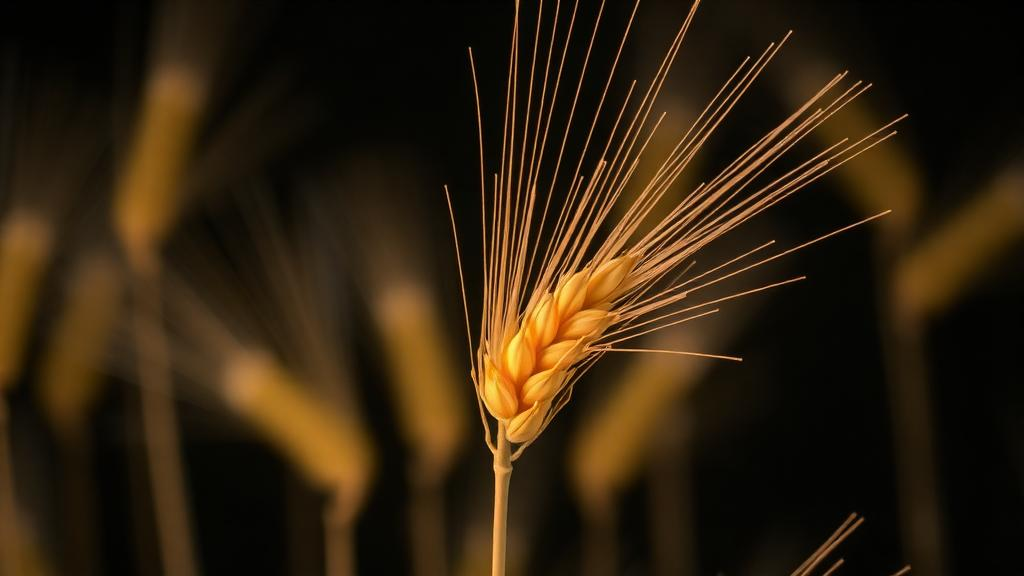
When a wheat seed is dropped into dry soil, its fate is decided within days. Germination is the most vulnerable moment in the life of a cereal crop, and in the arid and semi-arid regions where much of the world’s wheat is grown, poor seedling establishment translates directly into lost yield. Yet the genetic control of drought tolerance during germination has remained far less explored than drought responses in later growth stages, leaving breeders without clear molecular targets for one of the most consequential phases of the crop cycle. A new study published in Plant Cell Reports by Tongtong Liu, Lifeng Gao and colleagues at Shanxi Agricultural University and the Chinese Academy of Agricultural Sciences now fills part of that gap, mapping the genetic architecture of germination-stage drought tolerance across hundreds of wheat varieties and multiple environments.
The team assembled a natural population of 389 wheat varieties and subjected them to drought stress simulated with 20 percent PEG-6000, a water-soluble polymer that lowers the water potential of the germination medium and mimics the osmotic challenge a seed faces in drying soil. The experiment was repeated across three independent annual environments, a design choice that matters enormously in drought research, because the expression of stress tolerance traits is notoriously sensitive to year-to-year variation in conditions. Rather than relying on a single season, the researchers could ask which genetic signals held up consistently, and which were artifacts of a particular trial.
Six germination-related traits were measured for every variety in every environment: germination rate, shoot length, root length, root number, coleoptile length, and germination potential. From each trait the team calculated a drought resistance coefficient, which expresses how well a variety maintains performance under stress relative to its unstressed baseline. This normalization is important because varieties differ greatly in intrinsic vigor; a coefficient-based approach separates a variety’s inherent capacity from its ability to withstand water deficit specifically.
But the researchers went a step further, addressing a long-standing weakness in stress-tolerance phenotyping. Judging a variety by any single trait can be misleading, since drought tolerance is a composite property that emerges from root growth, shoot elongation, and the speed and completeness of germination acting together. To capture this, the team combined principal component analysis with a membership function method to distill the six traits into a single comprehensive drought tolerance evaluation value, abbreviated as the D-value. This statistical framework, widely used in multi-trait stress evaluations of crops such as maize and cotton, weights each trait according to how much independent information it contributes, producing a ranking that reflects overall tolerance rather than performance on one metric.
The consistency of these rankings across environments was striking. Pairwise correlation coefficients between the D-value rankings from different years all exceeded 0.82, with statistical significance at P below 0.001. In practical terms, a variety that ranked as drought tolerant in one year almost always ranked as tolerant in the others. That level of repeatability is exactly what breeders need, because it suggests the underlying genetic differences are stable rather than being swamped by environmental noise, and it validates the multi-index evaluation system the authors propose as a robust screening tool for germination-stage drought tolerance.
With reliable phenotypes in hand, the team turned to the genome. Using a 660K SNP array, they performed a genome-wide association study, or GWAS, a technique that scans the genome for genetic variants whose frequencies correlate with trait values across the population. The scan identified 270 significantly associated SNPs at a threshold of P less than 1 times 10 to the power of minus 4. Raw association hits, however, often include signals that appear in only one environment or affect only one trait, so the researchers applied a stringent filter: a locus had to be detected in at least two environments or be associated with multiple traits to qualify as an important quantitative trait locus. This filtering narrowed the field to ten important QTLs, of which eight were stably expressed across multiple environments and four showed pleiotropy, meaning a single genomic region influences several different traits simultaneously.
The standout discovery was a stable pleiotropic hotspot on chromosome 5D, comprising two adjacent loci designated qDT-G5D.1 and qDT-G5D.2. This region was associated with root number, germination potential, and germination rate, three traits that together capture much of what determines whether a seedling can establish itself in dry soil. A pleiotropic hotspot of this kind is particularly valuable for breeding, because selecting for the favorable allele at one locus can simultaneously improve several components of tolerance. Coordinated improvement of multiple drought tolerance traits through a single genomic region is far more efficient than pyramiding separate genes for each trait, and the 5D hotspot therefore stands out as a prime candidate for marker-assisted selection.
To move from statistical associations to biological mechanism, the authors integrated previously published transcriptome data, looking for genes within the important QTL intervals that behave differently between drought-tolerant and drought-sensitive varieties. This screen yielded twelve putative candidate genes whose differential expression links them plausibly to the tolerance phenotype. The team then carried out haplotype analysis, examining the natural sequence variants of these candidate genes and testing whether different haplotypes, or combinations of variants inherited together, correspond to different trait performance. The answer was affirmative for ten of the twelve genes: significant phenotypic differences were observed among haplotypes, meaning the sequence variation within these genes tracks with real differences in drought tolerance. That convergence of positional, expression, and haplotype evidence substantially strengthens the case that these genes are functionally involved in germination-stage drought response rather than merely riding along with nearby causal variants.
The broader significance of the work lies in what it hands to wheat breeders and to the research community. The multi-index D-value system offers a standardized, repeatable way to score germination-stage drought tolerance that can be adopted in other germplasm screens. The ten important QTLs, and especially the eight stably expressed ones, provide chromosomal landmarks that can be converted into molecular markers for marker-assisted breeding, allowing breeders to track tolerance alleles in seedling nurseries without waiting for full field evaluations. The 5D pleiotropic hotspot offers a single target with the potential to improve several traits at once, and the ten haplotype-validated candidate genes supply a starting point for functional studies aimed at understanding the molecular pathways that let a germinating seed cope with water deficit.
As climate change intensifies drought pressure on wheat-growing regions worldwide, the earliest days of a plant’s life are becoming an increasingly important focus of crop improvement. By combining multi-environment phenotyping, a statistically rigorous composite evaluation, high-density GWAS, and transcriptome-informed candidate gene analysis, this study demonstrates how modern genomic tools can dissect a complex stress response at a life stage that has long been overlooked. The genetic resources it delivers, from stable QTLs to a pleiotropic hotspot on chromosome 5D and a set of validated candidate genes, are the raw material from which more resilient wheat varieties can be built, ensuring that the critical transition from seed to seedling no longer depends quite so heavily on the vagaries of the weather.
Subject of Research: Genetic loci controlling drought tolerance during wheat germination identified through multi-environment GWAS
Article Title: Multi-environment genome-wide association study reveals genetic loci associated with drought tolerance during wheat germination
Article References: Liu, T., Gao, L., Li, J., Qiao, N., Jiang, D., Yang, J., Jia, J., Wang, J., Sun, D., & Li, N. (2026). Multi-environment genome-wide association study reveals genetic loci associated with drought tolerance during wheat germination. Plant Cell Reports, 45(10), Article 318. https://doi.org/10.1007/s00299-026-04014-1
Image Credits: AI Generated
DOI: 10.1007/s00299-026-04014-1
Keywords: wheat, drought tolerance, germination, GWAS, QTL, chromosome 5D, pleiotropy, SNP, candidate genes, haplotype analysis, marker-assisted breeding, PEG-6000
Cite Scienmag News
Alan Morgan. (October 3, 2026). Scientists Find a Chromosome 5D Hotspot That Helps Wheat Sprout Under Drought. Scienmag. https://scienmag.com/scientists-find-a-chromosome-5d-hotspot-that-helps-wheat-sprout-under-drought/
Alan Morgan. "Scientists Find a Chromosome 5D Hotspot That Helps Wheat Sprout Under Drought." Scienmag, 3 October 2026, https://scienmag.com/scientists-find-a-chromosome-5d-hotspot-that-helps-wheat-sprout-under-drought/. Accessed 4 October 2026.
Alan Morgan. "Scientists Find a Chromosome 5D Hotspot That Helps Wheat Sprout Under Drought." Scienmag. October 3, 2026. https://scienmag.com/scientists-find-a-chromosome-5d-hotspot-that-helps-wheat-sprout-under-drought/


