


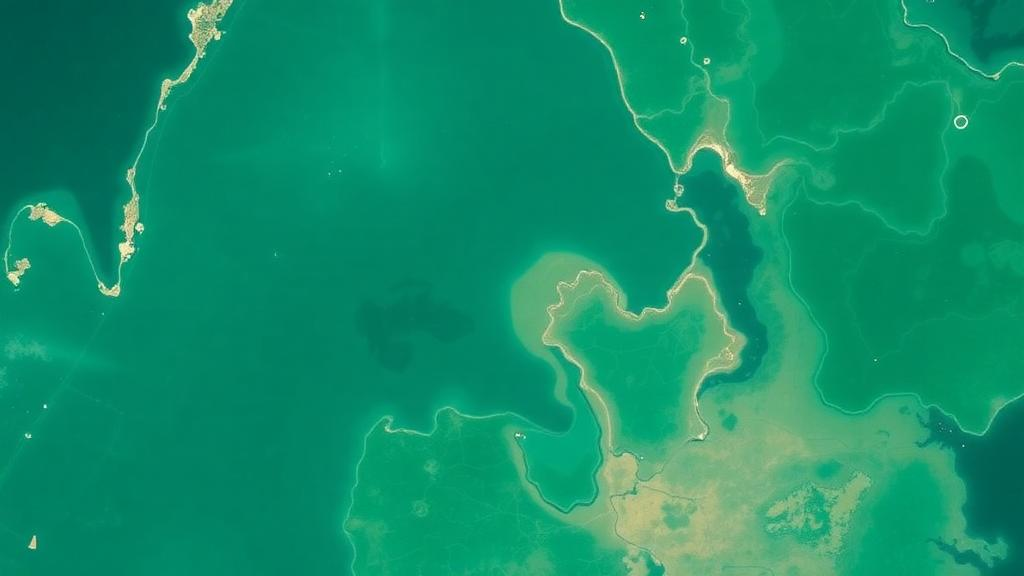
On the Brazilian island of Florianópolis, the Lagoa da Conceição is postcard material: a broad, shimmering coastal lagoon ringed by hills, fishing villages, and some of the country’s most coveted real estate. But a new scientific investigation suggests the lagoon’s postcard appearance conceals a more troubling story. By combining an unusually intimate look at the lagoon’s sediments with six years of satellite observations, researchers have assembled evidence that the water body is under measurable, and in places considerable, environmental stress.
The study, published in the journal Environmental Monitoring and Assessment, was led by Alcindo Neckel of Universidade Atitus and the University of Minho, together with colleagues from institutions in Brazil, the United States, and Portugal. Rather than relying on a single measurement technique, the team deliberately paired two complementary approaches. The first examined nanoparticles and ultrafine particles in the lagoon’s aquatic sediments, collected between 2024 and 2025. The second tracked three bio-optical variables of the water column from orbit between 2019 and 2025, using the Ocean and Land Colour Instrument aboard the European Space Agency’s Sentinel-3A and Sentinel-3B satellites. Together, the two lines of evidence tell a consistent story of degradation driven by human activity.
The sediment work began at ground level, literally. The team collected samples from 18 sites spread across the lagoon, targeting the fine-grained material that accumulates on the bottom and acts as a long-term archive of what has washed into the water. Sediments are often described as environmental memory: contaminants that pass through the water column quickly can bind to particles and settle, remaining detectable long after the original pollution event. By analyzing the nanoparticle and ultrafine fraction of these sediments, the researchers could identify contaminants at scales of billionths of a meter, far below what conventional water testing typically captures.
What they found was striking. The sediments contained iron nanoparticles with carbon contents reaching up to 60 percent, frequently associated with a suite of potentially toxic metals: chromium, nickel, vanadium, zinc, and zirconium. The presence of these elements together points toward industrial and urban sources rather than purely natural geology. Perhaps more alarming for a lagoon surrounded by neighborhoods and tourist infrastructure, the team also documented plastic nanoparticles, the smallest and most poorly understood fraction of the plastic pollution problem. Particles at this scale can be taken up by organisms at the base of the food web, and their behavior in aquatic ecosystems remains an active frontier of toxicology research.
The satellite component of the study operated at a very different scale. The researchers processed Sentinel-3 imagery at 153 points across the lagoon using the Sentinel Application Platform, or SNAP, extracting three key bio-optical variables. The first was chlorophyll-a, the pigment at the heart of photosynthesis, which serves as a proxy for algal abundance and, by extension, nutrient enrichment. The second was total suspended matter, a measure of the particles clouding the water. The third was the absorption of dissolved organic matter at a wavelength of 443 nanometers, a standard indicator of dissolved organic carbon loading in coastal waters.
Averaged over the 2019 to 2025 period, the satellite retrievals showed elevated values across the lagoon: chlorophyll-a concentrations of 7.187 milligrams per cubic meter, total suspended matter of 17.213 grams per cubic meter, and dissolved organic matter absorption of 5.555 per meter. Each of these numbers matters on its own. Elevated chlorophyll-a signals that algae are flourishing, often in response to nutrient runoff from sewage, fertilizers, or urban drainage. High suspended matter reduces light penetration, stressing seagrasses and other light-dependent habitats. And elevated dissolved organic matter absorption indicates a substantial load of organic compounds, which can carry pollutants and alter the lagoon’s chemistry.
To turn these point measurements into a spatial picture, the team applied K-means clustering, an unsupervised machine learning algorithm that groups observations by similarity without any prior labeling. The clustering, combined with robust analysis of variance to test whether the groups differed significantly, revealed a clear geospatial pattern: moderate to high concentrations of chlorophyll-a, suspended matter, and dissolved organic matter concentrated in the interior of the lagoon, with significantly lower values in the adjacent coastal areas. In other words, the lagoon itself is acting as a trap for the contaminants and nutrients flowing into it, while the open coastal waters beyond its connection to the sea remain comparatively cleaner.
That spatial gradient is scientifically meaningful because it helps distinguish local degradation from broader oceanic conditions. If the elevated bio-optical values were simply a reflection of regional water masses, one would expect a more uniform distribution. Instead, the hotspot pattern inside the lagoon points to sources within its own watershed: the untreated or partially treated wastewater, stormwater runoff, and urban development pressure that have accompanied Florianópolis’s rapid growth as a tourism and technology hub. The sediment findings reinforce this interpretation, since metals such as chromium, nickel, and vanadium are classic fingerprints of industrial and vehicular activity rather than pristine catchments.
The methodological pairing is arguably the study’s most transferable contribution. Sediment analysis provides depth of history and chemical specificity but only at sampled points; satellite ocean color provides breadth and continuity but only for optically active variables in the surface layer. By running both in parallel and showing that they converge on the same conclusion, the researchers demonstrated a template that other coastal lagoons, in Brazil and worldwide, could adopt at relatively low cost. Sentinel-3 data are freely available, and the SNAP software used to process them is open source, which means resource-strapped environmental agencies could replicate much of the monitoring workflow without expensive field campaigns.
The stakes for Lagoa da Conceição are high. The lagoon is central to Florianópolis’s identity and economy, supporting recreation, tourism, and traditional fishing communities, and its health is tightly linked to the wellbeing of the people who live around it. The study’s authors frame their findings within a broader concern about growing anthropogenic pressure on aquatic environments, which compromises ecosystems, public health, and the economic activities that depend on natural resources. Their evidence from a single iconic lagoon adds to a mounting global picture in which nanoparticles, plastics, and nutrient enrichment are quietly reshaping coastal waters. Whether the lagoon’s trajectory can be reversed will depend on wastewater management, watershed planning, and continued monitoring, and this study has now provided the monitoring baseline against which any future recovery, or further decline, will be measured.
Subject of Research: Water quality assessment of a Brazilian coastal lagoon using sediment nanoparticle analysis and Sentinel-3 satellite bio-optical variables
Article Title: Water quality assessment using sediment analysis and Sentinel-3-derived bio-optical variables in Lagoa da Conceição, Brazil
Article References: Water quality assessment using sediment analysis and Sentinel-3-derived bio-optical variables in Lagoa da Conceição, Brazil. (n.d.). https://doi.org/10.1007/s10661-026-15991-x
Image Credits: AI Generated
DOI: 10.1007/s10661-026-15991-x
Keywords: water quality, Lagoa da Conceição, Sentinel-3, OLCI, nanoparticles, chlorophyll-a, total suspended matter, dissolved organic matter, sediment analysis, plastic pollution, remote sensing, coastal lagoon
Cite Scienmag News
Violet Maxwell. (October 2, 2026). Satellites and Sediments Reveal Hidden Pollution in Brazil’s Famous Lagoon. Scienmag. https://scienmag.com/satellites-and-sediments-reveal-hidden-pollution-in-brazils-famous-lagoon/
Violet Maxwell. "Satellites and Sediments Reveal Hidden Pollution in Brazil’s Famous Lagoon." Scienmag, 2 October 2026, https://scienmag.com/satellites-and-sediments-reveal-hidden-pollution-in-brazils-famous-lagoon/. Accessed 2 October 2026.
Violet Maxwell. "Satellites and Sediments Reveal Hidden Pollution in Brazil’s Famous Lagoon." Scienmag. October 2, 2026. https://scienmag.com/satellites-and-sediments-reveal-hidden-pollution-in-brazils-famous-lagoon/


