


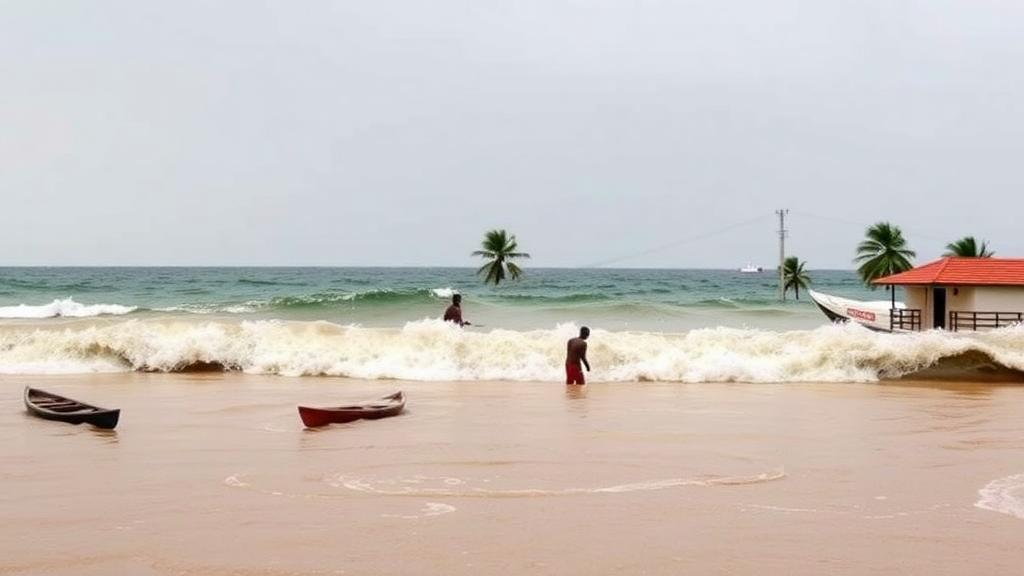
Along the low-lying coastline that stretches from Mauritania to Cameroon, the water that decides whether a community floods or stays dry is not governed by a single force. It is the product of a compound equation: sea level anomalies layered on top of storm surges, astronomical tides, and the often-underestimated push of wave run-up. A new open-access study published in Discover Oceans has now untangled those ingredients for the entire West African coast, reconstructing Extreme Coastal Water Levels, or ECWL, at 259 points spaced every 50 kilometres from 1994 to 2015. The result is the most detailed regional map yet of which oceanic and climatic processes actually push water over the edge in one of the world’s most vulnerable coastal corridors.
The technical approach behind the study is as important as its findings. The researchers combined satellite altimetry-based sea level anomalies from the Copernicus Marine Environment Monitoring Service with atmospheric and wave parameters from the ECMWF’s ERA-Interim reanalysis, storm surge outputs from the MOG2D-G barotropic model, and hourly astronomical tides from the FES30 global tide model. Wave run-up was modelled as a function of deep-water significant wave height, wavelength, and the subaerial coastal slope. Because these datasets arrived at different temporal resolutions, ranging from daily sea level fields to six-hourly surge and hourly tides, the team interpolated everything to a common hourly time step. That harmonisation matters: extreme coastal water levels are born from compound interactions that evolve on hourly scales, and a daily average would wash out precisely the peaks that flood homes and erode shorelines.
Once reconstructed, the ECWL record revealed a clear hierarchy of drivers. Tidal forces and wave run-up dominate the regional differences in extreme water levels, directly shaping coastal erosion and flooding, with Guinea-Bissau standing out as a hotspot because its wide, low-lying coastal plains amplify every centimetre of elevated water. Sea level anomalies, though small in mean terms at roughly 0.03 metres across countries, act as a slowly shifting baseline that reflects the cumulative state of the ocean and climate system, exacerbating the impacts of tides and waves when they coincide. The dynamic atmospheric contribution, essentially the storm surge signal driven by surface winds and pressure, remained comparatively minor, averaging around 0.02 metres across most of the coast.
The trend analysis added a sobering dimension. Sea level anomalies rose at an average of 3.08 millimetres per year along the coast, with local maxima reaching 4.23 millimetres per year, while total ECWL climbed at an average of 2.65 millimetres per year. Wave run-up, by contrast, declined slightly on average, at roughly 0.47 millimetres per year, though with substantial local variability. The dynamic atmospheric contribution was essentially flat. In other words, the steady rise in West Africa’s flood baseline is being driven primarily by the ocean itself, not by changing waves or winds, and that baseline keeps lifting the floor beneath every high tide and every swell event.
The spatial contrasts are striking. Mauritania and Senegal both show mean ECWL values above 2 metres with a consistent 98th percentile of 2.9 metres, indicating a stable but high extreme threshold. Guinea-Bissau records the highest 98th percentile in the region, far above its mean of 2.42 metres, signalling occasional very high extremes. Ghana presents perhaps the most dramatic gap: a mean of just 1.59 metres against a 98th percentile of 4.01 metres, meaning that when extremes arrive there, they arrive as sharp, exceptional spikes. Liberia shows the lowest exposure overall, while Nigeria sits in the middle with a mean near 1.57 metres and a 98th percentile of 2.6 metres.
Duration matters as much as height, and here the study quantified how long water stays dangerously high. Defining an extreme ECWL day as one exceeding the 98th percentile of a country’s distribution, the team found that Guinea-Bissau and Guinea logged the most extreme days, at 23 and 22 respectively in a single year, while Sierra Leone, Liberia, Togo, Benin, and Cameroon each recorded 15 to 17 days. Senegal, The Gambia, Ivory Coast, Ghana, and Nigeria hovered around 13 to 14 days. For communities in the Guinea-Bissau and Guinea cluster, flooding is not a brief shock but a prolonged condition, demanding continuous monitoring and rapid-response mechanisms rather than one-off defences.
Seasonality emerged as a second organising principle. Countries along the northwestern coast, including Mauritania, Senegal, The Gambia, Guinea-Bissau, and Guinea, see sea level anomalies peak around November at 0.10 to 0.14 metres, with tides peaking in September, while the lowest values arrive in May and June. Further south and east, the pattern shifts: Sierra Leone, Liberia, Ivory Coast, and Ghana peak earlier, with wave run-up reaching up to 1.33 metres in Ivory Coast in August, and Ghana recording run-up values as high as 1.44 metres. These rhythms track the migration of the Inter-Tropical Convergence Zone and the seasonal swell climate, in which long-period northwest swells and southwest trade-wind waves between 1 and 3 metres shape the coast from June to October.
To translate these patterns into policy, the researchers applied a k-means clustering algorithm to annual tide and wave run-up data, sorting the region’s countries into three hydrodynamic families. Cluster 1, Guinea-Bissau and Guinea, combines high tides of 0.88 and 0.79 metres with lower run-up, pointing to tidal barriers as the most logical investment. Cluster 2, spanning Liberia, Ivory Coast, Ghana, Togo, and Benin, features low tides between 0.26 and 0.34 metres but the region’s highest run-up values, from 1.05 to 1.25 metres, arguing for shoreline defences engineered against wave attack. Cluster 3, comprising Mauritania, Senegal, The Gambia, Sierra Leone, Nigeria, and Cameroon, shows a balanced interplay of moderate tides and run-up, calling for hybrid strategies. The clustering framework allows scarce adaptation resources to be matched to the actual physics of each coastline rather than applied uniformly.
Perhaps the most consequential finding concerns climate teleconnections. When the team correlated ECWL anomalies with major climate indices, the Atlantic Niño emerged as the clear regional heavyweight, with a moderate positive correlation of 0.5 and spatially coherent influence along the central and eastern coastline. The mechanism is physically intuitive: warm sea surface temperature anomalies in the tropical Atlantic alter the land-sea thermal gradient, strengthening the West African Monsoon and shifting the Intertropical Convergence Zone northward, which boosts rainfall, river discharge, and ultimately coastal water levels. By contrast, ENSO showed only a weak correlation of 0.15, the North Atlantic Oscillation a weak negative one of −0.17, and the Southern Annular Mode a negligible −0.04. Spatial correlation maps confirmed the pattern, with the Atlantic Niño reaching correlations of 0.49 in its warm phase and −0.47 in its cool phase, while ENSO, SAM, and NAO produced inconsistent, patchy signals across the coast.
The authors are careful to note that their zero-lag Pearson correlations indicate relative climatic influence rather than predictive or causal relationships, and that non-linear or lagged effects remain unexplored. Even so, the practical message is hard to ignore: flood prediction systems for West Africa should be tuned to the Atlantic Niño, a regional index, rather than leaning on global modes like ENSO that dominate headlines elsewhere. With urbanisation rates in countries such as Ghana, Nigeria, and Côte d’Ivoire projected to approach 70 percent by 2050, and sea level rise steadily raising the baseline beneath every tide, the study offers something the region has lacked, a physics-based, country-by-country blueprint for where the water comes from, when it rises, and what kind of defence actually fits each shore.
Subject of Research: Drivers of extreme coastal water levels and coastal flooding in West Africa
Article Title: Understanding the drivers of Extreme Coastal Water Levels in West Africa from oceanic and climatic processes
Article References: Brempong, E. K., Almar, R., Angnuureng, D. B., Abessolo, G. O., Dada, O. A., & Cissé, C. O. T. (2026). Understanding the drivers of Extreme Coastal Water Levels in West Africa from oceanic and climatic processes. Discover Oceans, 3(1), Article 23. https://doi.org/10.1007/s44289-026-00136-2
Image Credits: AI Generated
DOI: 10.1007/s44289-026-00136-2
Keywords: West Africa, extreme coastal water levels, Atlantic Niño, sea level rise, coastal flooding, wave run-up, tides, storm surge, ENSO, Guinea-Bissau, coastal erosion, flood management
Cite Scienmag News
Violet Maxwell. (October 2, 2026). Atlantic Niño, Not El Niño, Drives West Africa’s Extreme Coastal Floods. Scienmag. https://scienmag.com/atlantic-nino-not-el-nino-drives-west-africas-extreme-coastal-floods/
Violet Maxwell. "Atlantic Niño, Not El Niño, Drives West Africa’s Extreme Coastal Floods." Scienmag, 2 October 2026, https://scienmag.com/atlantic-nino-not-el-nino-drives-west-africas-extreme-coastal-floods/. Accessed 4 October 2026.
Violet Maxwell. "Atlantic Niño, Not El Niño, Drives West Africa’s Extreme Coastal Floods." Scienmag. October 2, 2026. https://scienmag.com/atlantic-nino-not-el-nino-drives-west-africas-extreme-coastal-floods/


