


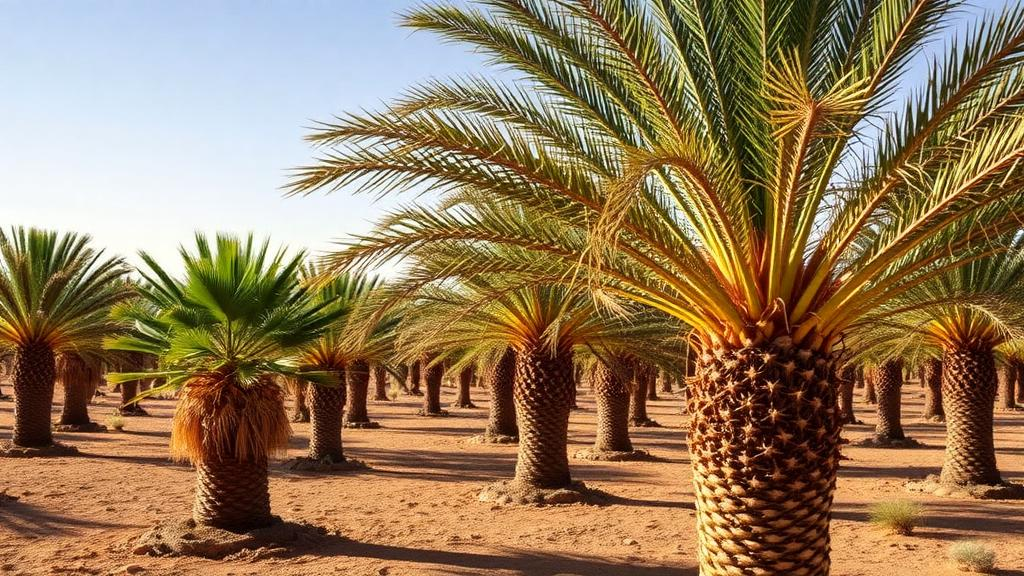
In the scorched orchards of Ahvaz, in Iran’s Khuzestan province, date palms endure some of the most punishing growing conditions on Earth. Summer temperatures routinely climb past levels that would wither most fruit crops, and growers have long accepted a hard bargain: the fruit that thrives in this furnace often pays a price in yield and quality. A new field study published in BMC Plant Biology suggests that the bargain may be negotiable. Researchers at Shahid Chamran University of Ahvaz report that an advanced nano-chelate fertilizer, delivered through deep banding and irrigation, lifted fruit yields of the Estemaran date cultivar by roughly 30 percent compared with unfertilized trees, while measurably improving fruit chemistry and the palms’ physiological resilience to heat.
The experiment, conducted during the 2023–2024 growing season, was designed as a completely randomized block study with three replications, a standard arrangement that helps researchers separate genuine treatment effects from the natural variability among trees. The team, led by Amir Ghorbani together with Mousa Mousavi and Esmaeil Khaleghi, compared four fertilization programs: an unfertilized control, the conventional fertilization method commonly used across Khuzestan province, and two regimes built around KHAZRA Advanced Nano-chelate fertilizer, one applied by deep banding with irrigation and another combining deep banding with foliar spraying. The choice of delivery method matters. Chelated nutrients are bound to organic carrier molecules that keep micronutrients soluble and available in alkaline soils, where iron, zinc, and manganese otherwise lock into insoluble forms that roots cannot absorb.
The results were striking in their consistency. Palms receiving the advanced chelate through deep banding and irrigation maintained the highest proportion of active green leaves relative to total leaves per tree, reaching 56.15 percent, a 27 percent increase over the control. That figure is more than a cosmetic improvement. In a palm, the canopy of healthy fronds is the photosynthetic engine that powers fruit filling, and heat stress typically accelerates leaf senescence, browning and killing fronds precisely when developing fruit demand the most carbohydrate. Keeping more leaves functionally green under extreme heat means the tree can sustain photosynthesis longer, translating directly into heavier, better-fed fruit clusters.
Yield told the same story. The deep-banding-plus-irrigation treatment produced the highest fruit yield at 56.1 kilograms per palm, a 30 percent gain over unfertilized trees. For a commercial date operation, where revenue scales with kilograms of marketable fruit per hectare, a difference of that magnitude across an entire orchard represents the margin between a marginal season and a profitable one. The authors note that fruit yield is the paramount objective in date production, and their data suggest that simply improving nutrient availability, rather than altering irrigation or planting density, can unlock a substantial share of the cultivar’s latent productivity even under the region’s characteristic heat stress.
Quality metrics moved in parallel with quantity. Antioxidant capacity in the fruit reached 1.39 millimoles of Fe(II) per 100 grams of fresh weight under the best treatment, a 7 percent increase over the control, indicating a denser concentration of the protective phenolic and related compounds that consumers and nutrition researchers prize in dates. Leaf morphology responded as well: the longest leaflets measured 30.67 centimeters, an 11 percent gain relative to the control, and the most favorable flesh-to-kernel ratio, 8.30, a 25 percent enhancement, was recorded under the conventional Khuzestan fertilization program. A higher flesh-to-kernel ratio means more edible pulp per fruit, a trait that packers and buyers scrutinize closely, since a fruit dominated by its woody seed commands a lower price.
Perhaps the most intriguing layer of the study sits at the molecular scale. The researchers tracked the expression of heat shock protein genes, the cellular emergency responders that fold and stabilize proteins when high temperatures would otherwise cause them to unravel. The pattern they observed was gene-specific and treatment-dependent. Trees receiving the second treatment showed the highest expression of PdHSP17.6 and PdHSP22, while the third treatment produced the strongest PdHSP26.5 expression. Intriguingly, the unfertilized palms mounted the strongest induction of PdHSP23.6, but this apparent molecular alarm came bundled with the highest levels of proline and malondialdehyde, and the lowest fruit yield of any group.
That combination is diagnostic. Proline accumulates in plant tissues as an osmoprotectant when cells are under stress, and malondialdehyde is a canonical marker of lipid peroxidation, the oxidative damage that membranes suffer when heat overwhelms their protective systems. In other words, the unfertilized trees were not thriving; they were struggling, burning molecular resources on stress signaling and damage repair instead of fruit production. The fertilized palms, by contrast, appeared to buffer heat stress through better nutrition, maintaining growth and yield while their stress-marker chemistry stayed comparatively restrained. Well-nourished plants simply have more physiological slack to absorb environmental punishment.
The findings arrive at a moment when heat stress is tightening its grip on agriculture far beyond Khuzestan. Date palms are famously adapted to arid zones, yet even this desert veteran has thresholds, and climate projections for the Middle East and North Africa point toward hotter, more erratic seasons. Breeding programs for heat-tolerant cultivars take decades. Nutritional interventions like the one tested here offer a faster lever, one that growers can pull within a single season using existing orchards. The study also carries a practical message about application technique: the deep-banding-plus-irrigation route outperformed the foliar-spray combination on the headline yield metric, suggesting that placing chelated nutrients into the root zone, where irrigation water can carry them steadily into the soil profile, beats relying on leaf surfaces that scorch under intense sun.
Cautions are warranted before declaring a universal solution. The study covers a single cultivar, Estemaran, in a single location over one growing season, and the published version remains subject to final editorial revisions. Fertilizer responses are notoriously context-dependent, shaped by soil chemistry, water quality, and the baseline fertility of an orchard. Still, the internal coherence of the data, spanning canopy health, yield, fruit chemistry, and gene expression, gives the results unusual weight. When four independent lines of evidence all point in the same direction, the underlying mechanism, improved nutrient availability buffering heat stress, becomes difficult to dismiss.
For the growers of Khuzestan, the takeaway is immediate and actionable. The authors conclude that cultivating Estemaran under Ahvaz’s typical heat-stress conditions while applying advanced chelate fertilization through deep banding and irrigation is likely to deliver fruit yields acceptable for commercial production. For the broader scientific community, the study adds a compelling data point to a growing literature on how targeted nutrition can modulate plant stress responses, down to the level of heat shock protein genes. As heat waves intensify across the world’s fruit belts, the humble date palm, fed a smarter diet, may be showing agriculture one way to keep producing under a warming sky.
Subject of Research: Effects of chelate fertilizer programs on date palm fruit yield and quality under heat stress
Article Title: Evaluation of the effect of chelate fertilizer application-based fertilization programs on improving the quantity and quality of date palm fruit of the Estemaran cultivar (Phoenix dactylifera L.) under natural heat stress conditions
Article References: Ghorbani, A., Mousavi, M., & Khaleghi, E. (2026). Evaluation of the effect of chelate fertilizer application-based fertilization programs on improving the quantity and quality of date palm fruit of the Estemaran cultivar (Phoenix dactylifera L.) under natural heat stress conditions. BMC Plant Biology. https://doi.org/10.1186/s12870-026-10036-4
Image Credits: AI Generated
DOI: 10.1186/s12870-026-10036-4
Keywords: date palm, chelated fertilizer, nano-chelate, heat stress, Phoenix dactylifera, fruit yield, fruit quality, antioxidant capacity, heat shock proteins, Khuzestan, fertilization, plant physiology
Cite Scienmag News
Alan Morgan. (October 2, 2026). Chelated Fertilizer Boosts Date Palm Yields Under Brutal Desert Heat. Scienmag. https://scienmag.com/chelated-fertilizer-boosts-date-palm-yields-under-brutal-desert-heat/
Alan Morgan. "Chelated Fertilizer Boosts Date Palm Yields Under Brutal Desert Heat." Scienmag, 2 October 2026, https://scienmag.com/chelated-fertilizer-boosts-date-palm-yields-under-brutal-desert-heat/. Accessed 2 October 2026.
Alan Morgan. "Chelated Fertilizer Boosts Date Palm Yields Under Brutal Desert Heat." Scienmag. October 2, 2026. https://scienmag.com/chelated-fertilizer-boosts-date-palm-yields-under-brutal-desert-heat/


