


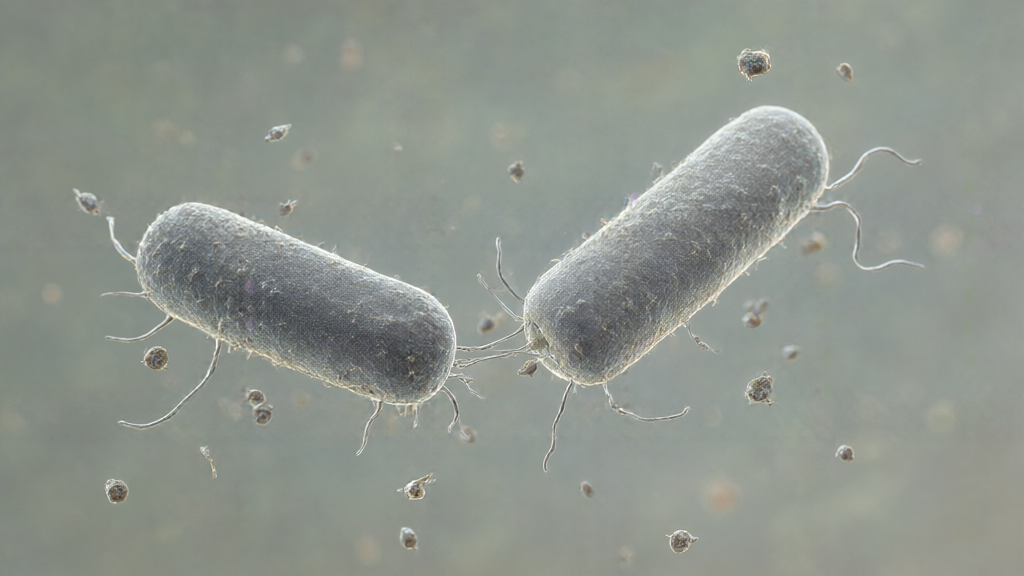
Researchers at the Institute of Science and Technology Austria (ISTA) have identified a mechanism in the gut bacterium Escherichia coli that resembles a primitive form of sexual reproduction. Published in the journal Molecular Biology and Evolution, the study demonstrates that under conditions of starvation stress, these bacteria utilize bacteriophages and the CRISPR-Cas immune system to transfer and incorporate genetic material. This process accelerates genetic reshuffling, potentially allowing bacterial populations to adapt more rapidly to changing environmental conditions.
Bacteria generally reproduce by asexual cell division, or binary fission, but horizontal gene transfer is already known to move genetic material between cells. The study by Pavel Payne and Professor Călin Guet examines a particular route in E. coli under starvation stress, involving bacteriophages and the CRISPR-Cas system. The researchers describe the resulting genetic exchange as sex-like; it does not replace binary fission as the mechanism of cell reproduction.
The study builds on the long-standing discovery of horizontal gene transfer, or HGT, which involves the movement of genetic material between organisms through means other than vertical inheritance from parent to daughter cell. This phenomenon was first described nearly a century ago with the discovery of natural competence, a state that allows some bacteria to actively take up free DNA from their environment. However, only a small minority of bacterial species possess this capability. In the 1940s, conjugation was identified as another form of HGT, where bacteria transfer genetic material, including antibiotic-resistance genes, through direct cell-to-cell contact using a structure called a sex pilus.
A third mechanism, transduction, was discovered a few years after conjugation and is central to the findings of the ISTA team. In this process, a bacteriophage, which is a virus that infects bacteria, can accidentally package fragments of bacterial DNA while replicating inside a host cell. This DNA is then transferred to another cell when the virus infects it. However, this natural form of transduction is generally inefficient for sustaining frequent DNA exchange because the majority of newly produced viruses carry their own genomes, which can wipe out susceptible bacterial populations. To survive, bacteria evolved defense systems like CRISPR-Cas, which target and neutralize phage genomes, providing protection against subsequent infections.
Payne, who completed his PhD at ISTA in 2016 and returned in 2025 as a postdoctoral researcher in the Guet group, previously found evidence that this bacterial immune system could lead to herd immunity. This means that the presence of immune bacteria in a population protects even those individuals that do not carry the immune system themselves. The remaining question for the research team was whether bacteria could leverage this herd immunity to reshuffle their DNA and how frequently this might occur. If such a mechanism existed, it would have significant implications for how bacteria adapt, survive, and evolve in dynamic environments.
The researchers demonstrated that by using anti-phage immunity as a primitive form of sexual reproduction, bacteria can adapt and evolve at a much faster rate. Genetic innovation through mutation alone is often slow, as beneficial mutations arise less frequently than harmful ones and appear in different individuals. DNA exchange allows these beneficial variants to be brought together, thereby accelerating adaptation. Payne noted that sex is widespread in nature for this reason, and the same mechanism may allow bacteria to purge deleterious mutations from their populations. By evolving immunity to phages, bacteria not only protect themselves but also enable frequent gene exchange, turning deadly predators into de facto pollinators that carry bacterial DNA between cells.
The study highlights that while the prevalence of this specific form of horizontal gene transfer remains quite low in bacterial populations, it occurs at a rate more than 100 times that of spontaneous mutations. This distinction is crucial for understanding bacterial evolution, as it suggests that this mechanism can make a substantial contribution to genetic variation. The researchers observed that bacteria reproduce asexually under favorable growth conditions, but the sex-like DNA transfer process becomes active when the bacteria are close to starvation. A specific gene linked to the starvation response was identified as a requirement for this mechanism, linking the process directly to the bacteria’s physiological state.
The implications of these findings extend to the broader understanding of bacterial evolution. From an evolutionary perspective, sexual reproduction is often advantageous under stressful conditions, and the study suggests that E. coli employs a comparable DNA reshuffling strategy during starvation. This process allows for a rapid response to environmental pressures, potentially enhancing the survival of the population. The use of CRISPR-Cas, a system that later became the basis for gene-editing technologies, in this context underscores the versatility of bacterial defense mechanisms. The researchers emphasize that this process is not merely a side effect of viral infection but a functional adaptation that facilitates genetic diversity.
The work provides a new perspective on the role of viruses in bacterial ecology. While bacteriophages are typically viewed as pathogens that kill their hosts, the study shows that they can also serve as vectors for genetic exchange in immune populations. This dual role highlights the complex interactions between bacteria and their viral predators. The findings suggest that the evolutionary dynamics of bacterial populations are more intricate than previously thought, with immune systems playing a key role in shaping genetic diversity. As researchers continue to explore these mechanisms, the potential applications in understanding antibiotic resistance and bacterial adaptation may become clearer.
In conclusion, the ISTA study reveals a sophisticated mechanism by which bacteria use their own immune systems to facilitate genetic exchange during times of stress. By leveraging bacteriophages as vectors for DNA transfer, E. coli can accelerate adaptation and evolution, clarifying how horizontal gene transfer can accompany asexual cell division. This discovery not only advances our understanding of bacterial biology but also highlights the importance of considering environmental conditions, such as starvation, in studying evolutionary processes. The research opens new avenues for investigating how similar mechanisms might operate in other bacterial species and under different environmental pressures.
Subject of Research: Biology
Article Title: Bacterial immunity—or a form of sex?
Article References: Bacterial immunity—or a form of sex?. (n.d.). Original publication
Image Credits: AI Generated
DOI: Not provided
Keywords: Bacteria, CRISPR-Cas, Horizontal Gene Transfer, Evolution, Bacteriophages, E. coli, Starvation Stress, Bacterial, immunity, form, scientific research
Cite Scienmag News
Juliet Wilcox. (October 2, 2026). ISTA Study Finds Bacteria Use Viruses for Sex-Like DNA Exchange During Starvation. Scienmag. https://scienmag.com/ista-study-finds-bacteria-use-viruses-for-sex-like-dna-exchange-during-starvation/
Juliet Wilcox. "ISTA Study Finds Bacteria Use Viruses for Sex-Like DNA Exchange During Starvation." Scienmag, 2 October 2026, https://scienmag.com/ista-study-finds-bacteria-use-viruses-for-sex-like-dna-exchange-during-starvation/. Accessed 2 October 2026.
Juliet Wilcox. "ISTA Study Finds Bacteria Use Viruses for Sex-Like DNA Exchange During Starvation." Scienmag. October 2, 2026. https://scienmag.com/ista-study-finds-bacteria-use-viruses-for-sex-like-dna-exchange-during-starvation/


