


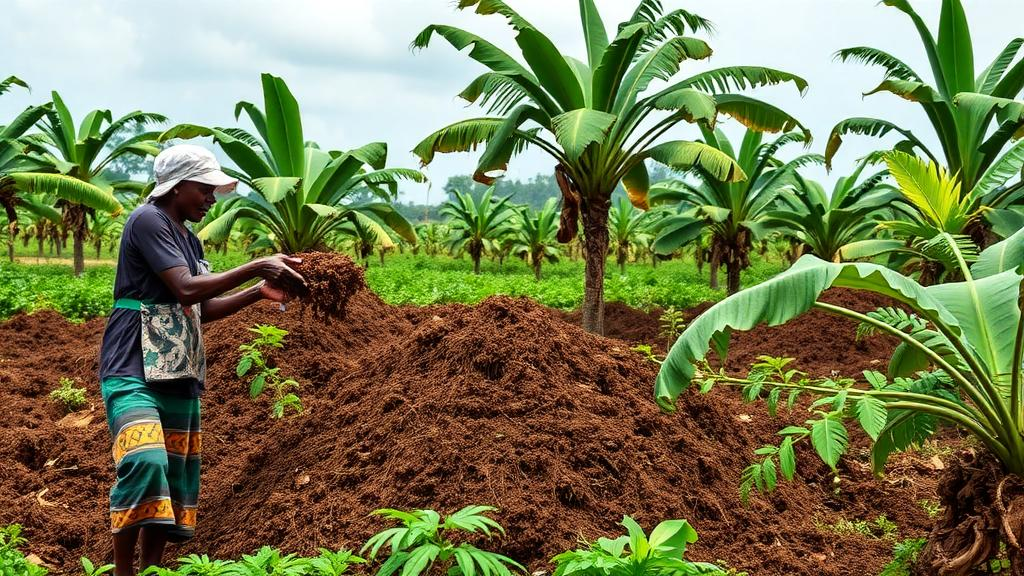
Ghana produces more cocoa than almost any nation on Earth, yet the smallholder farmers who grow the beans are watching their soils quietly die beneath their feet. A new survey of 150 cocoa farmers across five districts has revealed a striking paradox: the raw materials for cheap, effective organic fertilisers lie rotting on virtually every farm, and the farmers themselves are desperate for solutions, but almost none of them have ever heard that compost and biochar can be used on cocoa trees at all. The study, published in Discover Agriculture, found that not a single farmer surveyed had ever applied either amendment to their cocoa, and the reason was not scepticism, cost, or lack of interest. It was simply awareness.
The scale of Ghana’s cocoa economy makes the findings significant far beyond the farm gate. Around 71 percent of the world’s cocoa is grown in West Africa, with Ghana the second largest producer after Côte d’Ivoire. An estimated 800,000 Ghanaian farmers cultivate cocoa on plots typically smaller than five hectares, and the crop contributes roughly 22 percent of the country’s agricultural GDP, employs about 45 percent of the population, and accounts for nearly half of all export earnings. Yet productivity per hectare has barely improved over the past decade. Historic gains in national output have come mostly from clearing more land, not from growing more beans per hectare, a pattern repeated across the region.
The technical picture behind stagnant yields is well understood. Continuous cropping has depleted soil organic matter, and yields between individual farms vary enormously, from roughly 100 to more than 1,000 kilograms per hectare, with agronomic management a major determinant of the gap. Surveys of soils in Ghana’s cocoa districts reveal low organic matter and low pH, consistent with a boom-bust cycle in which cultivation mines the soil of nutrients. Chemical fertilisers, the default remedy, bring problems of their own: they acidify soils, reducing the availability and uptake of nutrients, they can pollute surface waters, and their price puts the quantities farmers actually need beyond their reach. Most of the surveyed farmers relied on subsidised fertiliser from the Ghana Cocoa Board, but complained that supplies were inadequate and arrived late.
Organic amendments offer a technically elegant alternative. Compost supplies plant nutrients, rebuilds soil organic matter, improves structure, boosts microbial activity, and can even suppress nematode pests in cocoa farms. Biochar, produced by burning organic material in the absence of oxygen through pyrolysis, is a highly recalcitrant form of carbon that improves soil structure, increases water-holding capacity, and alleviates the soil acidity that chemical fertilisers worsen. Crucially, both can be made from cocoa pod husks, the fibrous shells left behind after the beans are extracted, which pile up on farms as waste. The husks are rich in phosphorus and potassium, and studies in Nigeria have shown that pod-husk fertiliser can lower costs and raise revenues on cocoa farms. Composting the husks has also been shown to suppress the Phytophthora pathogen responsible for black pod disease.
To find out why farmers were not exploiting this resource, researchers from Kwame Nkrumah University of Science and Technology, the Cocoa Research Institute of Ghana, and the University of Reading surveyed 150 farmers randomly drawn from a population of 245 across five cocoa districts representing four soil types and all five major agroecological cocoa regions of Ghana. The districts, Aiyinase, Assin Foso, Dadiesoaba, Kade, and Nyarkrom, were selected using a soil map to ensure that Ferralsols, Lixisols, Nitosols, and Acrisols were all represented, since amendments may perform differently on different soils. A follow-up focus group of eight experienced farmers and cooperative leaders helped interpret the survey answers. The team is careful to note that participants were all already working with Cocoa Extension Agents, so the results describe engaged farmers rather than the most isolated growers.
The demographic profile that emerged is one of experienced but ageing farmers under real economic pressure. Respondents averaged 51 years old, with 16 years of cocoa experience on average, and three quarters had additional income sources, mostly petty trading, because cocoa alone could not sustain their households. One farmer told the focus group bluntly that the money from cocoa was inadequate for his family to survive a year. About 67 percent of farmers reported that soil fertility had declined over the years, and 92 percent said they could identify poor soil by signs such as unhealthy leaves, wilted pods, small beans, and falling yields. Yet when asked about organic amendments, only 6 percent had ever used any, and those cases turned out to be poultry manure, not compost or biochar.
The awareness gap was stark and, in places, almost comic. Nearly half the farmers had heard of compost, but overwhelmingly as a technique for growing vegetables, not cocoa, a legacy of alternative-livelihood training programmes run by COCOBOD and NGOs. Only 12.7 percent of those aware of compost knew how to make it. Biochar fared far worse: 97.4 percent had never heard of it, and none had any knowledge of how to prepare it. What makes the result remarkable is what happened when the concept was explained. Ninety-six percent of farmers unfamiliar with compost said they were willing to learn to make it, and 76 percent were willing to buy it, quoting an average price of 26.33 Ghana Cedis for a 25-kilogram bag. For biochar, 96 percent were willing to learn and 77 percent willing to buy. As one farmer put it, there is no market in Ghana where organic fertiliser can be purchased at all, even though national demand is estimated at 0.7 million tonnes per year and could rise to 2.7 million tonnes.
The study also uncovered a dangerous misconception. Farmers feared that spreading cocoa pod husks on their fields would spread disease, a worry echoed by official guidance from the Cocoa Research Institute of Ghana that discouraged using the husks as compost. The scientific literature says the opposite: composting the husks suppresses Phytophthora and reduces black pod incidence. Farmers ranked the bulkiness of organic fertiliser, the labour needed to apply it, and transport costs as their biggest obstacles, constraints that fall hardest on older farmers and on women and migrants with less secure access to family labour. The researchers also caution that biochar is not a universal fix, since it works best on acidic, infertile soils and can depress growth on neutral soils, meaning soil testing should precede any application.
The path forward, the authors argue, already exists in Ghana’s institutional landscape. Nearly 95 percent of surveyed farmers belonged to cooperatives, 93 percent received regular visits from extension agents, and a COCOBOD pruning initiative achieved adoption rates near 99 percent when machines were supplied through cooperatives. Embedding compost and biochar training in the same channels, alongside certification schemes such as Rainforest Alliance and Fairtrade and licensed buying companies, could replicate that success. With more than three quarters of farmers ready to buy amendments that nobody currently sells, the researchers see a clear opening for entrepreneurs to produce and distribute compost and biochar as a service, potentially supported by COCOBOD subsidies and the government’s One District One Factory policy. The raw material is free, the demand is proven, and the only thing missing, it turns out, is the message.
Subject of Research: Awareness and adoption of compost and biochar soil amendments among Ghanaian cocoa farmers
Article Title: Limited awareness prevents the use of compost and biochar as soil amendments by Ghanaian cocoa farmers
Article References: Awunyo-Vitor, D., Daymond, A., Quaye, A., Awudzi, G. K., Atuah, L., Mwafulirwa, L., Hammond, J., Turnbull, C., Lahive, F., Coole, S., Robinson, S., Hadley, P., & Sizmur, T. (2026). Limited awareness prevents the use of compost and biochar as soil amendments by Ghanaian cocoa farmers. Discover Agriculture, 4(1), Article 273. https://doi.org/10.1007/s44279-026-00754-6
Image Credits: AI Generated
DOI: 10.1007/s44279-026-00754-6
Keywords: cocoa farming, Ghana, compost, biochar, soil amendments, soil fertility, cocoa pod husks, smallholder farmers, agricultural extension, pyrolysis, sustainable agriculture, COCOBOD
Cite Scienmag News
Alan Morgan. (October 2, 2026). Ghanaian cocoa farmers shun compost and biochar simply because nobody told them. Scienmag. https://scienmag.com/ghanaian-cocoa-farmers-shun-compost-and-biochar-simply-because-nobody-told-them/
Alan Morgan. "Ghanaian cocoa farmers shun compost and biochar simply because nobody told them." Scienmag, 2 October 2026, https://scienmag.com/ghanaian-cocoa-farmers-shun-compost-and-biochar-simply-because-nobody-told-them/. Accessed 2 October 2026.
Alan Morgan. "Ghanaian cocoa farmers shun compost and biochar simply because nobody told them." Scienmag. October 2, 2026. https://scienmag.com/ghanaian-cocoa-farmers-shun-compost-and-biochar-simply-because-nobody-told-them/


