


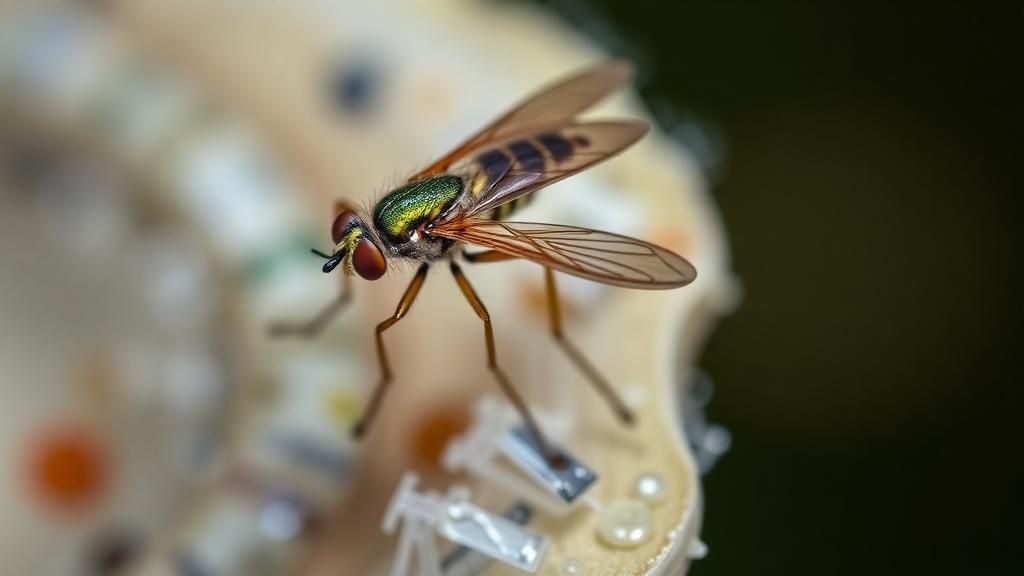
A widespread survey of wild sand flies in Northern Italy has revealed that nearly four in ten of these disease-carrying insects carry Wolbachia, a bacterial endosymbiont famous for its ability to manipulate the reproduction of its insect hosts. The finding, published in the journal Parasites & Vectors, marks the first multi-locus sequence typing characterization of Wolbachia in Phlebotomus perniciosus, the principal sand fly vector of leishmaniasis and other pathogens in the Mediterranean region. Because Wolbachia can interfere with the capacity of insects to transmit viruses, parasites, and other microbes, documenting its natural occurrence in sand fly populations is a critical first step toward evaluating whether it could be harnessed as a biological control tool against sand fly-borne diseases.
Sand flies are small, hairy flies of the subfamily Phlebotominae whose blood-feeding females transmit a range of pathogens, most notably Leishmania parasites, as well as phleboviruses such as those causing sand fly fever. More than one billion people live in areas where they are exposed to sand fly-borne infections, and with no effective human vaccines available for most of these diseases, vector control remains the principal line of defense. Traditional measures such as insecticide spraying face growing challenges from resistance and environmental concerns, prompting researchers to explore alternative strategies. Among the most promising of these is the use of Wolbachia, an intracellular bacterium that infects an enormous range of arthropods and can be deployed to suppress mosquito populations or reduce their ability to transmit pathogens such as dengue and Zika viruses.
Despite the success of Wolbachia-based approaches in mosquitoes, surprisingly little is known about the bacterium’s natural presence in sand flies. This gap in knowledge motivated a team of researchers at the Istituto Zooprofilattico Sperimentale della Lombardia e dell’Emilia-Romagna in Brescia, led by Maya Carrera and colleagues, to undertake a systematic survey of Wolbachia infections in wild-caught sand flies across Northern Italy. The study, conducted between 2023 and 2025, set out to determine not only how common the bacterium is in these populations but also which genetic types of Wolbachia are circulating, information that is essential for judging whether the endosymbiont is already interacting with local vector populations in ways that could be exploited.
The fieldwork covered 24 collection sites distributed across Northern Italy, a region where sand fly activity is seasonal and where Phlebotomus perniciosus dominates the vector community. The researchers deployed two complementary trapping methods: CO2-baited traps, which mimic the breath of vertebrate hosts and attract host-seeking females, and CDC light traps, a standard tool for sampling nocturnal flying insects. Captured specimens were pooled according to sex, collection site, and date, a pooling strategy that balances the practical constraints of molecular screening with the need to estimate infection prevalence across a large sample. Male sand flies, which can be identified by examining morphological features of their genitalia and other structures, were identified to species under the microscope, while females, which are harder to distinguish morphologically, were screened directly for Wolbachia DNA using polymerase chain reaction, or PCR.
The scale of the sampling effort was considerable. In total, 1,158 male sand flies were morphologically identified, revealing seven species in the region. Phlebotomus perniciosus was by far the most abundant, accounting for 751 specimens, followed by P. perfiliewi, P. neglectus, P. ariasi, Sergentomyia minuta, P. mascittii, and P. papatasi. For the molecular screening, 1,937 sand flies were divided into 124 pools, including 10 male pools that could not be assigned to a species morphologically. When these pools were tested for Wolbachia, the results were striking: the overall prevalence of infection was 38.7 percent, a remarkably high figure for a vector group in which Wolbachia had been considered rare or poorly documented.
Prevalence was not static across the study period. In 2023, 44.9 percent of the screened pools tested positive for the bacterium. The following year, the figure dropped to 21.3 percent, less than half the initial rate, before rebounding sharply to 57.1 percent in 2025. This year-to-year variation suggests that Wolbachia infection dynamics in sand fly populations are influenced by fluctuating ecological conditions, whether climatic, related to host population structure, or driven by other factors that the study was not designed to disentangle. Understanding what drives these swings will be important for any future attempt to model or manipulate the bacterium’s spread through wild populations.
To characterize the Wolbachia strains genetically, the team amplified five housekeeping genes used in the standard multi-locus sequence typing scheme for the bacterium: coxA, fbpA, ftsZ, gatB, and hcpA. Because Wolbachia is classified into supergroups based on such sequence data, this approach allows precise assignment of strains to evolutionary lineages. In addition, the researchers amplified the cytochrome oxidase I gene, or COI, a widely used DNA barcoding marker, to confirm the identity of the host sand flies, and for four samples they also sequenced a partial fragment of the wsp gene, which encodes a Wolbachia surface protein. Samples for which all target genes were successfully amplified were then subjected to nanopore sequencing, a long-read technology that enables rapid and relatively inexpensive generation of sequence data.
The genetic results were unambiguous and, in one respect, quite unexpected. Complete MLST profiles were obtained for 11 samples, and every one of them belonged to Wolbachia Supergroup B, one of the major divisions of the bacterium. COI barcoding confirmed that all 11 infected hosts were Phlebotomus perniciosus. More remarkable still, all 11 sequenced Wolbachia shared an identical sequence type, despite having been collected across different years and from different habitats within the study region. This genetic uniformity points to a single, well-established strain circulating in P. perniciosus populations across Northern Italy, rather than a diverse community of unrelated infections. When the researchers compared this profile against public sequence databases, they found no exact match; the closest known profile came from the confused flour beetle, Tribolium confusum, hinting at possible evolutionary links between the sand fly strain and Wolbachia found in other insect hosts.
The significance of these findings extends beyond basic microbiology. Wolbachia’s appeal as a control agent rests on two well-documented phenomena. The first is cytoplasmic incompatibility, a reproductive manipulation in which males carrying certain Wolbachia strains can only successfully breed with females carrying the same or a compatible strain, a mechanism that can be exploited to suppress populations or to drive desirable traits through a population. The second is the ability of some strains to reduce vector competence, meaning the infected insect becomes less able to support and transmit pathogens. Both mechanisms have been deployed successfully against Aedes mosquitoes in programs targeting dengue. Whether the Supergroup B strain found in P. perniciosus exhibits similar properties is not yet known, but the new study provides the essential baseline: researchers now know which strain is present, how common it is, and that it persists stably across years and habitats.
The authors emphasize that this work is a foundation rather than a conclusion. Future studies will need to examine the effects of the identified Wolbachia strain on sand fly reproduction, survival, and, crucially, vector competence for Leishmania parasites and phleboviruses. The demonstration that a single, genetically uniform strain infects a large fraction of the most important sand fly vector in Northern Italy raises the possibility that natural Wolbachia infections could already be influencing transmission dynamics in the region, or that they could be augmented through release strategies similar to those used against mosquitoes. As climate change and land-use shifts continue to expand the range of sand flies and the diseases they carry, tools that can complement or replace chemical insecticides will only grow in importance. This survey of Italian sand flies offers a detailed genetic portrait of a candidate ally hiding within the insects themselves, and it opens a concrete path toward testing whether that ally can be turned against the pathogens the flies transmit.
Subject of Research: Wolbachia endosymbiont infections in wild sand fly populations in Northern Italy
Article Title: Phylogenetic insights into Wolbachia natural infections in sand flies of Northern Italy
Article References: Carrera, M., Bertasio, C., Carta, V., Marelli, A., Muratore, R., Tolini, C., Lelli, D., Sozzi, E., Moreno, A., & Defilippo, F. (2026). Phylogenetic insights into Wolbachia natural infections in sand flies of Northern Italy. Parasites & Vectors. https://doi.org/10.1186/s13071-026-07578-9
Image Credits: AI Generated
DOI: 10.1186/s13071-026-07578-9
Keywords: Wolbachia, sand flies, Phlebotomus perniciosus, leishmaniasis, vector control, MLST, nanopore sequencing, Italy, endosymbiont, biological control, Parasites & Vectors, entomology
Cite Scienmag News
Morgan Morrow. (October 2, 2026). Common Bacterium Found Widespread in Italian Sand Flies Could Aid Disease Control. Scienmag. https://scienmag.com/common-bacterium-found-widespread-in-italian-sand-flies-could-aid-disease-control/
Morgan Morrow. "Common Bacterium Found Widespread in Italian Sand Flies Could Aid Disease Control." Scienmag, 2 October 2026, https://scienmag.com/common-bacterium-found-widespread-in-italian-sand-flies-could-aid-disease-control/. Accessed 2 October 2026.
Morgan Morrow. "Common Bacterium Found Widespread in Italian Sand Flies Could Aid Disease Control." Scienmag. October 2, 2026. https://scienmag.com/common-bacterium-found-widespread-in-italian-sand-flies-could-aid-disease-control/


