


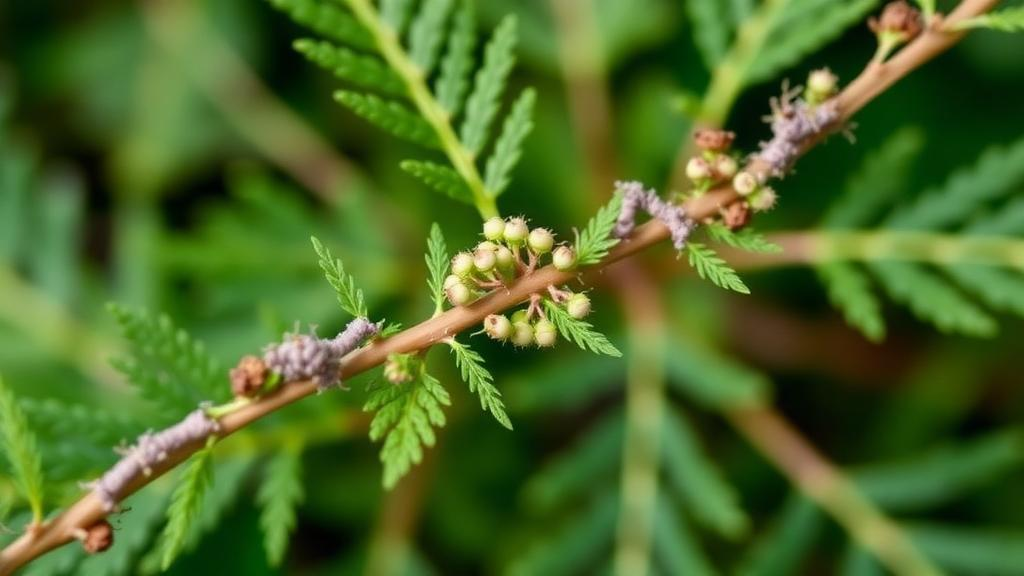
In a quiet greenhouse in Shijiazhuang, China, five elm cultivars that look almost indistinguishable to the trained eye have now given up one of their most intimate secrets: the complete sequence of their chloroplast genomes. A research team at Hebei Agricultural University and the Hebei Academy of Forestry and Grassland Sciences has assembled and compared the full plastid DNA of five Ulmus pumila cultivars—’Yangguang Nanhai,’ ‘Yangguang Nühai,’ ‘Xu Ri,’ ‘Yang Gang,’ and ‘Chao Yang’—and, in doing so, has opened a new molecular window onto one of the most commercially valuable but taxonomically slippery trees in the Northern Hemisphere. The study, published in Ecology and Evolution, is the first to report complete chloroplast genomes for these five cultivars and offers a practical toolkit for telling them apart when leaves, bark, and crowns simply will not cooperate.
Siberian elm, Ulmus pumila, is a botanical workhorse. It tolerates cold, drought, and salt-alkali soils that would kill most other trees, which makes it a prime candidate for ecological restoration in arid and degraded landscapes. Its wood is hard, fine-grained, and wear-resistant, prized for furniture and construction, while its bark and leaves contain flavonoids and other compounds with documented medicinal and industrial potential—the phloem even functions as a natural plant adhesive. Because the species is so useful, breeders have generated a wealth of cultivars selected from seedling progenies, each with subtle differences in crown shape, branch angle, leaf texture, and bark color. The problem is that these morphological differences are so subtle that traditional identification is prone to confusion, and the standard universal DNA barcodes lack the resolution to separate cultivated varieties that share such a recent common origin.
Chloroplast genomes have long been the molecular detective’s favorite tool in plant science. Unlike the nuclear genome, plastid DNA is typically inherited from only one parent—in elms, the mother—mutates at a moderate rate, and exists in a highly conserved structural framework that makes sequencing and comparison straightforward. Most land plant chloroplast genomes adopt a quadripartite architecture: a large single-copy region, a small single-copy region, and a pair of inverted repeats that mirror each other and bracket the single-copy sections. This architecture is so stable across species that deviations from it often signal meaningful evolutionary events. For the five elm cultivars, the team used a dual-sequencing strategy, combining short Illumina reads with long PacBio Sequel II reads, assembling the genomes with GetOrganelle, and verifying long-read alignments with BLASR before annotating genes with GeSeq.
The results revealed genomes that are both reassuringly familiar and quietly surprising. Total lengths ranged from 159,391 base pairs in ‘Yangguang Nühai’ to 159,769 base pairs in ‘Yangguang Nanhai,’ with guanine-cytosine content hovering between 35.47 and 35.56 percent—figures squarely within the norm for flowering plants. Each genome contained the expected LSC region of roughly 88,000 base pairs, an SSC region of about 18,800 base pairs, and inverted repeats of approximately 26,300 base pairs. But here came the twist: the number of annotated genes differed among cultivars, ranging from 131 to 133. The culprit was not some dramatic genomic upheaval but the pseudogenization or partial deletion of a single transfer RNA gene in the large single-copy region—a known form of intraspecific structural polymorphism in plant plastomes, yet one that had never been documented at this fine a scale within Ulmus pumila.
Beyond gene counts, the team cataloged an arsenal of repetitive elements that could serve as genetic fingerprints. Between 154 and 164 simple sequence repeats—short tandem motifs of DNA—were identified across the six cultivars analyzed, including a reference cultivar named ‘Jinmi’ retrieved from public databases. Mononucleotide repeats dominated overwhelmingly, with adenine and thymine bases showing a clear preference, and the number of repeats declined steadily as the repeat unit length increased. Some repeats were strikingly cultivar-specific: the pentanucleotide motif TTATT appeared only in ‘Yangguang Nühai’ and ‘Xu Ri,’ while the hexanucleotide TGGTAG was confined to the same two cultivars. Long repeats of thirty base pairs or more, detected with the REPuter software, ranged from 96 to 135 per cultivar within U. pumila, with forward and palindromic repeats predominating—sequences known to drive genome rearrangement and nucleotide variation over evolutionary time.
Comparative analysis across twenty-two Ulmus chloroplast genomes, visualized with mVISTA, confirmed that the genus maintains a deeply conserved overall structure, with the four ribosomal RNA genes showing near-perfect conservation. Variable sites clustered in the single-copy regions, and non-coding stretches proved far more variable than coding sequences. Nucleotide diversity analysis with DnaSP quantified this pattern: within U. pumila cultivars, overall diversity values stayed below 0.01, reflecting their shared maternal origin, yet several intergenic spacers—most notably trnH-GUG_psbA and ndhF_rpl32—showed polymorphism levels exceeding those of the universal DNA barcodes that have long frustrated elm taxonomists. At the interspecific level, diversity climbed as high as 0.05, with hotspots concentrated in the LSC and SSC regions while the inverted repeats remained quiet. The ycf1 gene, straddling the IR-SSC boundary with a diversity value of 0.035, emerged as a particularly promising core barcode for distinguishing elm species and cultivars at low taxonomic levels.
The boundary regions between the single-copy sections and the inverted repeats told their own evolutionary story. Across the broader Ulmaceae family, whose chloroplast genomes range from 157,356 base pairs in Trema levigatum to 160,388 in Ulmus lamellosa, genes such as rps19, rpl2, ycf1, and ndhF sit at different distances from the junctions, reflecting ancient expansion and contraction events that reshaped plastid architecture over millions of years. Within the five U. pumila cultivars, however, boundary shifts were confined to fluctuations of less than fifty base pairs—evidence of intraspecific genetic polymorphism rather than major evolutionary restructuring. These subtle variations, the authors note, carry limited evolutionary weight but can still function as auxiliary molecular features for cultivar differentiation.
Codon usage analysis added another layer of conservation to the picture. Across all twenty-two Ulmus taxa examined, leucine codons were used most frequently and cysteine codons least often, with methionine and tryptophan locked into single synonymous options. Preferential codons—those with relative synonymous codon usage values above 1.00—overwhelmingly ended in adenine or uracil, a hallmark of land plant plastid genomes. Effective number of codons values fell in the medium-high range, indicating weak overall codon bias, which the researchers interpret as evidence of strong purifying selection shaping these genomes. That interpretation was reinforced by substitution rate analysis: every shared protein-coding gene showed a ratio of non-synonymous to synonymous substitutions below 1, with values concentrated between 0 and 0.05, confirming that elm plastid genes are under intense selective constraint and evolve slowly enough to serve as reliable phylogenetic markers.
Phylogenetic trees built from complete chloroplast genomes of twenty-eight Ulmaceae species, using both maximum likelihood and Bayesian methods, produced strikingly concordant topologies. Ulmus emerged as a monophyletic group divided into three main clades, with Ulmus elongata occupying a basal, early-diverging position. The five cultivars clustered tightly together within the U. pumila clade, clearly separated from other elm species and only subtly differentiated from wild accessions—a pattern consistent with their shared maternal genetic background and their derivation from seedling selections of the same species. Collinearity analysis showed dense homologous gene connections across genomes, with only a few local rearrangements attributable to inversions or microdeletions, underscoring the structural stability of the elm plastome.
The practical implications extend well beyond evolutionary curiosity. Because chloroplast DNA is maternally inherited, the hypervariable markers identified here can trace maternal lineages and verify germplasm purity, but they cannot detect nuclear hybridization or introgression—events that are common in elm breeding programs. The authors therefore recommend pairing these plastid markers with nuclear tools such as genomic SSRs or SNPs for comprehensive cultivar authentication. Even with that caveat, the study delivers something elm science has lacked: cultivar-level molecular markers that work regardless of the tree’s growth stage, independent of the subjective judgment of crown shape or bark texture. For a species destined to anchor ecological restoration projects across arid and saline-alkali landscapes, and for breeders racing to develop stress-tolerant varieties, the ability to fingerprint germplasm with a handful of hypervariable chloroplast regions transforms both cultivar protection and molecular-assisted breeding. Five nearly identical trees, it turns out, were hiding five distinguishable genomic stories all along.
Subject of Research: Comparative chloroplast genomics and germplasm authentication of five Ulmus pumila cultivars
Article Title: Complete Chloroplast Genomes of Five Ulmus pumila Cultivars: Comparative Analysis, Evolutionary Dynamics, and Germplasm Authentication Implications
Article References: Wang, N., Yu, A., Ye, X., Zhang, L., Feng, S., Jiang, Z., Liu, C., Li, Y., & Huang, Y. (2026). Complete Chloroplast Genomes of Five Ulmus pumila Cultivars: Comparative Analysis, Evolutionary Dynamics, and Germplasm Authentication Implications. Ecology and Evolution, 16(10), Article e74352. https://doi.org/10.1002/ece3.74352
Image Credits: AI Generated
DOI: 10.1002/ece3.74352
Keywords: chloroplast genome, Ulmus pumila, Siberian elm, cultivar authentication, DNA barcoding, simple sequence repeats, nucleotide diversity, phylogenetics, purifying selection, inverted repeats, germplasm, molecular markers
Cite Scienmag News
Juliet Wilcox. (October 2, 2026). Elm Cultivar Genomes Decoded: Chloroplast DNA Reveals Hidden Fingerprints for Authentication. Scienmag. https://scienmag.com/elm-cultivar-genomes-decoded-chloroplast-dna-reveals-hidden-fingerprints-for-authentication/
Juliet Wilcox. "Elm Cultivar Genomes Decoded: Chloroplast DNA Reveals Hidden Fingerprints for Authentication." Scienmag, 2 October 2026, https://scienmag.com/elm-cultivar-genomes-decoded-chloroplast-dna-reveals-hidden-fingerprints-for-authentication/. Accessed 4 October 2026.
Juliet Wilcox. "Elm Cultivar Genomes Decoded: Chloroplast DNA Reveals Hidden Fingerprints for Authentication." Scienmag. October 2, 2026. https://scienmag.com/elm-cultivar-genomes-decoded-chloroplast-dna-reveals-hidden-fingerprints-for-authentication/


