


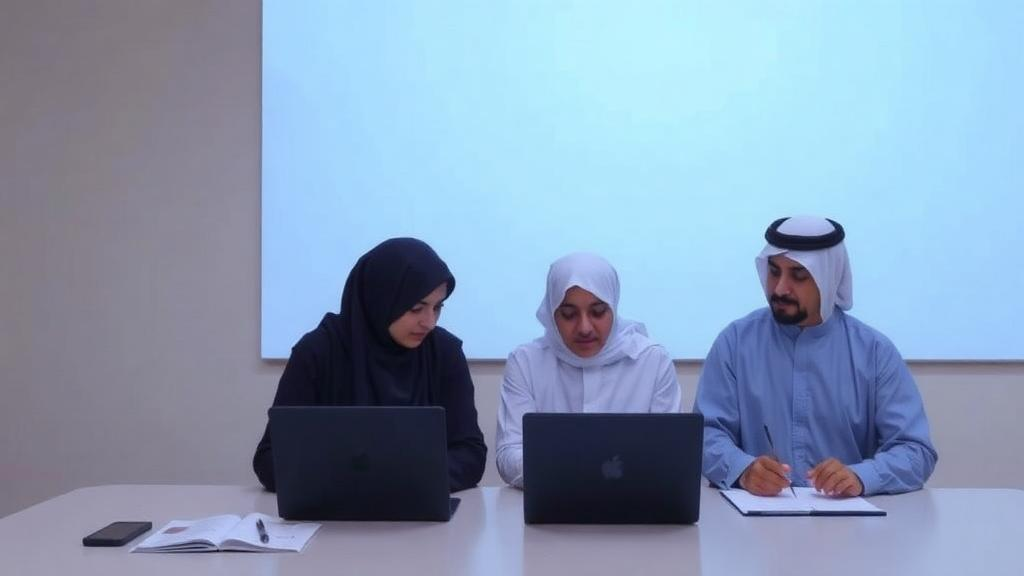
Generative artificial intelligence has swept through universities worldwide with remarkable speed, but one of the most important questions has remained surprisingly unanswered: how do the people who will actually teach the next generation use these tools, and do they understand the ethical minefield that comes with them? A new comparative study of student teachers at Sana’a University in Yemen and Qatar University offers one of the first rigorous answers, and its findings challenge some widely held assumptions about the so-called global digital divide.
The research, published in the journal Discover Education, surveyed 388 student teachers enrolled in the faculties of education at the two universities during the 2025/2026 academic year. The team, led by Aisha Fadl Al-Kaabi of Qatar University and Yahya Abdulrazaq Qutran of Sana’a University, used a descriptive, analytical and comparative design, combining a 41-item questionnaire measuring usage and ethical awareness with a 24-item attitude scale, all administered electronically through Google Forms. The instruments were validated by a panel of eleven experts and showed strong internal consistency, with Cronbach’s alpha coefficients ranging from 0.85 to 0.91 across the three measured dimensions.
The choice of settings was deliberate. Yemen and Qatar represent starkly different educational and economic environments: Qatar has made digital learning and artificial intelligence integration central pillars of its national development strategy, while Yemen continues to grapple with economic instability, limited internet connectivity and scarce formal AI education. If the digital divide shapes how future teachers engage with generative AI, it should have shown up clearly in this comparison. Instead, the results were strikingly even.
ChatGPT emerged as the undisputed tool of choice in both countries. At Qatar University, 93.15 percent of surveyed student teachers reported using it, while at Sana’a University the figure was 73.02 percent. Other applications such as Gemini, Microsoft Copilot, DeepSeek and Meta AI trailed far behind. The researchers attribute ChatGPT’s dominance to its early launch in late 2022, its user-friendly interface and its broad free accessibility, factors that appear to have levelled the playing field between students in a wealthy Gulf state and those in one of the world’s most economically challenged environments.
Statistically, the two groups were nearly indistinguishable. Qatar University students scored slightly higher on usage (a mean of 3.53 versus 3.48 on a five-point scale) and on ethical awareness (3.99 versus 3.88), but independent samples t-tests found neither difference statistically significant. Even more counterintuitively, Sana’a University students edged out their Qatari peers on attitudes toward generative AI, with means of 3.52 and 3.49 respectively, a difference that was also not significant. The effect sizes, ranging from Cohen’s d of 0.05 to 0.19, were negligible to small. The authors suggest that the ubiquity and accessibility of these tools may have decoupled AI adoption from local infrastructure and wealth, at least at the level of perception and self-reported use.
Beneath the headline parity, however, the study revealed telling differences in how the two groups actually deployed the technology. Sana’a University students most commonly used generative AI to explain and simplify difficult topics, while their Qatari counterparts favoured summarizing long texts. Both groups ranked searching for highly relevant information among their top applications. The ethical priorities also diverged in revealing ways. Students at both universities placed the highest importance on considering sustainability when using AI to prevent harm to the environment and society, but Sana’a students next prioritized avoiding biased or inaccurate content, whereas Qatari students emphasized avoiding plagiarism, reflecting global concerns about academic integrity and institutional policy.
The correlational analysis produced perhaps the study’s most thought-provoking finding. Usage and ethical awareness showed a statistically significant but weak positive correlation (r = 0.16, p < 0.001), and usage and attitudes were similarly weakly linked (r = 0.24, p < 0.001). Most strikingly, ethical awareness and attitudes were essentially unrelated (r = 0.07, p = 0.160), failing to reach statistical significance. In plain terms, enthusiasm for generative AI does not translate into ethical vigilance. The authors interpret this statistical decoupling as evidence that positive attitudes, driven largely by perceived utility, develop independently from ethical concerns, and they point to a persistent gap between theoretical awareness of ethical principles and their practical application, compounded by insufficient training and the absence of clear institutional guidelines.
Demographic variables told their own story. Gender produced no statistically significant differences in any of the three domains, a result the researchers link to the narrowing of the gender digital gap in academic contexts, since generative AI tools are now equally accessible to all students and ethical issues are addressed uniformly in curricula. Academic specialization, however, mattered in one crucial respect: students in scientific disciplines held significantly more positive attitudes toward generative AI than those in literary fields (means of 3.62 versus 3.42, t = 3.32, p = 0.01, Cohen’s d = 0.34), a small-to-moderate effect the authors attribute to the more immediate perceived relevance of AI to science careers. No specialization differences emerged in usage or ethical awareness.
The study is candid about its limitations. The sample was heavily imbalanced, with 315 participants from Sana’a University and only 73 from Qatar University, a disparity that weakens statistical power and raises the possibility of Type II errors, meaning real differences between the institutions could have gone undetected. The gender distribution, 338 females to 50 males, mirrors the actual population but similarly constrains gender-based comparisons. The cross-sectional, correlational design rules out causal inference, and the reliance on self-reporting introduces the risk of response bias, particularly in the ethical awareness domain, where participants may have overstated their adherence to responsible-use principles. The authors also note that multiple statistical tests were performed without formal alpha adjustments such as the Bonferroni correction, so significant findings, including the specialization effect, warrant cautious interpretation.
Despite these caveats, the implications are clear and urgent. The researchers recommend that both colleges of education adopt comprehensive institutional frameworks for integrating generative AI, including explicit academic integrity rules, human-centred guidelines emphasizing fairness, transparency and data privacy, and structured training programs to bridge the gap between theoretical knowledge and practice. They call for targeted support to boost positive attitudes among humanities students, a fundamental review of curricula and assessment methods away from traditional written tasks toward critical thinking and problem-solving, and future research using qualitative methods, longitudinal designs and balanced samples to probe why ethical awareness and enthusiasm for AI travel on such separate tracks. As generative AI becomes embedded in classrooms worldwide, this study suggests that the technology itself may be the great equalizer, but the ethical and pedagogical scaffolding around it remains the decisive variable.
Subject of Research: Generative AI use, ethics, and attitudes among student teachers in Yemen and Qatar
Article Title: The relationship between the uses of generative artificial intelligence and ethics and attitudes among student teachers in the faculties of education at Sana’a and Qatar Universities
Article References: Al-Kaabi, A. F., & Qutran, Y. A. (2026). The relationship between the uses of generative artificial intelligence and ethics and attitudes among student teachers in the faculties of education at Sana’a and Qatar Universities. Discover Education, 5(1), Article 1078. https://doi.org/10.1007/s44217-026-02204-3
Image Credits: AI Generated
DOI: 10.1007/s44217-026-02204-3
Keywords: generative artificial intelligence, ChatGPT, student teachers, teacher education, AI ethics, Sana'a University, Qatar University, higher education, digital divide, academic integrity, attitudes toward AI, comparative study
Cite Scienmag News
Courtney Benton. (October 2, 2026). Student Teachers in Yemen and Qatar Use AI Equally, Study Finds. Scienmag. https://scienmag.com/student-teachers-in-yemen-and-qatar-use-ai-equally-study-finds/
Courtney Benton. "Student Teachers in Yemen and Qatar Use AI Equally, Study Finds." Scienmag, 2 October 2026, https://scienmag.com/student-teachers-in-yemen-and-qatar-use-ai-equally-study-finds/. Accessed 2 October 2026.
Courtney Benton. "Student Teachers in Yemen and Qatar Use AI Equally, Study Finds." Scienmag. October 2, 2026. https://scienmag.com/student-teachers-in-yemen-and-qatar-use-ai-equally-study-finds/


