


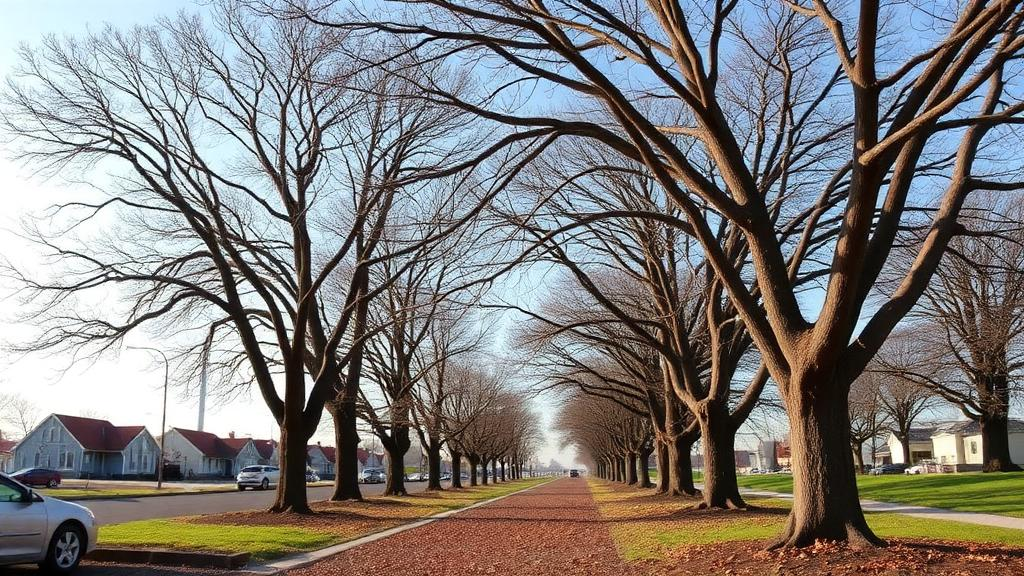
Along one of the busiest arteries of Constantine, a hillside city in northeastern Algeria, the humble European ash tree has been quietly keeping a record of everything the traffic throws at it. A new study published in Environmental Monitoring and Assessment shows that Fraxinus excelsior, the common ash, accumulates significant quantities of five toxic trace metals in its bark and leaves, making it a powerful living sensor of roadside pollution. Researchers led by Leila Sahli of Constantine 1-Frères Mentouri University examined cadmium, copper, chromium, lead and zinc in surface soils, foliage and bark at twenty traffic-exposed sites along national road number 05, comparing them with three clean reference sites in the nearby Chettaba forest. Their conclusion is striking: the ash tree does not merely survive the metallic assault of urban traffic, it documents it with enough precision to serve as a biomonitor, a phytoremediation agent and even a biological barrier along city streets.
The problem the team set out to measure is one that affects cities in both developing and developed countries. Road traffic is a major source of trace metal elements in urban air worldwide, and the metals do not simply drift away. Brake pads shed copper, tire wear releases zinc, engine and exhaust systems contribute nickel and other elements, and resuspended road dust carries a legacy of lead that persists decades after leaded gasoline was phased out. These particles settle on soil surfaces, adhere to bark and are intercepted by leaves, creating a chemical archive of a city’s transport habits. Conventional air-quality stations can capture this story only at fixed points and at considerable cost, which is why biologists have long been interested in organisms that sample the environment continuously, for free, everywhere they grow.
Constantine offered an ideal natural laboratory. The city sits on a dramatic rocky plateau crossed by deep gorges, and its road network channels dense traffic through constrained corridors, exposing the vegetation lining them to a steady stream of exhaust and non-exhaust particles. The researchers selected twenty distinct sites along the heavily trafficked national road number 05, sampling the top layer of soil beneath ash trees as well as the trees’ own leaves and bark. The three control sites in the Chettaba forest, removed from traffic influence, provided the background against which contamination could be judged. Soil samples were digested and analyzed for total trace metal content following standardized extraction protocols, allowing direct comparison with published background values for uncontaminated soils.
The soil results alone tell a sobering story. Lead concentrations exceeded background values at seventy percent of the studied roadside sites, and cadmium exceeded them at fifty-five percent. Because lead and cadmium have no essential biological function and are toxic to plants, animals and humans at low doses, their widespread enrichment signals genuine contamination rather than natural geological variation. The pattern is consistent with what traffic studies elsewhere have shown: lead reflects both historical gasoline emissions and ongoing resuspension of contaminated dust, while cadmium is associated with tire wear, lubricants and other vehicle components. Once deposited, these metals bind to soil particles and can remain available to roots and soil organisms for years, meaning the roadside ecosystem effectively remembers every era of the city’s transport history.
But the most revealing part of the study concerned the tree itself. To quantify how much of each metal moves from soil into plant tissue, the researchers calculated the bio-concentration factor, the ratio of a metal’s concentration in the plant to its concentration in the soil. The results overturned a common assumption. Bark, not leaves, turned out to be the dominant accumulator. For leaves, the mean bio-concentration factors followed the order copper, cadmium, zinc, chromium, lead; for bark the order was cadmium, copper, lead, zinc and chromium. A complementary measure, the metal accumulation index, confirmed the same picture, ranking chromium, zinc, copper, lead and cadmium for leaves, and copper, zinc, cadmium, chromium and lead for bark. Across all metals, bark accumulated roughly one and a half times as much as leaves, with a bark-to-leaf ratio of 1.61, the single exception being lead, which built up more in the foliage.
Why would bark outperform leaves as a metal trap? The answer lies in the physics and biology of the tree’s outer armor. Bark is not a passive covering; its suberized layers, the corky tissue that seals and protects the trunk, are known to entrap atmospheric particles and hold them in place. Earlier work on ash trees has shown that airborne particles become physically incorporated into the bark’s suber tissue, where they remain locked in place for the life of the tissue. Unlike leaves, which are shed each autumn and reset their chemical record annually, bark integrates deposition over years, functioning like a long-exposure photograph of the air the tree has breathed. For a biomonitoring program, that difference matters enormously: a single bark sample can summarize pollution exposure across multiple seasons, while a leaf sample captures only the current growing season.
To synthesize the tree’s overall accumulating capacity, the team also applied a comprehensive bio-concentration index, which aggregates performance across all five metals into a single value. For leaves, the index ranged from 0.03 to 0.72 across sites, and for bark from 0.06 to 0.74. The breadth of that range is itself informative. It shows that accumulation is not uniform along the road but varies with local conditions, traffic intensity, distance from the carriageway, wind patterns and the microtopography of Constantine’s ravine-carved terrain. Sites with the highest indices mark the pollution hotspots, and because the index is calculated from the tree itself, it reflects what the ecosystem actually experiences rather than what a dispersion model predicts.
The practical implications extend well beyond monitoring. The authors argue that Fraxinus excelsior is a promising species for phytoremediation, the use of plants to extract or stabilize contaminants, and for deployment as a biological barrier in urban roadside environments. A row of ash trees along a busy road does double duty: it intercepts and sequesters metallic particles that would otherwise be resuspended and inhaled by pedestrians and residents, and it provides a cheap, continuous readout of pollution levels that municipal authorities can sample at will. Previous research has already highlighted the ash’s talent for reducing industrial dust pollution in urban green belts, and the new accumulation data strengthen the case for including it in planting schemes designed to protect urban populations from traffic-borne metals. In cities where installing dense networks of electronic monitors is prohibitively expensive, a tree that doubles as a sensor network is an attractive proposition.
The study also fits into a rapidly growing global literature on plant biomonitors. Researchers have used lichens across Europe under a standardized protocol, pine needles in Turkey, oleander leaves in Brazil, and a range of roadside trees from Bangladesh to Iran to map metallic contamination. What distinguishes the Constantine work is its paired analysis of soil, leaves and bark in a Mediterranean North African city, an environment underrepresented in the biomonitoring literature despite facing intense traffic pressure and rapid urbanization. The finding that bark outperforms leaves echoes results from studies in Germany and central Iran, suggesting that bark-based monitoring may be a robust strategy across very different climates, and that urban foresters everywhere should think of trunks, not just canopies, when designing green infrastructure for pollution control.
There are, of course, limits to what a single species and a single road can demonstrate. Accumulation patterns depend on soil chemistry, tree age and seasonal timing, and a high concentration in bark reflects deposition as well as uptake, so distinguishing soil-derived from air-derived metal requires careful interpretation. The authors themselves note that the ash’s strong accumulation, particularly in bark, is precisely what makes it promising, but translating that promise into municipal practice will require calibration against instrumental measurements and replication in other cities. Still, the core message is hard to ignore. The trees lining our roads are not passive scenery; they are meticulous record-keepers of the metallic burden that traffic imposes on urban ecosystems. In Constantine, the common ash has now been shown to be one of the most articulate witnesses a city could have, and its testimony suggests that planting the right trees in the right places could quietly scrub a meaningful share of the poison out of the air that millions of urban dwellers breathe.
Subject of Research: Trace metal accumulation in roadside soils and ash trees used for urban pollution biomonitoring
Article Title: Trace metal elements accumulation in roadside ecosystems using Fraxinus excelsior L. as a bioindicator species
Article References: Sahli, L., Derouaz, M. C. E., Benguedouar, M. E. M., Sahnoune, L. K., Bazri, K. E., Djaafarou, M., & Saoud, W. (2026). Trace metal elements accumulation in roadside ecosystems using Fraxinus excelsior L. as a bioindicator species. Environmental Monitoring and Assessment, 198(10), Article 1134. https://doi.org/10.1007/s10661-026-15957-z
Image Credits: AI Generated
DOI: 10.1007/s10661-026-15957-z
Keywords: biomonitoring, Fraxinus excelsior, trace metals, roadside pollution, traffic emissions, soil contamination, bark, phytoremediation, bioaccumulation, urban air quality, Algeria, Environmental Monitoring and Assessment
Cite Scienmag News
Russell Cooper. (October 1, 2026). Roadside Ash Trees Reveal Hidden Metal Pollution in City Soils. Scienmag. https://scienmag.com/roadside-ash-trees-reveal-hidden-metal-pollution-in-city-soils/
Russell Cooper. "Roadside Ash Trees Reveal Hidden Metal Pollution in City Soils." Scienmag, 1 October 2026, https://scienmag.com/roadside-ash-trees-reveal-hidden-metal-pollution-in-city-soils/. Accessed 1 October 2026.
Russell Cooper. "Roadside Ash Trees Reveal Hidden Metal Pollution in City Soils." Scienmag. October 1, 2026. https://scienmag.com/roadside-ash-trees-reveal-hidden-metal-pollution-in-city-soils/


