


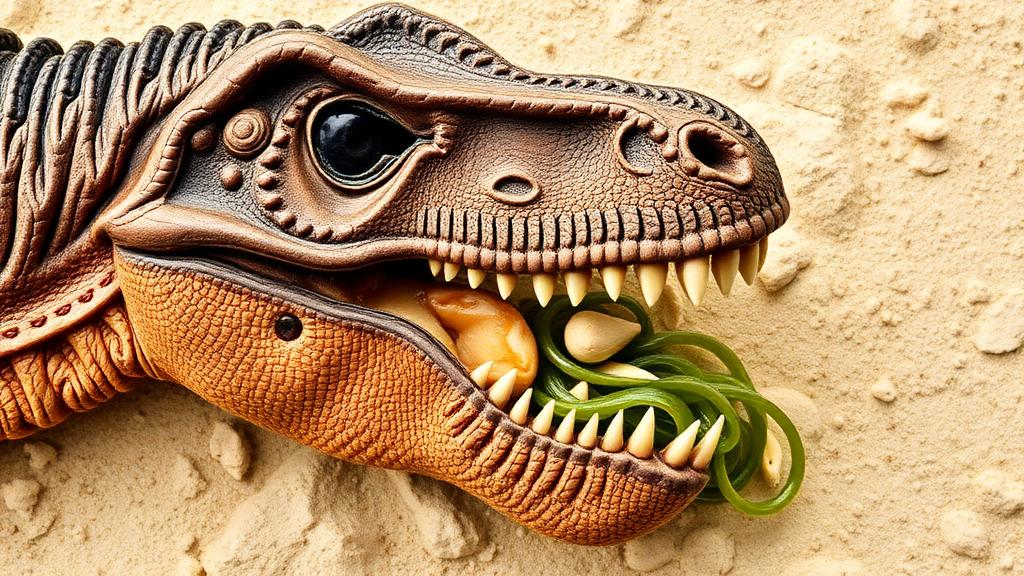
Long before humans ever walked a beach with a bucket of fried clams, dinosaurs may have been doing something surprisingly similar: strolling ancient shorelines and snacking on seafood washed up by the waves. A new study published in Frontiers in Ecology and Evolution presents chemical evidence that dinosaurs and the animals sharing their ecosystems regularly supplemented their diets with marine matter, a phenomenon scientists call marine subsidization. The research, led by Dr Clayton Forster, a geologist at the University of Arkansas, analyzed carbon isotopes locked inside fossilized teeth and bones from coastal and inland sites across North America. The findings suggest that the boundary between land and sea was far blurrier for Cretaceous ecosystems than many researchers had assumed, and that even giant herbivorous dinosaurs may have grazed on seaweed strewn across the sand after storms.
Marine subsidization is a well-documented ecological process in the modern world. Storms and tides routinely deposit marine algae, dead fish, and other ocean-derived organic matter onto beaches, where land-dwelling animals and other organisms exploit it as a convenient food source. Today, this subsidy is especially common in coastal ecosystems and becomes even more important when terrestrial food supplies falter, for example during droughts when inland vegetation is scarce. Seabirds, lizards, mammals, and insects all take advantage of these windfalls. What has remained unknown is how deep into Earth’s history this behavior extends. The new study provides the first identification of marine subsidization in prehistoric ecosystems, pushing the practice back more than 100 million years to the age of dinosaurs.
The key to the discovery lies in a chemical fingerprint carried in tooth enamel. Plants contain both light carbon-12 and heavy carbon-13 isotopes, and the ratio between them, expressed as the delta carbon-13 value, differs depending on where the plants grow. Marine plants generally carry higher carbon-13 values than land plants, and this signature passes up the food chain into the bodies of the animals that eat them. When an animal consumes food, the isotopic ratio is incorporated into its tooth enamel with a predictable upward shift, a difference of roughly 11 to 13 parts per thousand observed in the tooth enamel of living animals. This consistency makes enamel a reliable archive of diet, preserving chemical evidence long after soft tissues have vanished.
For decades, however, dinosaur teeth have presented a puzzle. The difference between the isotopic values of their presumed plant diets and the values recorded in their enamel was consistently higher than the range seen in living animals. Their delta carbon-13 values were also elevated beyond what would be expected for animals eating exclusively land-grown plants, which carry lower values than most marine plants. If dinosaurs, or the prey animals they fed upon, had been consuming marine matter, that extra input of heavy carbon could neatly explain the discrepancy. Testing this hypothesis required comparing fossils from animals that lived near the sea with those from animals that lived far inland, where marine food sources were simply unavailable.
The research team assembled fossils from sites that once lay along the coastlines of the Western Interior Seaway, a vast inland sea that split North America into two landmasses around 100 million years ago, and from the ancient Gulf of Mexico coastline. For comparison, they included fossils from land-locked sites far from any marine influence. The sampled deposits formed during two windows of the Cretaceous Period: the early Albian, roughly 113 to 107 million years ago, and the early Cenomanian, approximately 100 to 96 million years ago. The researchers powdered the fossil specimens for isotopic composition analysis and also applied laser ablation techniques, allowing them to compare chemical signatures across different regions, latitudes, and geological ages.
The results were striking. The delta carbon-13 values recorded in fossils from coastal sites were not only higher than those from the land-locked formation, but they were also consistent between coastal sites regardless of latitude or age. That uniformity is significant, because it points to a shared biological cause rather than random geological variation. According to the authors, coastal-dwelling organisms must have eaten some kind of organic matter originating from the ocean, or prey that had done so themselves. The pattern appeared across the food web, from fish to megaherbivores, indicating that the extra carbon source must have sat low in the food chain to influence both aquatic and terrestrial animals simultaneously.
Identifying the culprit required a process of ecological elimination. The mystery food source had to be an organism living in coastal but not inland habitats, and it had to remain available over many millions of years to explain the consistency of the signal across the Albian and Cenomanian deposits. Few candidates meet these criteria, the researchers concluded, besides marine macroalgae and macrophytes, in other words, seaweeds. Given that large coastal herbivores today almost universally supplement their diets with seaweed when the opportunity arises, the team argues it is likely that most of the sampled herbivorous dinosaurs behaved no differently, browsing on mats of algae and other marine vegetation left behind by the retreating tide.
Not every dinosaur in the dataset joined the beachcombing behavior, and that exception strengthens the case. Tenontosaurus tilletti, a large herbivorous dinosaur found in many locations throughout the Cretaceous, showed no evidence of marine consumption. Its delta carbon-13 value closely resembled that of modern animals that feed exclusively on land-growing plants. This contrast is important because it rules out alternative explanations, such as geological processes that might have altered the chemical traces in tooth enamel after the animals died. If burial conditions had uniformly shifted the isotopic values, all specimens from the same deposits should show the effect. Instead, the elevated signatures track dietary preference, species by species, exactly as a genuine dietary signal would.
The study does have limits that the authors acknowledge. The dataset clearly demonstrates marine subsidization in the coastal deposits examined, but it lacks data from polar and equatorial latitudes during the early Albian and early Cenomanian. Future research, the team notes, needs to determine whether the phenomenon was common across different latitudes and other time periods, such as the preceding Jurassic Period or the subsequent early Cenozoic Era. Even so, the implications reach beyond paleontology. As Forster concluded, the study emphasizes the connections between terrestrial and marine ecosystems, which are deeply intertwined and have been for hundreds of millions of years. Understanding those ancient linkages, the authors argue, highlights the importance of protecting the environmental connections that still exist along coastlines today.
Subject of Research: Marine subsidization of dinosaur-era coastal ecosystems revealed through carbon isotope analysis of fossil tooth enamel
Article Title: Dinos snacked on seafood washed up on ancient beaches, fossil study shows
Article References: Dinos snacked on seafood washed up on ancient beaches, fossil study shows. (n.d.). Original publication
Image Credits: AI Generated
DOI: Not provided
Keywords: dinosaurs, marine subsidization, carbon isotopes, tooth enamel, Cretaceous, Western Interior Seaway, seaweed, paleoecology, coastal ecosystems, Frontiers in Ecology and Evolution, Tenontosaurus, food webs
Cite Scienmag News
Gavin Prescott. (October 1, 2026). Dinosaurs Dined on Seaweed: Fossil Teeth Reveal Coastal Seafood Snacking. Scienmag. https://scienmag.com/dinosaurs-dined-on-seaweed-fossil-teeth-reveal-coastal-seafood-snacking/
Gavin Prescott. "Dinosaurs Dined on Seaweed: Fossil Teeth Reveal Coastal Seafood Snacking." Scienmag, 1 October 2026, https://scienmag.com/dinosaurs-dined-on-seaweed-fossil-teeth-reveal-coastal-seafood-snacking/. Accessed 4 October 2026.
Gavin Prescott. "Dinosaurs Dined on Seaweed: Fossil Teeth Reveal Coastal Seafood Snacking." Scienmag. October 1, 2026. https://scienmag.com/dinosaurs-dined-on-seaweed-fossil-teeth-reveal-coastal-seafood-snacking/


