


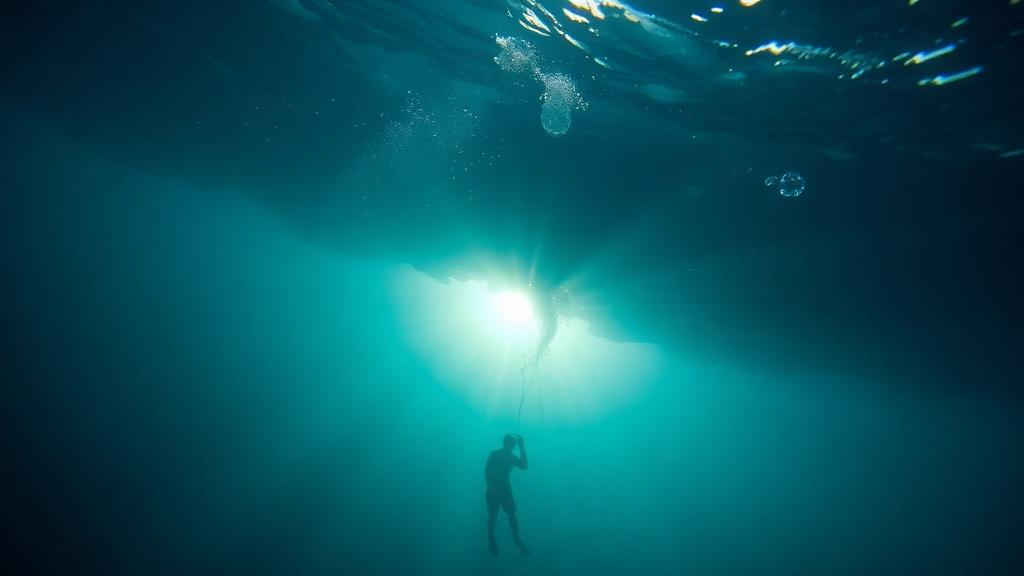
The ocean is one of the most visually hostile environments on Earth, and anyone who has snapped a photo beneath the waves knows why. Water absorbs red light first, then orange and yellow, until only a blue-green haze remains. Suspended particles scatter whatever light survives, washing out contrast and blurring detail. For scientists mapping coral reefs, engineers inspecting pipelines, and robots navigating shipwrecks, this distortion is more than an aesthetic nuisance; it degrades the raw material of underwater perception. A research team at North China University of Science and Technology in Tangshan now reports a new artificial intelligence approach that confronts the problem not by building ever larger networks, but by teaching a relatively compact model to think more carefully about what it sees. Their work, published in Earth Science Informatics, introduces a content-guided attention-based feature fusion network designed to restore clarity, color, and contrast to degraded underwater imagery.
Underwater image enhancement is what mathematicians call an ill-posed problem, meaning there is no unique correct answer lurking in the data. Once light has been absorbed and scattered, much of the original information is simply gone, and any restoration is an informed reconstruction rather than a perfect reversal. For decades, researchers attacked the problem with physics-based models that estimated how light attenuates at different depths and corrected colors accordingly. Classical methods used haze-line priors, color-line models, and adaptive histogram equalization to push images back toward what the scene would look like in air. These techniques helped, but they relied on simplified assumptions about water conditions that often failed in turbid harbors, deep reef shadows, or algal blooms, where the optical environment defies neat equations.
The rise of deep learning changed the landscape. Convolutional neural networks, trained on paired degraded and clean images, learned to map murky inputs to vivid outputs without explicit physics. Yet the Tangshan team identified a troubling trend in the field: many recent networks chase performance by simply growing deeper and wider, stacking layers and channels until computational costs balloon. That brute-force strategy suits well-funded laboratories with powerful graphics processors, but it sidelines the researchers, monitoring stations, and autonomous vehicles that must run enhancement in real time on modest hardware. Worse, the authors argue, scaling up ignores a subtler deficiency. Features extracted at different depths of a network capture different things, from broad global structure to fine local texture, and most architectures do a poor job of letting these levels of understanding talk to each other.
The new network, developed by Xiuman Liang, Xinzhe Yao, Haifeng Yu, and Zhendong Liu, tackles that communication gap head-on with three cooperating components. The first is a multiscale feature extraction module, tasked with pulling global information out of the image. By processing the scene at multiple scales simultaneously, this module captures the large-area color casts and lighting gradients that define the overall character of an underwater photograph. The second component, a cascading attention-aware enhancement module, works on the opposite end of the spectrum, hunting down local features: the edge of a fish silhouette, the texture of a coral polyp, the boundary of a submerged structure. Attention mechanisms inside this cascade learn to emphasize informative regions and suppress background clutter, a strategy borrowed from the way human vision fixates on salient details while ignoring noise.
The real innovation, however, lies in how the network marries these two streams. Naively concatenating global and local features creates what the authors call a mismatching of receptive fields. A global feature summarizes a wide swath of the image, while a local feature describes a small patch; when the two are fused indiscriminately, broad context can drown out fine detail or vice versa, depending on where they land. The team’s solution is a feature fusion module built on content-based guided attention. Rather than treating every spatial position equally, this module learns spatial weights on the fly, deciding for each location how much global influence and how much local influence the final representation should receive. The weights are content-guided, meaning they respond to what is actually in the image, so a sandy seafloor might lean heavily on global color correction while a cluttered reef scene leans on local texture preservation.
This guided fusion mechanism draws conceptual inspiration from content-guided attention schemes developed in adjacent computer vision problems, notably single image dehazing, where researchers confronted a parallel challenge of separating genuine scene structure from atmospheric veiling. By adapting that idea to the underwater domain, the Tangshan group achieves what they describe as full interactive fusion between global and local features. In practice, interactivity means the two branches are not merely summed at the end; their information flows through learned gates that continuously renegotiate the balance during reconstruction. The result is an output image in which global color casts are neutralized and local contrasts are sharpened in a coordinated fashion, rather than each being fixed by a separate pipeline that risks undoing the other’s work.
Evaluating an enhancement algorithm demands benchmarks, and the team subjected their network to comprehensive testing on three widely used underwater image datasets. The assessment combined qualitative comparisons, in which restored images are inspected for realistic color, contrast, and detail, with quantitative evaluations using standard metrics such as peak signal-to-noise ratio and structural similarity, alongside underwater-specific quality measures that model how human observers judge marine imagery. Across both modes of evaluation, the researchers report strong and competitive performance against existing methods. The qualitative gains are the kind that matter for real applications: greens and blues that had swallowed the scene give way to natural reds and warm tones, silhouettes sharpen into recognizable objects, and textures reemerge from the haze without the garish oversaturation that plagues some aggressive enhancement algorithms.
The efficiency argument is central to the paper’s significance. Because the architecture extracts global and local features in dedicated, streamlined modules and fuses them intelligently rather than compensating with sheer scale, it avoids the steep computational load of oversized networks. That matters for autonomous underwater vehicles, whose onboard computers juggle navigation, obstacle avoidance, and data logging on strict power budgets. It matters for real-time video enhancement on remotely operated vehicles during pipeline inspections or archaeological surveys. And it matters for the growing fleets of low-cost monitoring cameras scattered across reefs and aquaculture farms, which cannot feasibly offload every frame to a cloud data center. A network that delivers competitive restoration with modest resources extends high-quality underwater vision from the laboratory to the field.
The applications ripple outward through marine science and engineering. Clearer imagery improves the accuracy of object recognition models that count fish, detect invasive species, or identify munitions on the seafloor. It sharpens the inputs to depth estimation and three-dimensional reconstruction pipelines used in benthic habitat mapping. It aids biologists tracking coral bleaching, where subtle color shifts carry diagnostic meaning that haze can erase entirely. The work also sits within a broader trend in artificial intelligence: rather than asking how big a model can get, researchers increasingly ask how cleverly its components can interact. Attention mechanisms, once a niche idea, have become the connective tissue of modern vision systems precisely because they allocate computation where content demands it, and this study extends that philosophy to the peculiar optics of the sea.
Challenges remain, as they always do in this field. The problem is fundamentally ill-posed, so no algorithm can recover information that absorption destroyed; enhancement is always an educated inference, and different water types may still demand specialized tuning. Training data itself is a bottleneck, since authentic paired images of the same scene in turbid and pristine conditions are nearly impossible to capture, pushing researchers toward synthetic generation and unsupervised learning. The authors declare no competing interests, and their study received support from the Hebei Natural Science Foundation, the Hebei Education Department, and a graduate innovation fund at their university. Still, by showing that thoughtful attention-guided fusion can match heavyweight rivals at a fraction of the architectural complexity, the Tangshan team offers a template for the next generation of underwater vision systems, ones light enough to dive deep and smart enough to see clearly when they arrive.
Subject of Research: Deep learning-based underwater image enhancement using attention-guided feature fusion
Article Title: Content-guided attention-based feature fusion network for underwater image enhancement
Article References: Liang, X., Yao, X., Yu, H., & Liu, Z. (2026). Content-guided attention-based feature fusion network for underwater image enhancement. Earth Science Informatics, 19(10), Article 176. https://doi.org/10.1007/s12145-026-02218-3
Image Credits: AI Generated
DOI: 10.1007/s12145-026-02218-3
Keywords: underwater image enhancement, convolutional neural networks, attention mechanism, feature fusion, computer vision, image processing, deep learning, feature extraction, marine robotics, content-guided attention, Earth Science Informatics, receptive field
Cite Scienmag News
Blake Davidson. (October 1, 2026). Smart Attention Network Clears the Murk From Underwater Images. Scienmag. https://scienmag.com/smart-attention-network-clears-the-murk-from-underwater-images/
Blake Davidson. "Smart Attention Network Clears the Murk From Underwater Images." Scienmag, 1 October 2026, https://scienmag.com/smart-attention-network-clears-the-murk-from-underwater-images/. Accessed 1 October 2026.
Blake Davidson. "Smart Attention Network Clears the Murk From Underwater Images." Scienmag. October 1, 2026. https://scienmag.com/smart-attention-network-clears-the-murk-from-underwater-images/


