


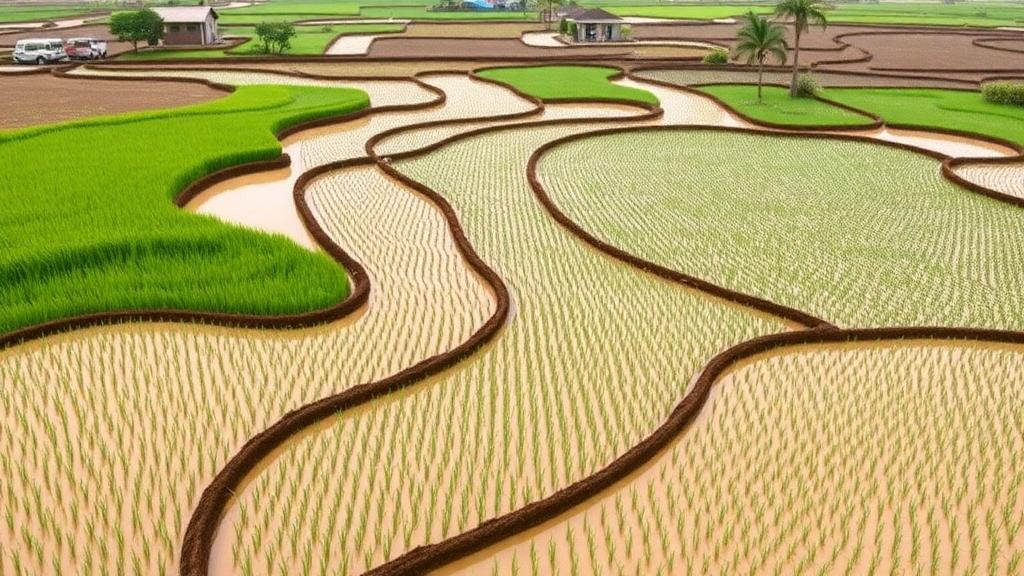
Rice feeds billions of people, but the flooded paddies it grows in are quietly one of the planet’s most important sources of methane, a greenhouse gas far more potent than carbon dioxide over the short term. For decades, farmers in Vietnam and across Asia have kept their fields submerged continuously, creating the oxygen-free conditions in which methane-producing microbes thrive. Now a multi-season field study from Vietnam has provided some of the most detailed evidence yet that a simple change in water management, known as alternate wetting and drying, can dramatically suppress methane production while reshaping the underlying chemistry of the soil in ways that were previously difficult to quantify.
The research, published in Environmental Monitoring and Assessment, was carried out by a team of Vietnamese and Japanese scientists led by Ngo Duy Dong of Hiroshima University, working with colleagues at the Vietnam National University of Agriculture, Phenikaa University, the University of Da Nang, and Hiroshima University. Rather than examining a single growing season, the team tracked a paddy field across three consecutive rice cropping seasons, comparing plots managed with alternate wetting and drying against plots kept under continuous flooding. This multi-season design matters, because soil chemistry does not respond to irrigation changes overnight; many of the most important processes unfold over months and years as microbial communities and elemental cycles adjust.
Alternate wetting and drying is deceptively simple in concept. Instead of maintaining a permanent layer of floodwater, farmers allow the field to dry periodically until the water table drops to a defined threshold below the soil surface, and then re-flood it. Each drying episode introduces oxygen into a soil that is normally starved of it. That pulse of oxygen suppresses the strictly anaerobic archaea that generate methane, and it also triggers a cascade of chemical reactions involving iron, manganese, nitrogen, and sulfur. The practice has been promoted for years as a water-saving technique, but questions have lingered about its side effects: does it deplete soil nitrogen, does it change the availability of toxic elements such as arsenic and cadmium, and does the benefit for methane persist over multiple seasons?
The new study addressed these questions with a combination of field observation and controlled laboratory incubations. The researchers measured soil chemical properties, the potential of the soil to produce methane, the rate at which organic nitrogen was mineralized into plant-available ammonium, and the concentrations of a broad suite of elements, from macronutrients to potentially toxic metals. To synthesize this large dataset, they applied principal component analysis, a statistical technique that condenses many correlated measurements into a small number of axes, allowing the overall biogeochemical fingerprint of each water treatment to emerge clearly.
The headline result concerns methane. When soil from the alternate wetting and drying treatment was incubated anaerobically in the laboratory for seven weeks, it produced far less methane than soil from continuously flooded plots. By the end of the incubation period, the difference was stark: 36.2 milligrams of carbon per kilogram of soil under alternate wetting and drying, compared with 96.5 milligrams under continuous flooding, a reduction of roughly 62 percent. This confirms that the effect of intermittent aeration is not merely a transient suppression of methane flux during the drying episodes themselves. The soil retains a diminished methane production potential even when subsequently returned to waterlogged, oxygen-free conditions, suggesting that repeated drying cycles fundamentally alter the microbial and chemical conditions that methanogens depend upon.
Nitrogen dynamics told a more nuanced story. Under alternate wetting and drying, the soil’s total nitrogen content declined to 1.08 grams per kilogram, compared with 1.32 grams per kilogram under continuous flooding. Ammonium accumulation during the incubation was also lower under the drying treatment, at 38.3 milligrams of nitrogen per kilogram of soil versus 62.5 milligrams under continuous flooding. These figures point to accelerated nitrogen transformation under alternating oxygen conditions. Each re-wetting of a dried soil typically triggers a burst of microbial activity, and the alternating presence and absence of oxygen promotes both mineralization and nitrification-denitrification pathways that can move nitrogen out of the organic pool and, in some cases, out of the soil entirely as gaseous losses. For farmers, this is a caution: the water-saving, methane-reducing practice may carry a hidden cost in nitrogen, potentially requiring adjusted fertilizer management to maintain yields.
One of the most interesting findings concerns iron and manganese, the so-called redox-sensitive elements. Concentrations of both were markedly higher in soils under alternate wetting and drying than under continuous flooding. This makes chemical sense. When a flooded soil dries, dissolved reduced iron and manganese oxidize and precipitate as oxides and hydroxides on soil particle surfaces. When the field is re-flooded, these oxides partially re-dissolve, but the repeated cycling changes where these elements reside and in what forms. Iron oxides are important players in paddy soil chemistry because they can adsorb phosphate, arsenic, and other solutes, and because microbes that reduce iron compete with methanogens for substrate. Higher iron and manganese availability under the drying regime may therefore be one of the mechanisms suppressing methane, as iron-reducing bacteria consume the organic matter and hydrogen that would otherwise fuel methane production.
Crucially for food safety, the study found that most macroelements and potentially toxic elements did not differ remarkably between the two water regimes. This addresses a persistent worry in the rice research community. Continuous flooding keeps arsenic in its more mobile, reduced form, and draining fields is sometimes proposed as a way to limit arsenic uptake by rice, but drying can increase cadmium mobility instead. The Vietnamese results suggest that, at least in this soil and over three seasons, alternate wetting and drying did not substantially enhance the accumulation of potentially toxic elements, a finding that supports its applicability as an environmentally sustainable practice rather than a trade-off that simply swaps one contamination risk for another.
The principal component analysis reinforced the picture of a soil fundamentally reorganized by its water history. Rather than scattered differences in individual measurements, the analysis revealed distinct, coherent shifts in the overall biogeochemical characteristics of soils under the two treatments. Soil pH was also significantly higher under alternate wetting and drying, at 6.22 compared with 5.68 under continuous flooding, a shift of more than half a pH unit that can influence nutrient availability, microbial community composition, and the solubility of metals. Periodic aeration tends to consume acidity through oxidation reactions and to alter the balance of alkalinity-generating reduction processes, and a modest pH increase of this kind is generally favorable for rice, since strongly acidic conditions can limit phosphorus availability and increase aluminum toxicity.
Taken together, the study offers a rare multi-season, whole-soil assessment of a practice that is rapidly being scaled up across Southeast Asia. Vietnam is one of the world’s largest rice exporters, and its delta regions face the twin pressures of water scarcity and greenhouse gas reduction targets, making alternate wetting and drying an attractive policy tool. The new evidence strengthens the case that the technique delivers its promised climate benefit, cutting methane production potential by more than half in incubation assays, without accumulating toxic metals in the soil. At the same time, the observed decline in total nitrogen and reduced ammonium accumulation is a signal that farmers adopting the practice will need to monitor nitrogen carefully, adjusting application rates and timing to avoid yield penalties. As climate-smart agriculture moves from pilot plots to millions of hectares, studies of this kind, which track the full elemental consequences of changing one variable as fundamental as water, will be essential for ensuring that the cure for methane does not create new problems in the paddies of the future.
Subject of Research: Effects of alternate wetting and drying irrigation on methane production, nitrogen transformation, and soil elemental dynamics in Vietnamese rice paddies
Article Title: Alternate wetting and drying in Vietnam affects methane production, nitrogen transformation, and soil elemental dynamics across three consecutive rice cropping seasons
Article References: Dong, N. D., Viet, T. D., Hoang, V. D., Dung, L. T., Tam, L. D., Son, T. N., Xuan, T. D., & Toan, N.-S. (2026). Alternate wetting and drying in Vietnam affects methane production, nitrogen transformation, and soil elemental dynamics across three consecutive rice cropping seasons. Environmental Monitoring and Assessment, 198(10), Article 1129. https://doi.org/10.1007/s10661-026-15965-z
Image Credits: AI Generated
DOI: 10.1007/s10661-026-15965-z
Keywords: alternate wetting and drying, rice paddies, methane, soil biogeochemistry, nitrogen mineralization, iron, manganese, soil pH, Vietnam, greenhouse gas mitigation, sustainable agriculture, water management
Cite Scienmag News
Alan Morgan. (October 1, 2026). Drying Rice Paddies on Purpose Slashes Methane and Reshapes Soil Chemistry in Vietnam. Scienmag. https://scienmag.com/drying-rice-paddies-on-purpose-slashes-methane-and-reshapes-soil-chemistry-in-vietnam/
Alan Morgan. "Drying Rice Paddies on Purpose Slashes Methane and Reshapes Soil Chemistry in Vietnam." Scienmag, 1 October 2026, https://scienmag.com/drying-rice-paddies-on-purpose-slashes-methane-and-reshapes-soil-chemistry-in-vietnam/. Accessed 1 October 2026.
Alan Morgan. "Drying Rice Paddies on Purpose Slashes Methane and Reshapes Soil Chemistry in Vietnam." Scienmag. October 1, 2026. https://scienmag.com/drying-rice-paddies-on-purpose-slashes-methane-and-reshapes-soil-chemistry-in-vietnam/


