


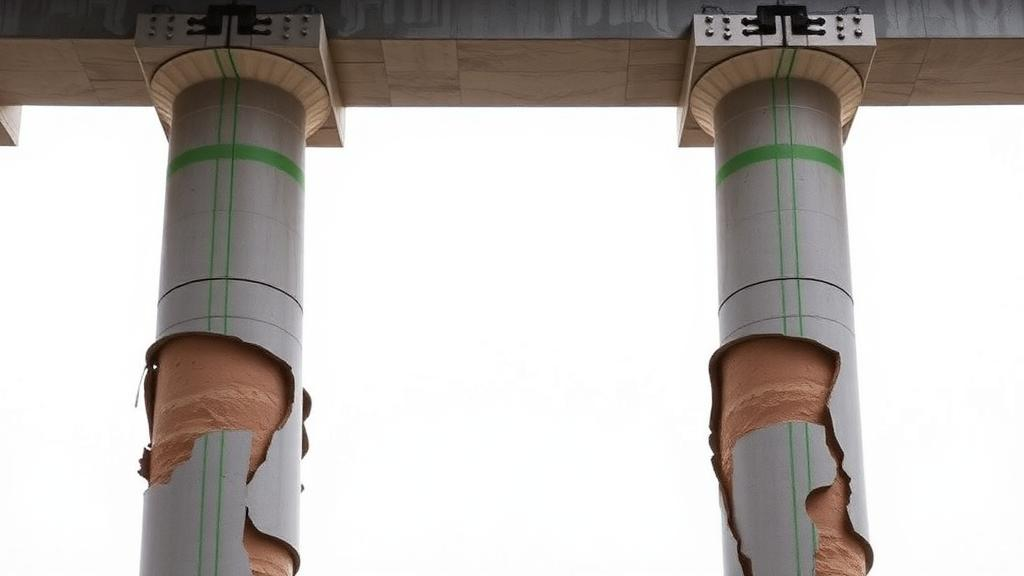
When a major earthquake strikes a city, the immediate question facing engineers is not just which buildings have collapsed, but which of the damaged ones can still be trusted. Reinforced concrete columns that have cracked, yielded, and lost stiffness during a mainshock may look deceptively intact, yet their capacity to survive a strong aftershock can be dramatically diminished. A new study published in the Bulletin of Earthquake Engineering tackles this problem with a combination of large-scale simulation and machine learning, offering a fast, data-driven way to predict how damaged columns will behave under further cyclic loading.
The research, led by Xiaohui Yu, Zenghui Li, Zihan He, Kuangyu Dai and Feng Fu, with affiliations spanning Guilin University of Technology, Zhengzhou University and City, University of London, focuses on the hysteretic behavior of reinforced concrete columns. Hysteresis describes the looping force–displacement curves a column traces as it is pushed back and forth past its elastic limit. These loops encode everything engineers need to know about a column’s energy dissipation, stiffness degradation and strength deterioration, but measuring them for real damaged structures is slow, expensive and often impossible after a disaster.
To build a foundation for their predictive models, the team first assembled a comprehensive database of 1,053 reinforced concrete column specimens tested under cyclic loading. For each column, the hysteretic response was simulated using the modified Ibarra–Medina–Krawinkler (I-M-K) model, a phenomenological framework widely used in seismic collapse assessment. The I-M-K model represents a column’s backbone curve — the envelope of its strength and stiffness — together with rules for cyclic deterioration, capturing how repeated inelastic cycles progressively erode yield strength, unloading stiffness, and post-capping behavior.
The central innovation lies in a two-stage simulation strategy designed to mimic what an earthquake actually does to a structure. In the first stage, a partial loading history drawn from the experimental data is applied to each intact column, producing a wide range of initial damage states, from hairline cracking to severe strength loss. In the second stage, the complete loading history is applied to these now-damaged columns, generating the full hysteretic response of a structure that has already been through a mainshock. This approach effectively turns one experimental record into many, allowing the researchers to explore the continuum between pristine and heavily damaged states without physically breaking hundreds of additional specimens.
From the simulated responses of the damaged columns, the researchers identified the backbone and cyclic deterioration parameters of the modified I-M-K model. By comparing the backbone parameters of damaged columns with those of their intact counterparts, they quantified damage-induced reduction factors, or DRFs, for key quantities including yield strength, elastic stiffness, strain hardening ratio, capping strength, and the chord rotation of the softening stage. These factors express, in precise numerical terms, how much of a column’s original capacity survives a given level of earthquake damage.
With the database of DRFs and deterioration parameters in hand, the team trained six different machine learning models to predict these values directly from a column’s initial damage state and its design parameters — inputs such as axial load ratio, longitudinal and transverse reinforcement ratios, concrete compressive strength, stirrup spacing, shear span-to-depth ratio, and cross-sectional dimensions. Rather than relying on a single arbitrary train-test split, the models were trained and tested across 1,000 random splits, a rigorous protocol that guards against lucky partitions and gives a robust picture of each algorithm’s true performance.
The verdict was clear: XGBoost, the gradient-boosted decision tree algorithm that has become a favorite in engineering applications, exhibited the best performance in predicting the hysteretic behavior of damaged columns. XGBoost builds an ensemble of decision trees sequentially, with each new tree correcting the errors of the previous ones, making it particularly adept at capturing the nonlinear interactions between design variables and damage states that govern structural response. To test that the model was not simply memorizing its training data, the researchers also evaluated it on three reinforced concrete column specimens outside the original database, examining its general applicability to unseen cases.
Crucially, the study does not treat its model as a black box. Using SHapley Additive exPlanations, or SHAP, a technique borrowed from cooperative game theory that attributes each prediction to the contributions of individual input features, the researchers interrogated what their model had learned. The analysis indicated that initial damage is the most influential feature governing the reduced hysteretic parameters — an intuitive but now quantitatively confirmed result, since the severity of pre-existing damage directly controls how much strength and stiffness remain for subsequent loading.
The practical implications extend well beyond the laboratory. After a damaging earthquake, engineers must rapidly decide whether a building is safe for occupancy, whether it needs retrofitting, or whether it should be demolished. Current post-earthquake assessment practice often relies on simplified damage indices, such as the Park–Ang damage index, and conservative assumptions that can lead to unnecessary closures or, worse, underestimated risk. A trained surrogate model like the one developed here could take measurable column properties and an estimate of sustained damage and return, in seconds, a full prediction of the residual hysteretic envelope — feeding directly into aftershock fragility analysis and resilience planning for entire building stocks.
The work also fits into a broader movement in earthquake engineering toward machine-learning-assisted seismic assessment, with recent studies applying similar methods to fragility estimation, drift capacity prediction, and parameter identification for nonlinear structural models. By releasing their column database as supplementary material and making the source code openly available on GitHub, the authors have lowered the barrier for other researchers to build on the approach. As cities in seismic regions face aging infrastructure and increasing exposure, tools that translate raw data into rapid, explainable predictions of residual capacity may become as essential to post-earthquake response as the seismometers that record the shaking itself.
Subject of Research: Machine learning prediction of the residual hysteretic behavior of post-earthquake damaged reinforced concrete columns
Article Title: Hysteretic behavior prediction of post-earthquake damaged reinforced concrete columns using machine learning
Article References: Yu, X., Li, Z., He, Z., Dai, K., & Fu, F. (2026). Hysteretic behavior prediction of post-earthquake damaged reinforced concrete columns using machine learning. Bulletin of Earthquake Engineering. https://doi.org/10.1007/s10518-026-02704-5
Image Credits: AI Generated
DOI: 10.1007/s10518-026-02704-5
Keywords: machine learning, XGBoost, reinforced concrete columns, hysteretic behavior, post-earthquake damage, seismic assessment, Ibarra-Medina-Krawinkler model, damage-induced reduction factors, SHAP, aftershock resilience, structural engineering, Bulletin of Earthquake Engineering
Cite Scienmag News
Violet Maxwell. (October 1, 2026). Machine Learning Predicts How Earthquake-Damaged Concrete Columns Will Behave Next. Scienmag. https://scienmag.com/machine-learning-predicts-how-earthquake-damaged-concrete-columns-will-behave-next/
Violet Maxwell. "Machine Learning Predicts How Earthquake-Damaged Concrete Columns Will Behave Next." Scienmag, 1 October 2026, https://scienmag.com/machine-learning-predicts-how-earthquake-damaged-concrete-columns-will-behave-next/. Accessed 1 October 2026.
Violet Maxwell. "Machine Learning Predicts How Earthquake-Damaged Concrete Columns Will Behave Next." Scienmag. October 1, 2026. https://scienmag.com/machine-learning-predicts-how-earthquake-damaged-concrete-columns-will-behave-next/


