


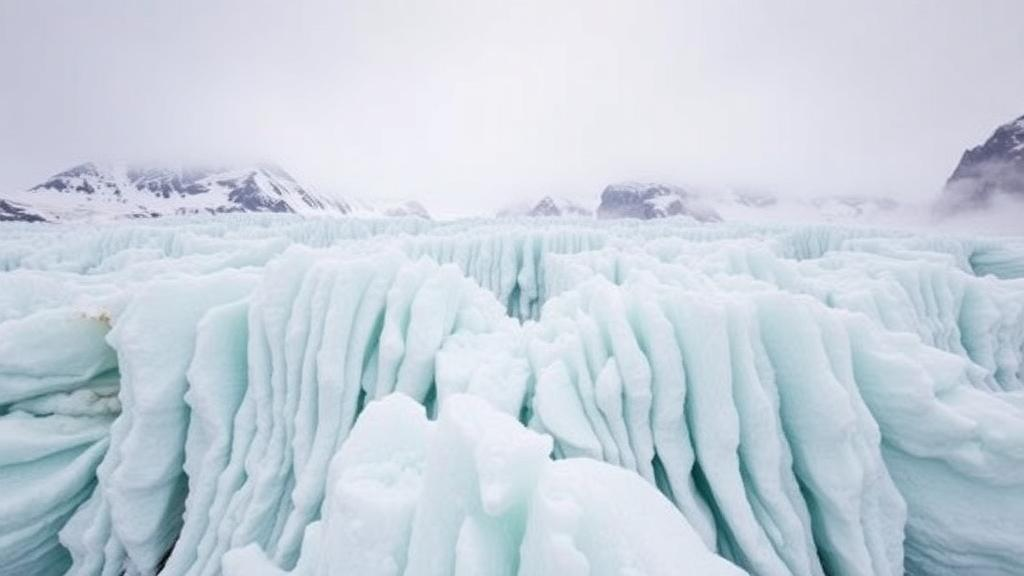
Switzerland’s glaciers have endured another catastrophic year, with new measurements showing that more than five percent of the country’s total glacial ice volume vanished during 2026 alone. The figures, compiled by the Swiss Glacier Monitoring Network GLAMOS and published in the annual report of the Swiss Academy of Sciences, confirm that the Alpine nation’s ice landscape is shrinking at a pace that has stunned even the researchers who have spent decades documenting it. Although the overall melt did not quite surpass the absolute record set in 2022, the 2026 losses rank among the most severe ever recorded, and the cumulative toll of the past half decade is now unmistakable: nearly twenty percent of Switzerland’s glacier volume has disappeared in just five years.
The physical scale of the loss is difficult to overstate. On average, glacier thickness across the monitoring network decreased by between 2.5 and 4 metres during the year, a figure that represents an enormous volume of water locked away for centuries in high-altitude ice. Some individual glacier tongues fared far worse, thinning by up to 10 metres of ice in a single season. At Konkordiaplatz, the vast accumulation basin at the heart of the Great Aletsch Glacier in the canton of Valais, photographs comparing the current ice extent with the average of measurements taken between 1953 and 1983 reveal a retreat that has accelerated dramatically in recent years, turning what was once a broad, snow-covered expanse into bare, debris-strewn ice.
For several of Switzerland’s smaller glaciers, 2026 marked the end of their existence entirely. The Bella Tola glacier in the canton of Valais and the Griessfirn in the canton of Glarus both melted away completely and permanently, joining a growing list of ice bodies that have vanished from the Swiss Alps within living memory. Their disappearance is not a temporary fluctuation but an irreversible threshold: once the ice mass falls below a critical size, the remaining ice can no longer survive the summer energy balance, and the glacier ceases to exist as a dynamic feature of the landscape. Researchers emphasize that these losses are permanent on any human timescale, since the climatic conditions that built these glaciers over millennia no longer prevail.
The most extreme melt of the year was concentrated in some of the country’s largest and most iconic ice masses. The Rhône Glacier, the Aletsch Glacier, and the Clariden Glacier, among others, all experienced their greatest melt on record in 2026. That these major glaciers, which possess far greater reserves of ice than the small cirque glaciers that vanished entirely, registered record losses underscores how exceptional the 2026 conditions were. Large glaciers typically respond more slowly to individual warm years because their sheer mass buffers short-term variability, so when even these giants post record ablation, the signal points to sustained, systemic forcing rather than ordinary weather noise.
The explanation for the devastation lies in the peculiar combination of the preceding winter and the following summer. The winter of 2025 to 2026 was among the ten least snowy winters in Switzerland since systematic snow measurements began. Snowpack is the glacier’s natural armour: a deep, bright snow layer reflects the majority of incoming solar radiation back to the atmosphere and shields the underlying ice from melting. When winter snowfall is meagre, glaciers enter the melt season already weakened, with dark older ice exposed earlier and absorbing more energy. The thin snow cover of 2025 to 2026 left Swiss glaciers unusually vulnerable before summer even began.
What followed was a summer of relentless heat and drought. Between May and September 2026, hot and dry conditions drove melt rates to excessive levels, and crucially, the melting extended all the way up to the highest elevations, where ice had historically remained safe even in warm years. For a total of 76 days, summer heatwaves pushed the freezing point above 4,000 metres, more than twice the long-term average and a Swiss record. Under such conditions, even the highest firn basins and summit icefields lost mass, leaving no refuge anywhere in the high Alps. By September, no snow remained even at 3,500 metres, stripping the glaciers of their protective white cover and exposing dark ice to direct solar radiation for the final weeks of the ablation season, which further amplified the melt through the feedback between surface darkening and energy absorption.
The data underpinning these findings come from GLAMOS, the Glacier Monitoring Network, which conducts long-term, systematic monitoring of Swiss glaciers and is headquartered at ETH Zurich together with the universities of Fribourg and Zurich. The network’s annual mass balance assessments rest on decades of field measurements, combining in situ stake readings and snow pit observations on representative glaciers with geodetic surveys that track changes in ice volume across the full inventory. This observational continuity is what allows scientists to place any single year, including 2026, in a reliable historical context and to distinguish genuine trends from year-to-year variability. The 2026 report, authored by Matthias Huss, Andreas Bauder, Andreas Linsbauer and Mylène Barandun, documents a mass balance year that ranks among the most extreme in the measurement record.
The meltwater released by the dying glaciers has tangible, if paradoxical, consequences for the country’s water supply. From July to September 2026, Swiss glaciers released approximately 2,200 billion litres of water, more than four times the annual drinking-water consumption of all Swiss households. During the hot, dry summer months, this outflow temporarily cushioned water shortages in downstream valleys, feeding rivers and reservoirs precisely when precipitation failed and demand peaked. In this sense, glacier melt acted as an emergency buffer against drought, a service the ice has provided to Alpine communities and the wider European river system for millennia.
Yet the researchers are clear that this buffering function is a wasting asset. The very melt that relieved summer water stress in 2026 is the mechanism by which the glacier reservoir is being emptied. As glacier area continues to shrink irreversibly, the volume of water the ice can release in dry summers declines with it. In the coming decades, the temporary relief of meltwater will give way to a new reality in which the late-summer contribution of ice to Alpine streams dwindles, with implications for hydropower, agriculture, ecology and water management far beyond the Swiss borders, since Alpine glaciers feed some of Europe’s major rivers.
The 2026 results thus capture a landscape in the midst of a transformation that is both rapid and permanent. Five years in which nearly a fifth of the national ice volume disappeared, individual glaciers blinking out of existence, and record melt on the largest ice bodies together illustrate how sensitive Alpine glaciers are to the combined effects of warm summers and snow-poor winters. The GLAMOS monitoring network’s measurements will continue to track the retreat, providing the observational foundation for understanding how much ice remains, how quickly it is going, and what the Alps will look like when the current era of accelerated loss runs its course. For Switzerland’s glaciers, 2026 was not an anomaly but another step in a sustained decline that the measurements show no sign of halting.
Subject of Research: Annual mass balance and record ice loss of Swiss glaciers in 2026
Article Title: Devastating year for Switzerland’s glaciers
Article References: Devastating year for Switzerland’s glaciers. (n.d.). Original publication
Image Credits: AI Generated
DOI: Not provided
Keywords: Swiss glaciers, GLAMOS, glacier melt, mass balance, climate change, Aletsch Glacier, Rhône Glacier, snow cover, heatwaves, water resources, ETH Zurich, Alps
Cite Scienmag News
Violet Maxwell. (October 1, 2026). Switzerland Loses Over 5 Percent of Its Glacier Ice in a Single Record-Setting Year. Scienmag. https://scienmag.com/switzerland-loses-over-5-percent-of-its-glacier-ice-in-a-single-record-setting-year/
Violet Maxwell. "Switzerland Loses Over 5 Percent of Its Glacier Ice in a Single Record-Setting Year." Scienmag, 1 October 2026, https://scienmag.com/switzerland-loses-over-5-percent-of-its-glacier-ice-in-a-single-record-setting-year/. Accessed 4 October 2026.
Violet Maxwell. "Switzerland Loses Over 5 Percent of Its Glacier Ice in a Single Record-Setting Year." Scienmag. October 1, 2026. https://scienmag.com/switzerland-loses-over-5-percent-of-its-glacier-ice-in-a-single-record-setting-year/


