


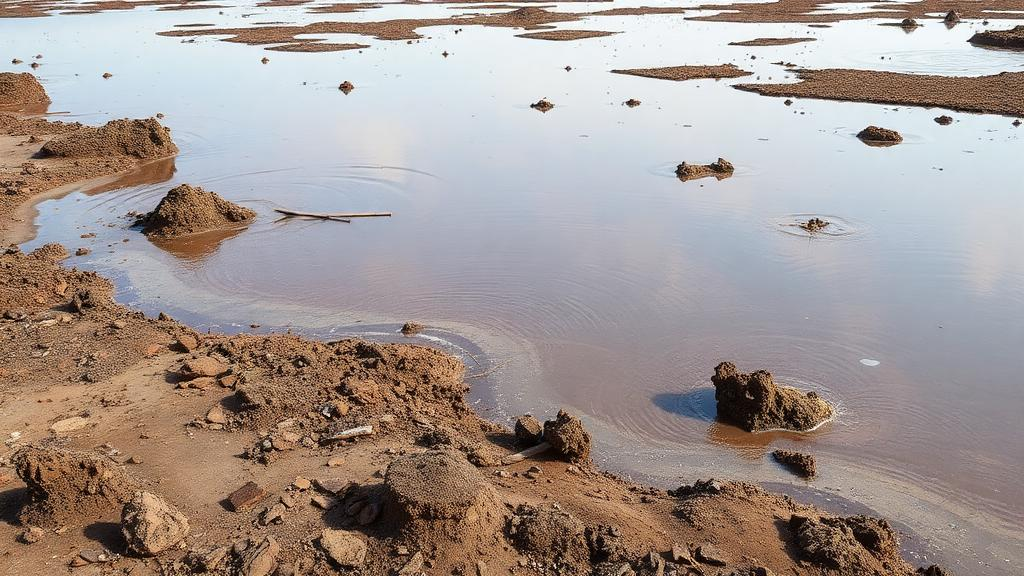
In the coastal district of Lakshmipur, southeastern Bangladesh, the water that families draw from their tube wells each day is quietly changing. A new study published in Environmental Geochemistry and Health has taken one of the most detailed seasonal snapshots yet of the region’s groundwater, and the picture it paints is troubling. Researchers from the University of Rajshahi collected 46 groundwater samples across the district, half before the monsoon rains arrived in March and April 2024 and half after the rains receded in October and November 2024. By comparing the two seasons side by side, they were able to track how the chemistry of this vital resource shifts as the delta alternates between dryness and deluge, and how those shifts translate into real risks for the people who depend on these aquifers for drinking water.
The team measured the full suite of physicochemical parameters, major ionic species, and selected trace metals using standard field and laboratory methods. What they found was a groundwater system under pressure from both natural geogenic processes and human activity. In the pre-monsoon period, salinity exceeded acceptable limits in 54.16 percent of samples, while sodium and chloride concentrations breached thresholds in 58.33 percent. Heavy metals told an even starker story: iron surpassed the standards set by Bangladesh’s Department of Environment in 75 percent of samples, manganese in 91.67 percent, potassium in 71.17 percent, and arsenic in 66.67 percent. These are not marginal exceedances confined to a few unlucky wells; they describe a broad regional pattern of contamination affecting the majority of the water sources tested.
After the monsoon, the pattern shifted but did not improve. Salinity exceedance dropped to 43.48 percent of samples, suggesting that monsoon recharge dilutes some of the salt burden, yet sodium concentrations exceeded limits in 65.22 percent of samples and chloride in 47.83 percent. More alarmingly, arsenic exceedance jumped to 95.65 percent of post-monsoon samples, while iron and manganese remained problematic in 86.96 percent and 73.91 percent respectively, and potassium in 60.87 percent. The monsoon, rather than flushing the aquifer clean, appears to mobilize or concentrate certain contaminants, particularly arsenic, in ways that make post-monsoon water in many wells less safe than the same wells produced months earlier.
To understand why, the researchers turned to the classical tools of hydrogeochemistry. Integrated analysis of the water’s ionic composition indicated that groundwater evolution in the district is strongly controlled by mineral dissolution and water-rock interaction, the slow chemical conversation between infiltrating rainwater and the sediments it percolates through. Ratios of sodium to chloride below one pointed to chloride enrichment driven by evaporation and localized saline-water influence, a signature consistent with coastal intrusion and concentration effects. Positive values of the chloro-alkaline indices revealed the occurrence of reverse ion exchange, a process in which calcium and magnesium in the water swap places with sodium held on clay mineral surfaces, further reshaping the water’s chemistry as it moves through the aquifer matrix.
The study’s methodological novelty lies in how it translates all this chemistry into a single, defensible measure of drinkability. Rather than relying on a conventional water quality index, which weights every parameter equally regardless of how much it actually varies, the team employed an entropy-based water quality index, or EWQI. Rooted in Shannon’s information theory, entropy weighting assigns greater influence to parameters that show the most variability and uncertainty across samples, letting the data itself decide which contaminants matter most. In the pre-monsoon season, 20 percent of samples rated as excellent and 35 percent as good, but a striking 30 percent fell into the extremely poor category. After the monsoon, excellent samples rose to 30 percent, yet extremely poor samples climbed to 43 percent, meaning that while some wells improved, the worst wells got worse, widening the gap between safe and unsafe water sources across the district.
Because water quality classification is inherently fuzzy, a sample is rarely purely good or purely bad, the researchers also deployed a fuzzy inference system coupled with three-dimensional response surface analysis. This modeling approach, borrowed from control engineering, allows partial memberships in multiple quality categories simultaneously and can probe how pairs of contaminants jointly influence the overall index. The analysis revealed that interactions between iron and potassium, and between manganese and arsenic, were strongly associated with variations in the EWQI. In other words, the degradation of water quality in Lakshmipur is not simply the sum of individual contaminants but emerges from combinations of metals acting together, a finding that has direct implications for which wells should be prioritized for treatment or abandonment.
Independent pollution indices corroborated the EWQI results. The heavy metal pollution index, the heavy metal evaluation index, the degree of contamination, and the nitrate pollution index all confirmed widespread heavy metal contamination across the sampled wells. The convergence of four separate indices, each constructed differently, on the same conclusion strengthens the case that metal contamination in the district’s aquifers is systemic rather than incidental. Given that arsenic enrichment in the alluvial aquifers of the Bengal delta has been documented for decades, the new study adds Lakshmipur to the map of districts where the problem persists and, in the post-monsoon window, intensifies.
The most consequential part of the analysis concerns human health. Using standard exposure models, the team calculated hazard quotients for non-carcinogenic effects of the detected contaminants and aggregated them into a hazard index. The results showed that children face greater non-carcinogenic risks than adults, with hazard index values exceeding the safe threshold of one. A hazard index above one indicates that the combined exposure to contaminants through drinking water surpasses the level considered acceptable over a lifetime, and the fact that children exceed this threshold more readily reflects their higher water intake relative to body weight and their developing physiology. In practical terms, the water from a substantial fraction of wells in the district poses measurable health risks to the most vulnerable members of the community.
What emerges from the study is a call to action grounded in seasonal reality. The authors emphasize the need for regular seasonal groundwater monitoring, safe-well mapping so that households can identify which wells are safe at which times of year, treatment of metal-contaminated wells, and sustainable management of the coastal aquifer as a whole. Because water quality in Lakshmipur is not static, a well that tests clean in March may deliver arsenic-laden water in November, monitoring programs that sample only once a year risk systematically missing the worst conditions. The integration of entropy weighting, fuzzy logic, pollution indices, hydrogeochemical interpretation, and health risk assessment in a single framework offers a template that could be applied to other coastal districts of Bangladesh and to deltaic aquifers worldwide facing similar combinations of salinity, geogenic metals, and human pressures.
The researchers also chart a path forward. Future work, they note, should include long-term seasonal observations, denser sampling networks, and formal uncertainty and sensitivity analyses to sharpen groundwater quality assessments under changing climatic and anthropogenic conditions. As sea levels rise and extraction intensifies across the Ganges-Brahmaputra-Meghna delta, the pressures on aquifers like Lakshmipur’s will only grow. This study demonstrates that with the right analytical toolkit, it is possible to see not just whether groundwater is contaminated, but when, where, and why, knowledge that coastal communities will need in increasing measure as the seasons continue to reshape the water beneath their feet.
Subject of Research: Seasonal hydrogeochemistry, water quality, and health risks of coastal groundwater in Lakshmipur District, Bangladesh
Article Title: Hydrogeochemical evaluation and entropy-driven water quality assessment of Lakshmipur District’s groundwater, Southeastern Bangladesh
Article References: Hasan, M. M., Haque, K. E., Ahmed, S., Hasan, M. N. I., & Hasan, M. M. (2026). Hydrogeochemical evaluation and entropy-driven water quality assessment of Lakshmipur District’s groundwater, Southeastern Bangladesh. Environmental Geochemistry and Health, 48(15), Article 616. https://doi.org/10.1007/s10653-026-03501-4
Image Credits: AI Generated
DOI: 10.1007/s10653-026-03501-4
Keywords: groundwater, Bangladesh, coastal aquifer, arsenic, heavy metals, salinity, entropy water quality index, fuzzy inference, health risk assessment, hydrogeochemistry, water pollution, seasonal monitoring
Cite Scienmag News
Sloane Callahan. (September 30, 2026). Groundwater in Coastal Bangladesh Is Failing the Test, Season by Season. Scienmag. https://scienmag.com/groundwater-in-coastal-bangladesh-is-failing-the-test-season-by-season/
Sloane Callahan. "Groundwater in Coastal Bangladesh Is Failing the Test, Season by Season." Scienmag, 30 September 2026, https://scienmag.com/groundwater-in-coastal-bangladesh-is-failing-the-test-season-by-season/. Accessed 30 September 2026.
Sloane Callahan. "Groundwater in Coastal Bangladesh Is Failing the Test, Season by Season." Scienmag. September 30, 2026. https://scienmag.com/groundwater-in-coastal-bangladesh-is-failing-the-test-season-by-season/


