


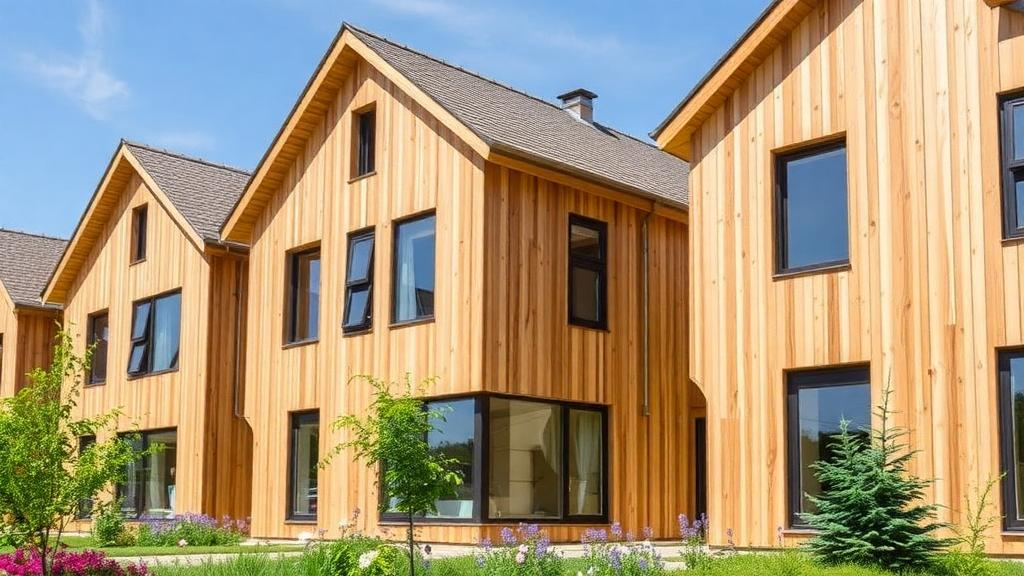
Denmark’s construction industry stands at a crossroads, and a new study suggests the path it chooses could determine whether the nation’s buildings ever fit within its climate budget. Researchers from Aalborg University have projected the material flows and environmental impacts of Danish construction from 2025 to 2050, comparing a future built with wood against one built the conventional way with concrete, brick, and steel. Their conclusion is striking: a full shift to wood-based construction could nearly halve the greenhouse gas emissions of new buildings, yet even that dramatic improvement would leave the sector consuming almost half of Denmark’s entire allocated share of the global carbon budget.
The study, published in the Journal of Industrial Ecology, analyzed sixteen real-world case buildings spanning eight typologies, including single-family homes, multi-family apartments, offices, schools, daycares, retail spaces, sports centers, and cultural buildings. Wooden buildings were defined as those with at least half of their structural components made of wood, while conventional buildings reflected traditional Danish practice, relying primarily on concrete, bricks, and steel. Each building underwent a full life cycle assessment following the European standards EN 15804 and EN 15978, covering material production, transportation, construction, replacements during a fifty-year reference period, and end-of-life processing. The team then coupled these building-level assessments with a national forecast of construction activity generated using the Holt-Winters time series method, which captures both the long-term trend and the cyclical rhythm of the building sector.
The material flow analysis reveals how deeply concrete is embedded in Danish construction, even when wood takes center stage. In the wood-based pathway, concrete still accounts for 68 percent of total material weight, largely because foundations and ground slabs remain concrete-intensive; together these two elements make up roughly two-thirds of the mass of a wooden building. In the conventional pathway, concrete dominates even more thoroughly at 85 percent of total weight. Wood and other biobased products comprise 23 percent of material weight in the wooden pathway but a mere 2 percent in the conventional one. Single-family homes, multi-family homes, and office buildings emerge as the dominant consumers of materials and the largest emitters, together representing the bulk of both pathways’ projected impacts through 2050.
The climate results are unambiguous. Under an immediate, complete transition to wood construction, new Danish buildings would emit 1.04 million tons of CO2 equivalents per year, compared with 2.03 million tons under conventional construction. The upstream picture is even more dramatic: because wood sequesters carbon as it grows, and the study applied the standard minus-one-plus-one accounting rule that credits this storage at material production and releases it at end of life, the wooden pathway shows net-negative upstream emissions of 0.16 million tons of CO2 equivalents annually, while the conventional pathway generates 1.40 million tons from manufacturing alone, a difference of more than eightfold. Conventional construction also fared worse in photochemical ozone formation, acidification, fossil fuel depletion, and non-renewable energy use, with impacts roughly 1.3 to 2 times higher.
Yet the study is notable for refusing to tell a simple story of wood as an environmental panacea. The researchers assessed the full suite of impact categories specified in the Danish regulation, and wood-based construction showed modestly higher impacts in ozone depletion, eutrophication, and depletion of minerals and metals. The most significant trade-off appeared in renewable primary energy use, where the wooden pathway scored far higher, reflecting the substantial biogenic energy content of timber, much of which is released when wood is incinerated at end of life to feed Danish district heating systems. Downstream, the wooden pathway showed nearly double the global warming impact of the conventional one, driven by biogenic carbon released during incineration, even though this is balanced by the sequestration credited upstream.
The pace of transition matters as much as the destination. The researchers modeled two gradual scenarios alongside the immediate switch: one rising linearly from today’s 11 percent wood-based share to 50 percent by 2050, and another reaching full adoption by mid-century. Both gradual pathways moderated the benefits and the trade-offs alike. Under partial substitution, the global warming advantage of wood shrank from a factor of 1.9 to between 1.2 and 1.4, a sobering reminder that incremental change delivers incremental results. A sensitivity analysis added another layer of nuance: when conventional buildings were adjusted to comply with Denmark’s tightened climate limit values, the relative advantage of wooden construction narrowed considerably, and in one case, daycare buildings, wood actually performed worse once both systems met regulatory requirements. Part of wood’s apparent benefit, in other words, reflects the poor baseline of conventional practice rather than inherent material superiority.
Concerns about whether European forests could supply such a transition appear, for Denmark at least, to be manageable. Drawing on market analysis of six supplier countries, the study finds that full timber implementation in Danish construction could be met 54 times over under current conditions, and a 50 percent transition 103 times over. Broader European modeling of timber availability, which measures annual net availability to ensure forest regeneration rates remain intact, shows ample supply in the Nordic and Northern Continental regions, with supply-demand balances ranging from 2 in the Continental region up to 15 in the north. The caveat is significant: if all European countries ramp up wood demand simultaneously, resource availability becomes a genuine concern, particularly in the Continental geocluster where potential shortages are concentrated.
The methodological limitations are candidly acknowledged. Each building typology and pathway was represented by a single case building, meaning the forecast inherits the idiosyncrasies of individual designs, geometries, and material choices. Comparison with a global database of material intensities suggests the study’s concrete intensity for multi-family homes sits above the international 75th percentile, while its wood intensities for single-family homes and non-residential buildings exceed typical ranges, potentially inflating the impacts attributed to wood products. The study also applies current environmental product declarations across the entire 2025 to 2050 forecast period, though the authors argue this conservative approach is unlikely to overestimate wood’s benefits.
The most sobering finding transcends the wood-versus-concrete debate entirely. Denmark’s allocated share of the global carbon budget, estimated at 2.1 million tons of CO2 equivalents annually based on the Planetary Boundaries framework, must cover all national consumption, from food and clothing to energy and buildings. New construction alone would consume 49 percent of that budget under the wooden pathway and 96 percent under the conventional one, and since buildings currently account for roughly 30 percent of Denmark’s greenhouse gas emissions, the sector’s emissions far exceed any reasonable allocation. The study’s authors, echoing the United Nations Environment Programme’s avoid-shift-improve framework, conclude that material substitution, however valuable, cannot substitute for systemic change: building less, renovating more, embracing circular economy principles, and continuing to decarbonize conventional materials like concrete. Five of the eight building types could comply with Danish climate limits by switching to wood, making timber a capable near-term strategy, but the numbers make clear that a climate-resilient building sector will require every lever at once.
Subject of Research: Life cycle assessment forecasting of wood-based versus conventional construction pathways and their environmental impacts in Denmark
Article Title: Forecast of building materials and their related environmental impacts: comparing wood-based and conventional construction pathways
Article References: Andersen, C. E., Hansen, R. N., Hoxha, E., & Birgisdóttir, H. (2026). Forecast of building materials and their related environmental impacts: comparing wood-based and conventional construction pathways. Journal of Industrial Ecology. https://doi.org/10.1007/s44498-026-00159-0
Image Credits: AI Generated
DOI: 10.1007/s44498-026-00159-0
Keywords: life cycle assessment, wood construction, greenhouse gas emissions, concrete, building materials, carbon budget, Denmark, biogenic carbon, material flow analysis, sustainable construction, embodied carbon, building regulations
Cite Scienmag News
Sloane Callahan. (September 30, 2026). Wood Buildings Could Halve Construction Emissions, Danish Study Finds. Scienmag. https://scienmag.com/wood-buildings-could-halve-construction-emissions-danish-study-finds/
Sloane Callahan. "Wood Buildings Could Halve Construction Emissions, Danish Study Finds." Scienmag, 30 September 2026, https://scienmag.com/wood-buildings-could-halve-construction-emissions-danish-study-finds/. Accessed 4 October 2026.
Sloane Callahan. "Wood Buildings Could Halve Construction Emissions, Danish Study Finds." Scienmag. September 30, 2026. https://scienmag.com/wood-buildings-could-halve-construction-emissions-danish-study-finds/


