


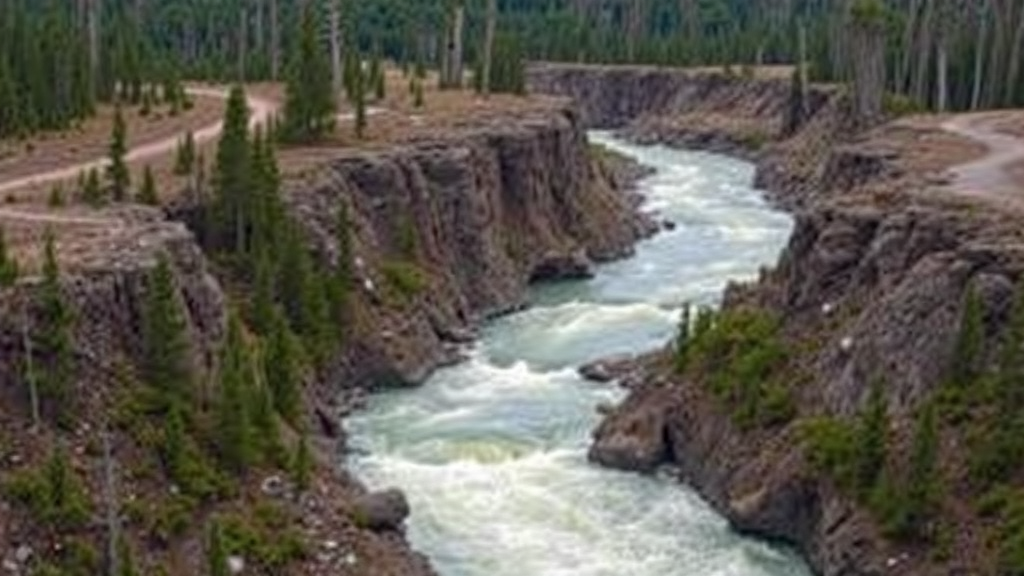
In 2018, scientists flying over a remote river in Alaska’s Brooks Range noticed something that should not have been possible: a bright orange plume billowing through water that had run clear for as long as anyone could record. There was no mine nearby, no industrial facility, no road for hundreds of miles. The watershed was about as pristine as any landscape on Earth. Yet the river was turning the color of rust, and the discoloration was spreading. A new study from the University of California, Davis, published in the journal AGU Advances, now confirms that these orange waters are not a curiosity but a chemical event of remarkable intensity — one that is more acidic and more heavily loaded with metals than the drainage that leaches out of operating metal mines.
The research team examined six affected watersheds, all located within national parks and preserves in northwest Alaska’s Brooks Range, an area protected from development precisely because of its untouched character. Between the summers of 2022 and 2024, the researchers collected water samples from the main channels of these rivers, from their tributaries, and from hillside seeps where groundwater emerges from thawing soil. Their goal was to quantify how acid rock drainage — the same class of chemical process that makes mine runoff toxic — behaves when it is triggered not by excavation but by a warming climate.
The underlying mechanism begins underground. Arctic soils sit atop permafrost, ground that has remained frozen for centuries or millennia. Within that frozen matrix are sulfide minerals, including pyrite, the iron sulfide often called fool’s gold. As air temperatures rise, permafrost thaws and water that once ran off the surface instead trickles down into newly unfrozen soil. There it meets minerals that have never been exposed to oxygenated water. The resulting oxidation reactions release iron, sulfuric acid, and a suite of other metals into the groundwater, which then discharges into streams. The iron precipitates as rusty hydroxides, staining the water orange, while the acid and dissolved metals travel with the flow.
What the new study reveals is how far that contamination travels and how concentrated it becomes. Metal concentrations in the affected rivers measured roughly seventy times higher than baseline levels as far as sixty miles downstream from the points where the metal-rich groundwater entered the channels. Senior author Brett Poulin, a professor in UC Davis’s Environmental Toxicology department, emphasized that this is genuinely acidic, metallic water — comparable to or worse than what drains from mines — despite originating in wilderness. The chemistry of these plumes, he noted, can become more toxic as the water moves downstream, meaning the impact zone extends far beyond the hillside seeps where the process begins.
There is, however, a measure of resilience built into the river systems themselves. The study found that the main channels did not become more acidic overall, even as acidic tributary inputs accumulated. The rivers appear to buffer the incoming low-pH water, a capacity the researchers interpret as a sign that the system can partially absorb the shock. Poulin described this buffering as good news, but he paired it with a caution: while the pH of the mainstem holds, dissolved metals increase downstream and can be transported over very long distances, carrying the contamination into habitats well removed from the thaw zones where it originates.
To understand when and why this phenomenon began, the team turned to long-term water quality records for the region. The analysis traced the onset of the acid rock drainage event to 2019, a year that coincided with the hottest summer on record in Alaska, followed by an unusually snowy winter. That combination, the researchers argue, set the stage for a region-wide chemical trigger. Deep snow insulates the ground beneath it, preventing the soil from refreezing during winter. When the next summer arrived, water was able to penetrate deeper into the soil column than it had in previous years, reaching mineral deposits that had remained sealed behind the frozen layer.
The records showed abrupt, large spikes in sulfate and zinc concentrations in 2019, followed by a steady decline as the watersheds entered what the authors describe as a recovery phase. First author Taylor Evinger, a Ph.D. candidate in Poulin’s lab, explained the team’s interpretation: water moved deeper into the soil because of thaw, interacted with the sulfide minerals trapped there, and triggered all of these watersheds at roughly the same time. The synchrony across multiple independent drainages is itself telling. It suggests that a single climatic anomaly — one extreme summer and one insulating winter — was sufficient to switch on acid-generating chemistry across an entire region of the Arctic.
The scale of the phenomenon continues to grow. Previous studies had already documented more than 200 rivers and streams affected by rusting water, and since Poulin’s group published its initial 2024 paper attributing the color change to thawing permafrost, similar occurrences have been reported in boreal and Arctic Canada and in other permafrost-bearing parts of the world. Poulin stressed that this process was never forecast, predicted, or included in any assessment of how the Arctic will change under a warming climate. It represents an entirely unanticipated pathway by which climate change alters water chemistry — not through melting ice or shifting precipitation alone, but by unlocking geochemical reactions that had been locked away in frozen ground for thousands of years.
For now, the direct risks appear contained. There are no known adverse impacts to people or wildlife from the acid rock drainage entering these remote streams, and researchers have not observed massive fish die-offs or drinking water quality problems harming villages. But the authors are careful to frame that reassurance as provisional. Additional research is underway to examine the risks more deeply, particularly because metal toxicity in aquatic food webs can accumulate gradually and because the affected watersheds feed into larger river systems. The team also notes that thawing permafrost and the ground subsidence that accompanies it carry implications for local infrastructure, an added dimension of concern for communities across the Arctic.
Evinger summarized the study’s dual message as concerns and hopes. The hope lies in the rivers’ demonstrated buffering capacity and in the apparent recovery phase following the 2019 spike, which suggests the systems are not in runaway decline. The concern lies in the sheer number of affected watersheds — hundreds of them — and in what the phenomenon reveals about the reach of climate change. These rivers are essentially untouched by human activity, and yet they are undergoing chemical transformation as severe as anything produced by industrial mining. That a warming atmosphere can generate mine-strength acid drainage in protected wilderness, the researchers argue, is a new reality of climate change, one that water quality assessments across the circumpolar North will now have to confront.
Subject of Research: Climate-driven thawing of permafrost triggering acid rock drainage and metal contamination in Arctic rivers
Article Title: Alaska’s orange rivers more metallic than acid mine drainage
Article References: Alaska’s orange rivers more metallic than acid mine drainage. (n.d.). Original publication
Image Credits: AI Generated
DOI: Not provided
Keywords: permafrost thaw, acid rock drainage, rusting rivers, Alaska, Brooks Range, water quality, heavy metals, Arctic climate change, sulfide minerals, river chemistry, UC Davis, AGU Advances
Cite Scienmag News
Russell Cooper. (September 26, 2026). Alaska’s Rusting Rivers Carry Metal Loads Far Exceeding Mine Drainage. Scienmag. https://scienmag.com/alaskas-rusting-rivers-carry-metal-loads-far-exceeding-mine-drainage/
Russell Cooper. "Alaska’s Rusting Rivers Carry Metal Loads Far Exceeding Mine Drainage." Scienmag, 26 September 2026, https://scienmag.com/alaskas-rusting-rivers-carry-metal-loads-far-exceeding-mine-drainage/. Accessed 26 September 2026.
Russell Cooper. "Alaska’s Rusting Rivers Carry Metal Loads Far Exceeding Mine Drainage." Scienmag. September 26, 2026. https://scienmag.com/alaskas-rusting-rivers-carry-metal-loads-far-exceeding-mine-drainage/


