


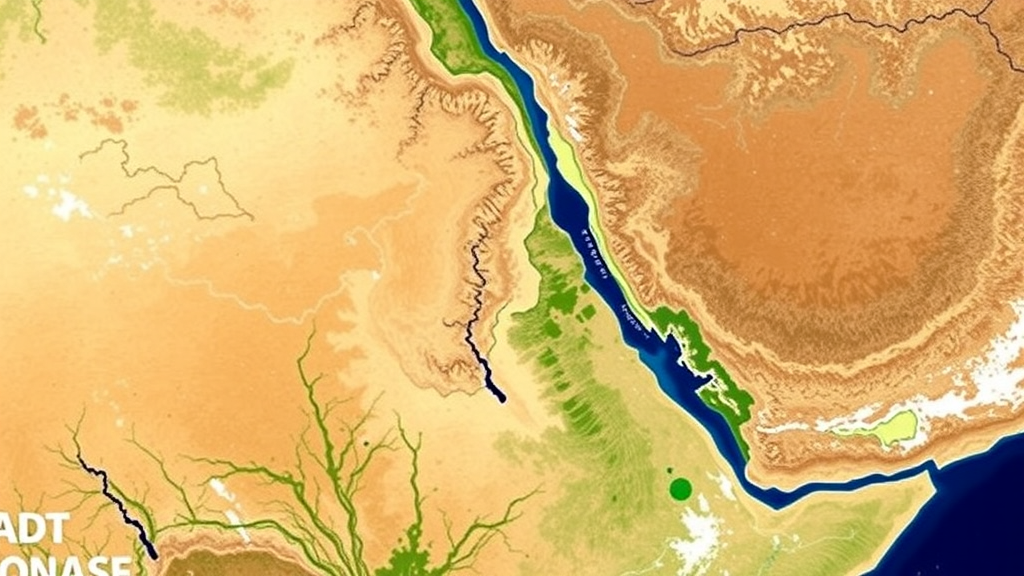
Dryland ecosystems, which span roughly 40 percent of Earth’s land surface and provide a home and livelihood for more than two billion people, have long been portrayed in satellite records as one of the planet’s quiet success stories. Rising atmospheric carbon dioxide has fertilized plant growth across the world’s arid and semi-arid regions, producing a persistent greening trend that shows up clearly in decades of orbital measurements. But a new study published in Nature Climate Change by researchers at the University of Arizona reveals that this apparent stability is deceptive. Beneath the greening trend lies an escalating pattern of year-to-year volatility, in which wet years produce explosive vegetation growth and dry years inflict increasingly severe setbacks. According to the analysis, roughly 80 percent of global drylands are experiencing this intensifying instability, a dynamic that global vegetation models have so far failed to capture.
The research, led by Wen Zhang, a doctoral student in the University of Arizona’s School of Natural Resources and the Environment, drew on more than 40 years of satellite observations to track changes in the vegetation leaf area index, a measure closely linked to vegetation activity and productivity. Leaf area index quantifies the amount of leaf surface per unit of ground area, making it one of the most direct remotely sensed indicators of how much photosynthetic machinery an ecosystem is deploying at any given time. By examining how this index fluctuated across four decades, the team could distinguish the long-term greening trend from the shorter-term swings superimposed on it. What they found was that the extremes are diverging: the upper peaks of vegetation activity during wet years and the lower troughs during dry years are moving farther and farther apart as time goes by.
“The upper and lower extremes are getting farther and farther apart as time goes by,” Zhang said. “Vegetation activity is increasing during wet years, but dry years are hitting plants harder. It’s a bit like the nursery rhyme about the little girl with the curl: When it’s good, it’s very good, but when it’s bad, it’s awful.” The metaphor captures a phenomenon that ecologists describe as a boom-and-bust dynamic, in which the amplitude of ecosystem variability grows even as the average trajectory appears healthy. In practical terms, a dryland that greening statistics suggest is thriving may in fact be swinging between states of lush productivity and stress with a frequency and intensity that earlier decades never showed.
The most likely driver of this pattern, Zhang explained, is the combination of rising atmospheric carbon dioxide with natural rainfall variability, although she cautioned that more data is needed to pin down the precise mechanisms. There is evidence that under elevated CO2 concentrations, plants can use water more efficiently, because higher CO2 levels allow them to photosynthesize while keeping their stomata, the microscopic pores on leaf surfaces, partially closed. This improved water-use efficiency reduces water loss and enables plants to grow more leaves, particularly in water-limited environments where moisture is the primary constraint on growth. The result is the well-documented CO2 fertilization effect that underlies the dryland greening trend observed from space.
But the same physiological advantage carries a hidden cost. “Larger vegetation requires more resources to maintain, so when a moderate drought hits the following year, these larger plant structures need more resources than are available, which leaves them far more sensitive and vulnerable,” Zhang said. In other words, the extra leaf area that CO2 fertilization produces during favorable years becomes a liability when water is scarce. Bigger canopies demand more transpiration to stay cool and more carbohydrates to maintain, and when a drought arrives, the oversized vegetation experiences proportionally greater stress than it would have in a lower-CO2 world. This mechanism can transform an ordinary dry year into a disproportionately severe bust, amplifying the natural oscillation of dryland ecosystems rather than damping it.
The consequences of this growing volatility extend well beyond ecology into the economics of agriculture and livestock production. In rain-fed farming regions such as the American Southwest, where crops depend directly on precipitation rather than irrigation, higher year-to-year variability may force a heavier reliance on artificial irrigation simply to maintain consistent productivity. Pasture and rangeland forage production, which follows the same boom-and-bust rhythm as natural vegetation, will likewise become harder to predict. For ranchers who must decide each season how many animals their land can support, that unpredictability is not an abstract concern but a direct threat to planning and livelihoods.
“Higher variability in forage production presents a significant challenge for rangeland managers,” said Bill Smith, senior author of the study and an associate professor specializing in land, water and climate change geospatial analysis in the School of Natural Resources and the Environment. “Ranchers depend on stable forage production so they can accurately plan out their land needs each growing season. Less predictable forage production can thus disrupt their plans with potential detrimental consequences to livelihoods.” In regions where stocking decisions must be made months in advance of the growing season, a single bust year that follows an unusually productive boom can leave managers with herds that their pastures cannot sustain, forcing costly destocking or supplemental feeding.
Beyond its immediate agricultural implications, the intensifying flicker in dryland productivity may be an early warning of deeper ecological change. David Moore, a study co-author and professor in the School of Natural Resources and the Environment who chairs the watershed management and ecohydrology program, pointed to a pattern observed across many ecological systems. “If you look at lots of different ecological systems, their productivity tends to flicker on and off right before a big change happened. It’s a sign that they’re under stress and losing their resilience. It’s possible that’s what’s happening with drylands,” he said. This idea, sometimes discussed in the scientific literature as a critical slowing down or flickering signal preceding regime shifts, suggests that the growing variance in dryland vegetation could foreshadow a transition to a fundamentally different ecosystem state, though predicting the ultimate outcome of such flickering remains difficult.
Part of that difficulty lies in the limitations of the tools scientists use to project the future. The study evaluated 13 of the leading global vegetation models and found that none of them captured the observed increase in year-to-year variability. “The models assume drylands are still stable and that plants will respond to changes in atmospheric carbon dioxide and rainfall in predictable ways,” Zhang said. “They fail to account for how plant responses are fundamentally changing over time.” In effect, the models reproduce the greening trend but not the instability that accompanies it, presenting a smoothed and overly optimistic picture of dryland behavior. Because these models feed into the Earth system models used for climate projections, the blind spot propagates upward into forecasts of carbon storage, water resources and food production.
“If Earth system models are not correctly capturing the sensitivity of dryland plants to climate change, then all bets are off when making projections 50 years into the future,” Smith said. “We hope this paper inspires new research focused on a better understanding and representation of drylands in the Earth system.” The message of the study is ultimately one of recalibration: the greening of the world’s drylands, often cited as evidence that rising CO2 is boosting global vegetation, conceals a loss of stability that satellites can now measure and that models must learn to represent. For the two billion people who depend on these landscapes, the difference between a stable green trend and an escalating boom-and-bust cycle is the difference between predictable harvests and a future in which every growing season is a gamble.
Subject of Research: Rising CO2-driven boom-and-bust vegetation instability in global dryland ecosystems
Article Title: Satellite data exposes escalating 'boom-and-bust' dynamic in greening drylands
Article References: Satellite data exposes escalating 'boom-and-bust' dynamic in greening drylands. (n.d.). Original publication
Image Credits: AI Generated
DOI: Not provided
Keywords: drylands, satellite data, leaf area index, CO2 fertilization, vegetation models, climate change, ecosystem stability, rangeland management, rain-fed agriculture, Nature Climate Change, University of Arizona, boom-and-bust dynamics
Cite Scienmag News
Russell Cooper. (September 25, 2026). Four Decades of Satellite Data Reveal Growing Boom-and-Bust Chaos in Greening Drylands. Scienmag. https://scienmag.com/four-decades-of-satellite-data-reveal-growing-boom-and-bust-chaos-in-greening-drylands/
Russell Cooper. "Four Decades of Satellite Data Reveal Growing Boom-and-Bust Chaos in Greening Drylands." Scienmag, 25 September 2026, https://scienmag.com/four-decades-of-satellite-data-reveal-growing-boom-and-bust-chaos-in-greening-drylands/. Accessed 4 October 2026.
Russell Cooper. "Four Decades of Satellite Data Reveal Growing Boom-and-Bust Chaos in Greening Drylands." Scienmag. September 25, 2026. https://scienmag.com/four-decades-of-satellite-data-reveal-growing-boom-and-bust-chaos-in-greening-drylands/


