


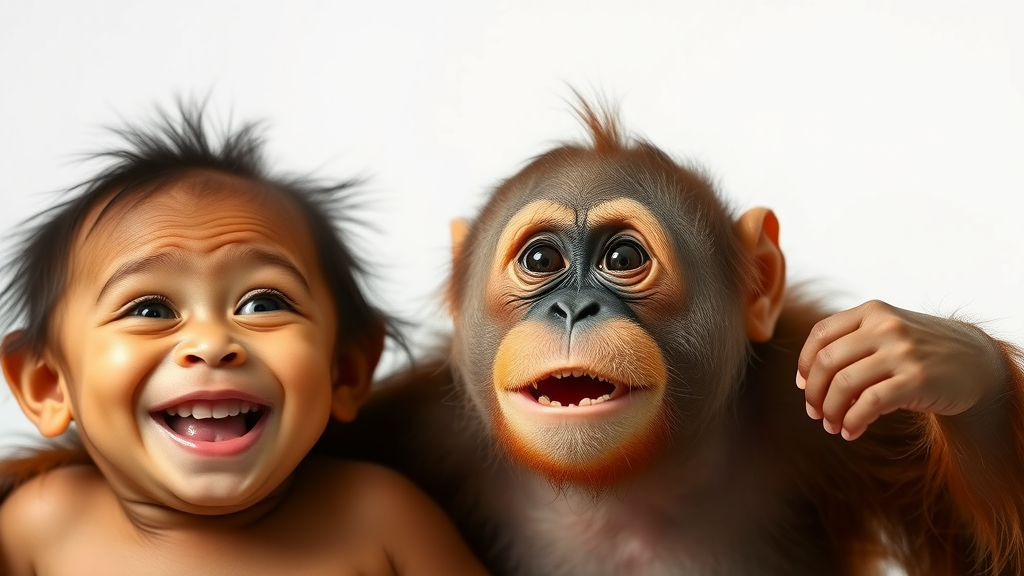
A baby’s first smile, a toddler’s blush of shame, a determined raised chin, an orangutan’s playful grin: these moments may look like small, charming fragments of everyday life, but according to a major new collection of research they are windows onto one of the most fundamental questions in behavioural science. What do emotional expressions actually do, and why have they evolved to be so visible? A special issue of Philosophical Transactions of the Royal Society B, edited by psychologists Milica Nikolić and Disa Sauter of the University of Amsterdam together with Mariska Kret of Leiden University and Lauri Nummenmaa of the University of Turku, gathers nineteen articles that reframe emotional expression not as a passive signal to be decoded by observers, but as an active force that shapes behaviour, development and social relationships from the earliest months of life.
The editorial team behind the issue argues that the field has spent decades focusing heavily on emotion recognition: how accurately observers can identify what someone else is feeling from a face, a voice or a posture. The new collection deliberately shifts the lens inward, toward the person doing the expressing. Emotional expressions, the editors propose, should be understood in terms of their origins and development, their continuity across animal species, and the practical roles they play in behaviour and social life. In this framing, emotions become a visible inner world, a living link between brain, body and environment, rather than a private mental state that occasionally leaks to the surface.
Among the most striking contributions is a study co-conducted by Cristina Colonnesi of the University of Amsterdam, which examines how infants in their first year of life actively construct positive moments with the people around them. The researchers observed that eight-month-old babies, markedly more than four-month-olds, initiate episodes of shared positive emotion themselves. A typical sequence involves a baby smiling and then drawing an adult into mutual laughter, creating a loop of shared enjoyment that the infant, not the caregiver, set in motion. Rather than primarily reacting to another person’s smile, older babies increasingly deploy their own positive expressions as social tools, using them to start and sustain warm, enjoyable interactions.
That developmental shift may look subtle, but its implications are considerable. The ability to initiate, rather than merely respond to, shared positive emotion suggests growing flexibility in how infants use their emotional behaviour in social contexts. It hints that the foundations of humour, joint attention and even the social bonding that characterises later friendship may be laid in the first year of life, not through language or instruction, but through the infant’s own expressive behaviour. Shared laughter between a baby and an adult is, in this view, not a charming by-product of caregiving but a developmental achievement produced by the infant’s emerging expressive control.
A second line of work, presented by Milica Nikolić and colleagues, turns to self-conscious emotions: shame, guilt, shyness and pride. These emotions are distinctive because they arise when children begin to view themselves through the eyes of others, and the research shows that they are already visible in a child’s facial expressions, body posture and gaze during the first few years of life. Crucially, they prove to be far more than internal feelings. The studies reviewed in the issue indicate that these emotions have characteristic outward signatures and, more importantly, predictable behavioural consequences that begin shaping a child’s social world very early.
The consequences differ sharply depending on the emotion. When children feel guilty about something that has gone wrong, they are subsequently more likely to try to make amends, whether by helping others, sharing resources or repairing damage they have caused. Shame produces the opposite pattern: children who feel ashamed are more likely to withdraw, avoid eye contact and steer clear of the situations that triggered the feeling. Nikolić and her colleagues are careful to note that the evidence base is still limited, but they argue that these self-conscious emotions likely play an early role in shaping social behaviour and reputation, functioning as internal regulators that push children toward repair in one case and retreat in the other.
The third major contribution, from Disa Sauter and her team, dismantles one of the most persistent assumptions in popular psychology: that feeling good means smiling. In a study covering twenty-two different positive emotions, grounded in participants’ own personal experiences, the researchers mapped which facial muscles and movements are activated for each emotion. The results reveal that many positive feelings carry their own distinct facial profiles that involve no smile at all. Interest and determination are prime examples; in the case of determination, the defining feature is a raised chin rather than any movement of the mouth. Other positive emotions, such as amusement and elation, do involve distinct smiles, characterised by upturned corners of the mouth and often accompanied by closed eyes and strongly raised cheeks.
The technical significance of this work lies in its demonstration that positive facial behaviour is a heterogeneous family of expressions rather than a single gradient of smile intensity. Feeling good, the researchers show, manifests in a variety of facial configurations, including spontaneous ones, and the classic smile is only one member of that family. For fields ranging from affective computing to clinical screening, which often rely on smile detection as a proxy for positive affect, the findings suggest that such proxies may systematically miss positive states such as interest or determination, and may misread them when they appear without any mouth movement at all.
A fourth study, authored by postdoc Christopher Riddell, Milica Nikolić and colleagues, extends the comparative dimension of the issue by examining mimicry of the play face, an exaggerated, playful expression resembling a smile that typically appears during rough-and-tumble play. The researchers compared infants, adults and orangutans. Both human infants and adults were more likely to produce a play face themselves after observing one in another person than after seeing a neutral expression, and their own expressions mirrored what they saw even without any direct interaction with the person being mirrored. Orangutans, by contrast, rarely showed this behaviour. For them, play faces arise primarily during direct social play, whereas in humans contagious smiling can break free of the play context altogether and spread through observation alone.
Taken together, the nineteen articles of the special issue, published under the title Mechanisms, development, phylogeny and functions of emotional expressions, make a coherent case that emotional expressions are central to development from the very start, shaping both individual behaviour and the formation and regulation of social relationships, from a baby’s first self-initiated smile to the complex body language of shame and pride. In their editorial, Nikolić, Kret, Nummenmaa and Sauter call on the research community to study emotions more within real-life contexts, attending to how expressions emerge, develop and function for both the expresser and the people around them. If the collection is right, the smile that lights up a living room, the guilty glance after a broken vase and the raised chin of a determined child are not merely decorations on an inner life. They are the mechanisms through which that inner life reaches out and builds the social world.
Subject of Research: The development, evolution and social functions of emotional expressions in humans and other animals
Article Title: From a baby's smile to a monkey's grin: how emotions shape our behaviour
Article References: From a baby's smile to a monkey's grin: how emotions shape our behaviour. (n.d.). Original publication
Image Credits: AI Generated
DOI: Not provided
Keywords: emotional expressions, infant development, smiling, self-conscious emotions, shame, guilt, facial expressions, play face, orangutans, mimicry, social behaviour, developmental psychology
Cite Scienmag News
Courtney Benton. (September 26, 2026). From baby smiles to orangutan play faces: how emotional expressions shape behaviour. Scienmag. https://scienmag.com/from-baby-smiles-to-orangutan-play-faces-how-emotional-expressions-shape-behaviour/
Courtney Benton. "From baby smiles to orangutan play faces: how emotional expressions shape behaviour." Scienmag, 26 September 2026, https://scienmag.com/from-baby-smiles-to-orangutan-play-faces-how-emotional-expressions-shape-behaviour/. Accessed 4 October 2026.
Courtney Benton. "From baby smiles to orangutan play faces: how emotional expressions shape behaviour." Scienmag. September 26, 2026. https://scienmag.com/from-baby-smiles-to-orangutan-play-faces-how-emotional-expressions-shape-behaviour/


