


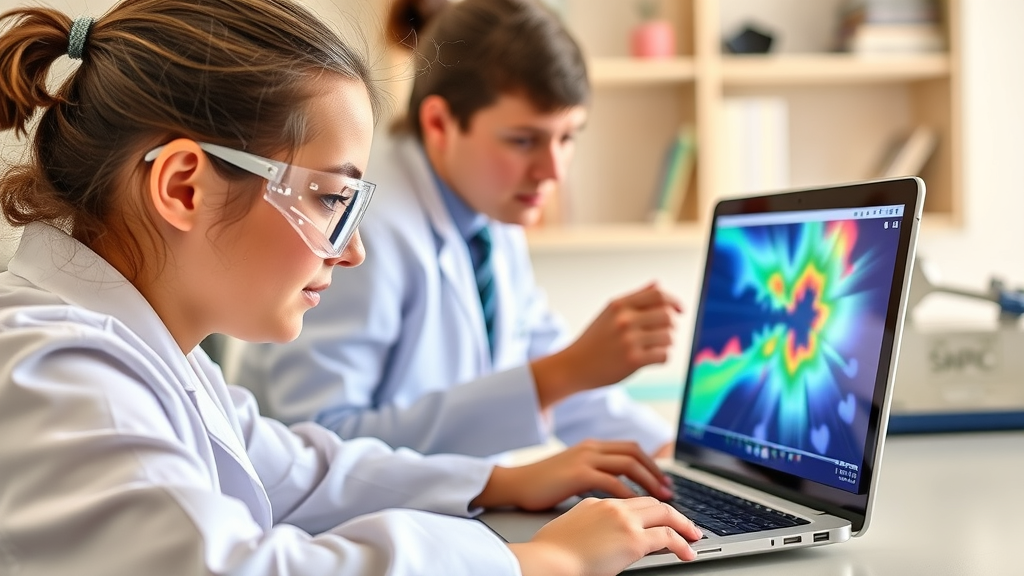
Virtual simulations have long been touted as one of the most promising technologies in science education. By letting students manipulate variables, zoom from macroscopic to submicroscopic levels, and watch abstract concepts come alive on screen, they have repeatedly been shown to improve conceptual understanding, boost motivation, and even outperform some physical laboratory equipment. Yet a large new study of more than 600 science, technology, engineering, and mathematics teachers in Spain reveals a sobering gap between what these tools can do and how often they are actually used in secondary classrooms. The research, published in the Journal of New Approaches in Educational Research, offers one of the most detailed portraits to date of why adoption has lagged, and its findings resonate far beyond Spain.
The team, led by Álvaro Barreras of the Universidad Internacional de La Rioja, surveyed 609 in-service teachers of mathematics, physics, chemistry, biology, geology, and technology across all of Spain’s autonomous communities and the autonomous city of Ceuta. The sample, drawn through convenience non-probability sampling, was large enough to meet accepted standards for populations exceeding 5,000 individuals. It skews toward public schools, which accounted for 80.8 percent of respondents, and toward urban settings, at 73.9 percent. Women made up 62.2 percent of participants, and nearly 37 percent had more than two decades of teaching experience. Data were collected in early 2022 using two previously validated instruments, one measuring teacher competences in the use of virtual simulations and the other measuring attitudes toward them.
The headline result is striking: only 54 percent of the teachers surveyed use virtual simulations habitually in their science classes. The rest either use them occasionally, at 29 percent, or never, at 17 percent. For a technology that the literature credits with improving student performance both on its own and in combination with real laboratories, that figure represents a substantial underuse. The study’s authors argue that this mismatch between proven benefit and classroom reality demands attention from both researchers and education policymakers, especially because simulations support scientific inquiry, mathematical competence, and conceptual model comprehension while simultaneously engaging students in ways traditional instruction often does not.
Statistical analysis revealed that age, gender, and school type had no significant effect on how frequently teachers used simulations. Instead, two variables mattered: years of teaching experience and the subject taught. Notably, the relationship with experience was not linear. Teachers with between 5 and 10 years in the classroom reported the highest frequency of use, followed by veterans with more than 20 years. The effect of experience was small by conventional benchmarks but classified as medium under Hattie’s educational interpretation. The authors suggest that younger teachers bring stronger general digital skills, while the most experienced teachers contribute superior pedagogical judgment about integrating technology, with the two mid-career and senior groups effectively combining those advantages.
Subject differences proved even more consequential. Physics and chemistry teachers and technology teachers emerged as the heaviest users, while biology and geology teachers and, most strikingly, mathematics teachers rarely reached for simulations. The effect size here was moderate by Cohen’s criteria and high by Hattie’s, with physics and chemistry and technology teachers showing the largest mean ranks. The mathematics finding particularly puzzled the researchers, given the wide availability of free simulation tools in that field and consistent evidence that such resources improve attitudes toward mathematics and mathematical competence. The authors conclude that targeted interventions are needed specifically for mathematics education, where underuse appears most acute despite obvious opportunities.
To understand what was holding teachers back, the study included an open-ended question, with responses analyzed qualitatively by four independent experts using an inductive-deductive framework. The difficulties clustered into four categories: lack of resources, teacher needs, student-related challenges, and curriculum design constraints. The most numerous category, accounting for more than 40 percent of reported difficulties, concerned the teachers themselves. Within it, three subcategories stood out: the poor fit between available simulations and teaching needs, with respondents complaining that tools were often too simple or too complex for their student profiles; the scarcity of formal training, forcing teachers to fund their own learning or teach themselves; and the limited usability of many simulators, which often ship without adequate tutorials.
Resource shortages came second. The dominant complaint was classroom logistics: not enough computers, unreliable devices, and slow internet connections. A smaller subset of teachers, less than 5 percent within that category, pointed to the digital divide at home, noting that some students lack devices and hesitate to use simulations outside school. Student-related difficulties rounded out the picture. About 40 percent of concerns in that category involved students’ limited fluency with simulation software, with one teacher observing that many teenagers use their phones only for social media and little else. Teachers also worried about trial-and-error behavior, in which students click randomly until they hit the right answer instead of reasoning first, along with distraction, low motivation for autonomous inquiry, and loss of focus on the activity’s actual learning goal.
Curriculum design issues, though the least numerous at roughly 10 percent of difficulties, painted a vivid picture of squeezed classroom time. Teachers described wasting precious minutes booting computers and explaining simulator interfaces, struggling to accommodate wide variation in student knowledge levels, and battling large class sizes and 55-minute sessions that leave little room for technological detours. Overly broad curricula compounded the problem. When the researchers tallied the individual subcategories across all responses, three issues together represented more than 60 percent of teachers’ concerns: classroom computer resources, the characteristics and availability of suitable simulations, and the need for training in how to find, select, and integrate them.
The training data underscored that concern. Only 19 percent of surveyed teachers had ever received formal training in virtual simulations, while 81 percent had not. Those most likely to have been trained were experienced teachers of mathematics and technology, an ironic twist given that mathematics teachers were among the least frequent users. Demand for training was nonetheless overwhelming: 50.1 percent rated general training as very necessary and another 27.6 percent as necessary. For training in searching for and selecting simulations, the figures rose to 52.1 percent and 28.6 percent, and for integration into the classroom, 46.1 percent and 28.4 percent. Notably, the need for training declined with experience in a roughly linear fashion, with the newest teachers, those with fewer than five years, expressing the greatest demand, and significant differences emerging between them and colleagues with more than 20 years.
The authors argue that the solution lies in coordinated educational policy and purpose-built training programs rather than in simply distributing more hardware. Effective training, they suggest, should connect teachers to curated repositories of quality simulators, build capacity to evaluate tools against specific learning objectives, demonstrate multiple didactic approaches including demonstration, home use, and guided inquiry projects, and prepare teachers to troubleshoot technical problems on the fly. Because the study was conducted in a single country with non-probabilistic sampling, the results cannot be generalized wholesale, and the authors call for future work comparing in-service and pre-service teachers and precisely defining what teachers in each scientific discipline need from simulation developers. Still, the message is clear: the barriers to virtual simulations are not about teacher skepticism or student ability alone, but about a systemic failure to equip educators with time, tools, and training, a failure that reformers ignore at the cost of a generation’s scientific literacy.
Subject of Research: Factors influencing secondary science teachers' use of virtual simulations in the classroom
Article Title: Factors influencing the use of virtual simulations by science teachers in secondary education
Article References: Barreras, Á., Moreno-Mediavilla, D., Gómez, R., & Palacios, A. (2026). Factors influencing the use of virtual simulations by science teachers in secondary education. Journal of New Approaches in Educational Research, 15(1), Article 1. https://doi.org/10.1007/s44322-025-00049-6
Image Credits: AI Generated
DOI: 10.1007/s44322-025-00049-6
Keywords: virtual simulations, science education, STEM teachers, secondary education, teacher training, educational technology, ICT integration, teacher perceptions, classroom resources, Spain, mathematics education, mixed methods
Cite Scienmag News
Courtney Benton. (September 26, 2026). Why Science Teachers Shy Away From Virtual Simulations Despite Proven Benefits. Scienmag. https://scienmag.com/why-science-teachers-shy-away-from-virtual-simulations-despite-proven-benefits/
Courtney Benton. "Why Science Teachers Shy Away From Virtual Simulations Despite Proven Benefits." Scienmag, 26 September 2026, https://scienmag.com/why-science-teachers-shy-away-from-virtual-simulations-despite-proven-benefits/. Accessed 26 September 2026.
Courtney Benton. "Why Science Teachers Shy Away From Virtual Simulations Despite Proven Benefits." Scienmag. September 26, 2026. https://scienmag.com/why-science-teachers-shy-away-from-virtual-simulations-despite-proven-benefits/


