


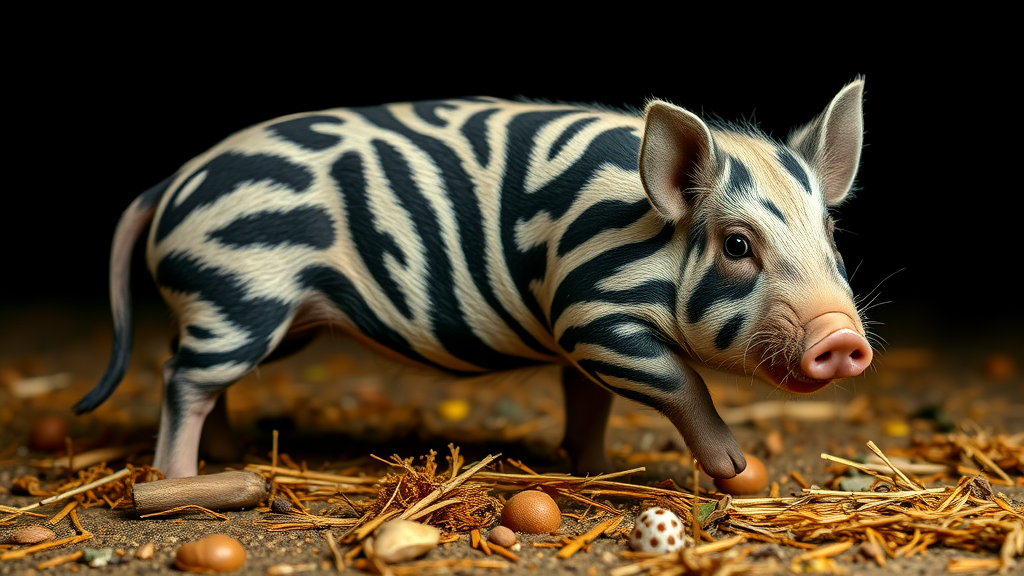
Few sights in the animal kingdom are as instantly recognizable as the striped coat of a wild boar piglet. Those alternating bands of light and dark fur, known as juvenile stripes, act as a built-in camouflage pattern that helps newborn animals melt into dappled forest undergrowth and avoid the eyes of predators. As the piglet matures, the pattern quietly fades, replaced by the uniform grizzled coat of the adult. The pattern also surfaces in hybrid populations of wild boar and even in experimental crosses between European white Duroc and Chinese Erhualian pigs, making the trait a natural experiment in mammalian pigment genetics. Yet despite its visibility and evolutionary importance, the molecular machinery that paints these stripes onto a newborn pig has remained largely unexplored. A new study published in BMC Genomics by Sanya Xiong and colleagues at Jiangxi Agricultural University now offers the most detailed genetic and molecular portrait of porcine juvenile striping to date.
The research team assembled an unusually powerful resource for dissecting the trait: a population of 932 second-generation offspring produced by intercrossing white Duroc boars with Erhualian sows. Because juvenile striping appears in this intercross population alongside solid-colored animals, the pedigree provided the statistical contrast needed to hunt for the trait’s genetic architecture. The researchers performed genome-wide association studies, or GWAS, using both chip-based genotyping and imputation-based approaches that leverage whole-genome sequence data to fill in millions of additional variants. This dual strategy allowed them to scan the pig genome for DNA markers that reliably track with the presence or absence of stripes across hundreds of animals, a standard technique in quantitative genetics that correlates inherited variation with observable traits.
The scan produced two suggestive association signals, one on pig chromosome 6 and another on chromosome 8. On chromosome 6, the strongest positional candidate was MC1R, the melanocortin 1 receptor gene that sits at the heart of the melanin switching system in mammals. MC1R acts as a molecular dial that determines whether pigment cells produce dark eumelanin or reddish-yellow pheomelanin, and mutations in this gene are responsible for some of the most famous coat color variants in dogs, horses, cattle, and pigs. On chromosome 8, the candidate gene was KIT, a receptor tyrosine kinase gene famous for its role in the migration and survival of pigment-producing cells during embryonic development. KIT disruptions classically produce white spotting patterns, because pigment cell precursors fail to reach their destinations in the skin.
Genotyping of the candidate mutations revealed a striking pattern. The striped pigs in the study did not carry the MC1R c.67_68insCC insertion mutation, and they also lacked the KIT duplication that produces characteristic white patterning in domestic pigs. This tells a coherent story: these two well-known pigment mutations, when present, appear to disrupt or erase the juvenile stripe pattern entirely. But the inverse did not hold. Some animals in the population that lacked both mutations still failed to show stripes, indicating that the presence of a striped coat cannot be explained by these two loci alone. Something else in the genome must be required to switch the stripe program on, prompting the team to dig deeper.
That deeper search took the form of a conditional GWAS, a statistical refinement in which the researchers re-ran the association analysis while accounting for the effects of the already-identified loci. By statistically removing the contribution of the MC1R and KIT regions, the analysis could expose additional genetic signals that had been masked by the stronger effects. This approach uncovered a further genomic locus, again on chromosome 8, and the gene nearest to the new association signal was CORIN. CORIN encodes a membrane-bound serine protease with a well-documented role in pigmentation biology; in other mammals, corin mutations are known to shift the balance of the melanocortin pathway and alter coat color patterning. Its emergence from the conditional analysis suggests that CORIN may act as a modifier that cooperates with the primary pigment genes to permit the striped pattern to develop.
Identifying the genes involved was only half the puzzle. Juvenile striping is fundamentally a spatial phenomenon: neighboring regions of the same dorsal skin follow different pigment programs, producing alternating dark and light bands. To understand how one patch of skin knows to go dark while its neighbor stays light, the team collected skin samples from the dark stripes and light stripes of three 2-day-old striped piglets and subjected them to parallel comparative transcriptome sequencing, or RNA-seq, which measures which genes are active in each tissue. The spatial comparison revealed that TYRP1, tyrosinase-related protein 1, was significantly upregulated in the dark-stripe skin. TYRP1 is an enzyme working directly in the melanin biosynthesis pathway, supporting the production of eumelanin, so its elevated activity in dark bands fits neatly with the visible difference in pigment deposition between the two stripe types.
The most technically ambitious component of the study was its use of ATAC-seq, the assay for transposase-accessible chromatin using sequencing. This method exploits a laboratory enzyme that preferentially inserts sequencing adapters into open, loosely packed stretches of chromatin, thereby creating a genome-wide map of regulatory regions where DNA is physically accessible to transcription factors. Because gene activity is largely controlled by which regulatory switches are open at any given moment, ATAC-seq reveals the layer of regulation that sits above the genome sequence itself. The team profiled accessible chromatin separately in dark-stripe and light-stripe skin, identifying peaks specific to each compartment and quantifying their quality using standard metrics such as the fraction of reads falling within peaks.
That chromatin map delivered a compelling lead. The researchers identified an accessible chromatin region located 1.8 kilobases downstream of the TYRP1 gene, a position consistent with a distal regulatory element such as an enhancer. Enhancers are DNA sequences that can lie far from the gene they control, binding transcription factor proteins and boosting gene expression in specific tissues or, in this case, specific skin territories. The analysis suggested that this downstream accessible region may contain binding sites for SOX10, the SRY-box transcription factor 10, a master regulator of the neural crest lineage from which pigment cells are born. If SOX10 or related factors bind preferentially to this open region in dark-stripe skin, it could explain how TYRP1 expression is boosted in the dark bands while remaining lower in the light ones, providing a plausible molecular mechanism for the spatial patterning of the stripes.
Taken together, the study sketches a layered genetic model of porcine juvenile striping. At the top level, the presence or absence of disruptive pigment mutations matters: the MC1R c.67_68insCC insertion and the KIT duplication appear capable of overriding the stripe program, which is why striped coats vanish from most domestic pig lineages where these mutations have been selected, whether deliberately or incidentally, during breeding. Below that, a conditional locus near CORIN likely contributes to whether the stripe program can be expressed at all in animals free of the disruptive mutations. And at the finest level, the pattern itself is executed through spatially restricted gene regulation, with an accessible chromatin element downstream of TYRP1, potentially controlled by SOX10-family transcription factors, driving higher melanogenic activity in dark-stripe skin than in adjacent light-stripe skin.
The work also demonstrates the power of integrating multiple genomic technologies on a single well-structured population. GWAS pinpointed where in the genome the relevant variation lies, RNA-seq revealed which genes behave differently between the patterned territories, and ATAC-seq illuminated the regulatory landscape that might explain that differential behavior. Each method alone would have left the picture incomplete; the association signals could not say how stripes are patterned, and the expression data could not say why TYRP1 differs between bands. For pig breeders and evolutionary biologists alike, the findings carry practical weight. Understanding which mutations erase juvenile striping clarifies how domestication reshaped coat appearance, and the identification of CORIN and the TYRP1 regulatory region provides molecular markers that could be used to track or manipulate the trait. More broadly, the striped piglet joins the growing list of mammalian color-pattern systems, from zebrafish stripes to big-cat rosettes, in which the interplay of pigment genes and chromatin-level regulation is being decoded base pair by base pair.
Subject of Research: The genetic and molecular mechanisms underlying juvenile stripe coat patterning in pigs
Article Title: Unraveling porcine juvenile striping: insights from the integration of genomics, transcriptomics and ATAC-seq
Article References: Xiong, S., Cui, D., Xiao, S., Li, L., & Guo, Y. (2026). Unraveling porcine juvenile striping: insights from the integration of genomics, transcriptomics and ATAC-seq. BMC Genomics. https://doi.org/10.1186/s12864-026-13377-4
Image Credits: AI Generated
DOI: 10.1186/s12864-026-13377-4
Keywords: juvenile stripes, wild boar, pig genetics, GWAS, MC1R, KIT, CORIN, TYRP1, ATAC-seq, RNA-seq, SOX10, coat color
Cite Scienmag News
Juliet Wilcox. (September 25, 2026). Genomics Study Decodes the Striped Camouflage of Wild Boar Piglets. Scienmag. https://scienmag.com/genomics-study-decodes-the-striped-camouflage-of-wild-boar-piglets/
Juliet Wilcox. "Genomics Study Decodes the Striped Camouflage of Wild Boar Piglets." Scienmag, 25 September 2026, https://scienmag.com/genomics-study-decodes-the-striped-camouflage-of-wild-boar-piglets/. Accessed 25 September 2026.
Juliet Wilcox. "Genomics Study Decodes the Striped Camouflage of Wild Boar Piglets." Scienmag. September 25, 2026. https://scienmag.com/genomics-study-decodes-the-striped-camouflage-of-wild-boar-piglets/


