


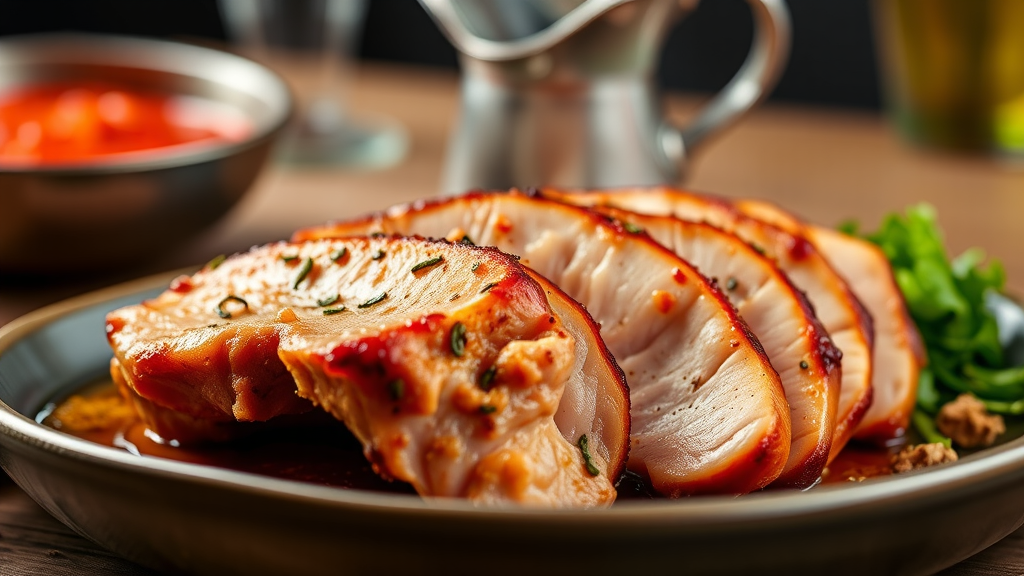
Every year, a surprising share of the pork that leaves the processing plant never reaches its full potential on the plate. Some loins arrive pale, soft, and unnaturally wet, a condition meat scientists call PSE, short for pale, soft, and exudative. These muscles, damaged by a too-rapid drop in pH after slaughter, weep moisture, look washed-out in the display case, and often turn tough and dry when cooked by conventional methods. A new study published in Food Science of Animal Resources suggests that a restaurant favorite, sous-vide cooking followed by a quick sear, may be the rescue strategy this low-grade meat has been waiting for.
The research, conducted by Boin Lee, Seunghyun Lee, and Young Min Choi at Sunmoon University in Korea, set out to answer a question that has been largely ignored in the sous-vide literature: what happens when meat with an inherently compromised structure is cooked gently at precisely controlled low temperatures? Most previous work on sous-vide has focused on normal-quality pork, leaving a gap in knowledge about whether the technique can compensate for the defects of PSE meat or whether those defects are simply beyond repair.
To find out, the team purchased 42 porcine longissimus dorsi muscles, the cut known commercially as pork loin, from a local market and sorted them into two quality classes based on lightness and drip loss. Thirty-four loins met the criteria for reddish-pink, firm, and non-exudative meat, the industry’s benchmark for normal quality, while eight were classified as PSE, with lightness values above 50 and drip loss exceeding 6 percent. The PSE loins indeed proved paler and far leakier than their normal counterparts, losing 7.25 percent of their weight as drip compared with 2.76 percent for the normal group, even though the ultimate muscle pH of the two classes was statistically indistinguishable.
Each loin was then divided into sections and assigned to one of three cooking treatments. The first was conventional pan-frying on a stainless-steel pan heated to 180 degrees Celsius, with cooking continued until the core of the meat reached 71 degrees. The second was sous-vide, in which vacuum-packed samples were immersed in a water bath held at exactly 60 degrees for three hours. The third, abbreviated SVS, combined the two: the same gentle water-bath cooking followed by a rapid 60-second sear on each side at 180 degrees. These parameters were chosen deliberately, drawing on earlier studies showing that pork loin slices around two centimeters thick reach optimal quality after sous-vide treatment at 60 degrees for three to four hours, and that searing sous-vide pork for roughly a minute produces the most acceptable appearance.
The physicochemical results were striking. Pan-fried PSE loins lost the most weight during cooking among the PSE groups at 23.8 percent and registered the highest Warner-Bratzler shear force values, the standard instrumental measure of toughness. In contrast, PSE loins cooked sous-vide, whether seared afterward or not, achieved shear values statistically identical to those of normal-quality pork cooked by any of the three methods. In other words, the gentle water bath erased the toughness penalty that PSE meat normally pays under high heat. The searing step did add extra treatment loss, pushing PSE-SVS samples to 29.5 percent weight loss, but the tenderness advantage held firm.
The explanation lies in the physics and biochemistry of low-temperature cooking. Because sous-vide sealing prevents evaporative losses and the water bath never exceeds 60 degrees, muscle proteins denature gradually and evenly. Endogenous enzymes such as calpains and caspases retain enough residual activity below 70 degrees to weakly degrade myofibrillar proteins, while heat-stable collagen slowly converts to gelatin. The result is less transverse fiber shrinkage, better water retention, and a structure that yields easily to the bite. For PSE meat, whose protein functionality is already impaired by postmortem denaturation, this forgiving thermal environment appears to prevent the compounding damage that a hot pan inflicts.
Sensory evaluation told an equally compelling story. Eleven trained panelists, assessed over dozens of sessions after at least six months of training, scored the cooked samples on a nine-point scale for tenderness attributes, juiciness, flavor, off-flavor, and overall acceptability. Sous-vide loins from both quality classes were rated softer, more tender, less chewy, and juicier than pan-fried samples, and the panelists could not reliably distinguish the tenderness of PSE and normal loins within the same sous-vide treatment. Remarkably, PSE loins cooked sous-vide alone were judged more tender and juicy than normal loins cooked conventionally, and PSE sous-vide samples earned higher overall eating acceptability scores than normal pan-fried pork.
Sous-vide does have an Achilles heel, and the panelists saw it clearly. The low cooking temperature limits Maillard reactions, the cascade of chemistry between amino acids and reducing sugars that produces browned surfaces and roasted aromas. Sous-vide-only samples looked pale, scored lowest on color and appearance acceptability, and carried the weakest flavor intensity in both quality classes. This is where the searing step proved decisive. A minute on the hot pan created the familiar browned crust, and with it, color acceptability scores jumped so that seared PSE loins were rated just as visually appealing as seared normal loins. Flavor intensity also rose significantly in the seared groups, driven by the volatile compounds generated at high surface temperatures.
The study is not a claim that PSE and normal pork are interchangeable. Panelists still detected differences in juiciness and flavor intensity within the seared group, and PSE meat lost more weight during cooking under every treatment, reflecting its fundamentally weaker water-holding capacity. Appearance scores for PSE loins also lagged behind normal loins within each cooking method, likely because the disrupted muscle structure of PSE meat impairs uniform protein network formation during heating. What the findings do establish is that sous-vide technology, especially when paired with a brief sear, can substantially narrow a quality gap that the meat industry has long treated as an unavoidable loss.
The implications reach well beyond the laboratory. With global pork consumption rising and carcass weights projected to climb, the incidence of PSE meat, linked to intensive genetic selection for fast-growing, glycolytic muscle fibers, is unlikely to disappear soon. Upgrading low-grade loins into products that consumers actually enjoy eating represents both an economic and a sustainability win, reducing waste in processing and foodservice settings. For chefs and home cooks, the study adds scientific weight to a technique already beloved in fine dining: cook gently, sear fast, and even imperfect meat can deliver a tender, juicy, beautifully browned result.
Subject of Research: Effects of sous-vide and searing cooking treatments on the quality of PSE and normal pork loins
Article Title: Effects of sous-vide and searing treatments on cooked meat and organoleptic quality attributes in pork loins derived from PSE and normal conditions
Article References: Lee, B., Lee, S., & Choi, Y. M. (2026). Effects of sous-vide and searing treatments on cooked meat and organoleptic quality attributes in pork loins derived from PSE and normal conditions. Food Science of Animal Resources, 46(1), Article 82. https://doi.org/10.1007/s44463-026-00076-7
Image Credits: AI Generated
DOI: 10.1007/s44463-026-00076-7
Keywords: PSE pork, sous-vide cooking, searing, pork loin, meat quality, sensory evaluation, Maillard reaction, tenderness, juiciness, water-holding capacity, food science, meat processing
Cite Scienmag News
Alan Morgan. (September 25, 2026). Sous-Vide Plus Searing Rescues Low-Grade PSE Pork, Study Finds. Scienmag. https://scienmag.com/sous-vide-plus-searing-rescues-low-grade-pse-pork-study-finds/
Alan Morgan. "Sous-Vide Plus Searing Rescues Low-Grade PSE Pork, Study Finds." Scienmag, 25 September 2026, https://scienmag.com/sous-vide-plus-searing-rescues-low-grade-pse-pork-study-finds/. Accessed 25 September 2026.
Alan Morgan. "Sous-Vide Plus Searing Rescues Low-Grade PSE Pork, Study Finds." Scienmag. September 25, 2026. https://scienmag.com/sous-vide-plus-searing-rescues-low-grade-pse-pork-study-finds/


