


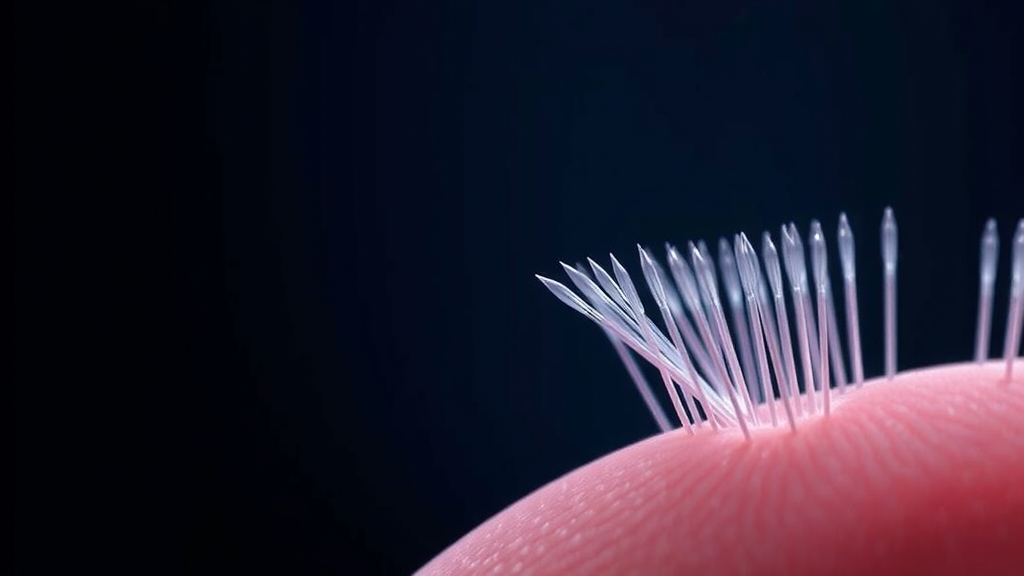
Scientists have unveiled a minimally invasive microneedle platform that can deposit two different therapeutics into two distinct layers of the skin in a single insertion, a feat that could reshape how fibrotic and other multilayer skin diseases are treated. The system, described in Advanced Science, pairs a drug-loaded hydrogel coating with mRNA-carrying lipid nanoparticles housed in helical grooves machined into the surface of an acupuncture-style needle. When the needle is inserted and rotated, the hydrogel sheds into the dermis while the nanoparticles travel deeper into the subcutaneous fat, allowing each layer to receive the therapy matched to its own pathology.
The motivation comes from a growing recognition that skin diseases are not uniform across depth. Using spatial transcriptomics, the research team mapped bleomycin-induced fibrotic skin and found sharply stratified pathology. In the subcutaneous layer, the adipocyte marker Fabp4 progressively declined, reflecting fat loss and metabolic dysfunction. In the dermis, the senescence marker Cdkn1a steadily rose, pointing to an accumulation of aged, inflammation-secreting fibroblasts. Histological examination of clinical specimens from patients with localized scleroderma confirmed the same architecture: disorganized dermal collagen and fibrotic replacement of the subdermal adipose compartment. Immunofluorescence co-staining revealed senescent fibroblasts clustered in the dermis and adipocyte-to-myofibroblast transition, known as AMT, in the subcutis.
These findings suggest that the dermis and subcutis follow separate pathogenic programs, with the dermis driven by inflammation and cellular senescence and the fat layer driven by metabolic failure and fibrotic remodeling. Conventional delivery approaches cannot respect that geography. Subcutaneous injections and electroporation tend to leave mRNA stranded in the superficial dermis, while standard microneedle patches struggle to reach beyond the upper skin compartments. The stratum corneum, the skin’s tough outer barrier, remains a formidable obstacle for nucleic acid therapeutics, and controlling delivery depth has been an persistent challenge in cutaneous mRNA medicine.
The new platform builds on the team’s earlier threaded microneedle technology, in which continuous spiral grooves are etched into a stainless-steel needle roughly 4 millimeters long with an outer diameter of 230 micrometers. The grooves serve as protective channels that guide nanoformulated cargo along the insertion tract, reducing shear stress and tissue damage while enabling layer-resolved deposition. In prior work, the platform delivered neurotrophic factors for nerve repair and penetrated cartilage’s subchondral region for joint repair. For the skin application, the distal 1.5 millimeters of the threaded region carries the therapeutic payload.
The two therapeutic modules were engineered with complementary release behaviors. The first is SRT1720@HA, a hyaluronic acid hydrogel loaded with SRT1720, a SIRT1 agonist chosen after spatial transcriptomic analysis identified SIRT1 as a target in the epidermal and superficial dermal regions. Rheological testing confirmed a stable viscoelastic network, and in vitro release experiments showed roughly 80 percent cumulative SRT1720 release over 96 hours. The second module is PGC1α@LNP, lipid nanoparticles encapsulating messenger RNA encoding PGC-1α, a master regulator of mitochondrial metabolism identified as a target in the dermal-subcutaneous transitional zone. The nanoparticles measured about 108 nanometers in diameter, achieved an encapsulation efficiency of 92.6 percent, and released approximately 65 percent of their mRNA payload over 96 hours. Confocal imaging demonstrated time-dependent endosomal escape, and the formulation survived lyophilization and one month of storage without losing its ability to drive PGC1α expression in cells.
When the two modules were combined on a single threaded needle, fluorescence tracing in simulated skin and in living mice revealed a striking spatial division of labor. The hydrogel coating, sitting on the needle’s exterior, was preferentially wiped off during insertion and retained in the dermis, much like a conventional coated needle. The groove-embedded nanoparticles, protected from premature displacement, were carried along the full insertion tract and deposited from the dermis into the subcutaneous layer, particularly during rotational manipulation. Each microneedle carried roughly 44 nanograms of encapsulated PGC1α mRNA and about 15 nanograms of SRT1720, quantified by batch weighing and liquid chromatography-tandem mass spectrometry.
Safety and localization data supported the design. CCK-8 assays, EdU proliferation tests, and live-dead staining showed that both carriers were well tolerated by L929 fibroblasts and differentiated 3T3-L1 adipocytes across the tested concentration ranges. After microneedle application, exogenous PGC1α mRNA was detected only in treated dorsal skin, declining over time, while SRT1720 remained below the limit of quantification in plasma, lymph nodes, liver, and spleen. The system delivered its payloads locally with no measurable systemic exposure.
In cell models, each module addressed its layer-specific pathology. In senescent fibroblasts, SRT1720@HA reduced β-galactosidase positivity, restored migratory capacity in scratch assays, and dampened expression of senescence markers CDKN2A and CDKN1A along with SASP cytokines including IL-6 and IL-1β. In an AMT model where TGF-β1 pushed adipocytes toward a myofibroblast-like state, PGC1α@LNP preserved lipid droplets, upregulated adipocyte genes such as PPARγ, Perilipin, and Adiponectin, and downregulated fibrotic markers including α-SMA and Col1a1 at both the RNA and protein levels.
The decisive test came in bleomycin-induced skin fibrosis mice treated every other day for two weeks. All microneedle-based interventions improved fibrotic features, but the dual-loaded system performed best, markedly reducing dermal thickness, collagen deposition, and elastic fiber destruction. Layer-specific mechanisms were confirmed by immunostaining: the hydrogel module cut the proportion of senescent dermal fibroblasts, while the nanoparticle module suppressed AMT in the subcutaneous fat, and only the combination achieved both. Transcriptomic sequencing showed that combined treatment silenced p53 signaling, inflammatory genes, and matrix-remodeling pathways while reactivating lipid biosynthesis, mitochondrial electron transport, and PPAR-dependent metabolic programs.
The authors caution that the mouse model does not fully recapitulate human fibrosis, that dose-matched free-drug controls are still needed to separate cargo effects from the platform itself, and that long-term durability and recurrence after treatment cessation remain open questions. Even so, the study demonstrates a versatile blueprint for layer-specific intervention in skin disease, one that could extend beyond fibrosis to any condition whose pathology is written differently in the dermis than in the fat beneath it.
Subject of Research: Layer-specific dermal and subcutaneous drug and mRNA delivery using a modular LNP-hydrogel threaded microneedle platform for treating skin fibrosis
Article Title: Layer‐Specific Dermal and Subcutaneous Delivery via Modular LNP–Hydrogel‐Integrated Threaded Microneedles
Article References: Xie, F., Zhang, Y., Ling, S., Huang, Y., Wei, Y., Fu, R., He, J., Liu, B., Zhou, L., Huo, K., Wang, Y., Li, Q., Du, Y., Cui, W., & Xie, Y. (2026). Layer‐Specific Dermal and Subcutaneous Delivery via Modular LNP–Hydrogel‐Integrated Threaded Microneedles. Advanced Science, Article e77624. https://doi.org/10.1002/advs.77624
Image Credits: AI Generated
DOI: 10.1002/advs.77624
Keywords: microneedles, mRNA therapy, lipid nanoparticles, skin fibrosis, spatial transcriptomics, SIRT1, PGC-1α, hydrogel, senescence, adipocyte-to-myofibroblast transition, drug delivery, Advanced Science
Cite Scienmag News
Denise Maddox. (September 25, 2026). Threaded Microneedles Deliver mRNA and Drugs to Precise Skin Layers. Scienmag. https://scienmag.com/threaded-microneedles-deliver-mrna-and-drugs-to-precise-skin-layers/
Denise Maddox. "Threaded Microneedles Deliver mRNA and Drugs to Precise Skin Layers." Scienmag, 25 September 2026, https://scienmag.com/threaded-microneedles-deliver-mrna-and-drugs-to-precise-skin-layers/. Accessed 25 September 2026.
Denise Maddox. "Threaded Microneedles Deliver mRNA and Drugs to Precise Skin Layers." Scienmag. September 25, 2026. https://scienmag.com/threaded-microneedles-deliver-mrna-and-drugs-to-precise-skin-layers/


