


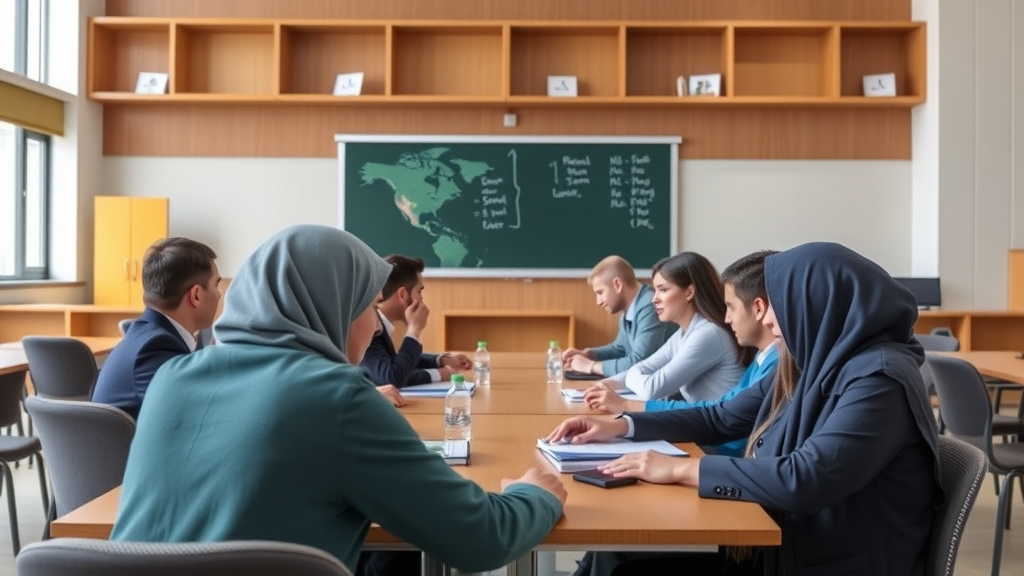
A team of education researchers in Kazakhstan has proposed a new organisational model that links a university pedagogy department directly with its resource and methodological centre, arguing that the two units can achieve far more together than either can alone. The study, conducted at the Kazakh National Women’s Teacher Training University and published in SN Social Sciences, set out to determine whether the effectiveness of a pedagogical department could be improved by formally integrating its activities with the centre responsible for methodological support. The work arrives at a moment when higher education institutions across Central Asia are under intense pressure to modernise, digitise and prove their competitiveness against both regional and global benchmarks.
The research team, led by Karakat Nagymzanova of L.N. Gumilyov Eurasian National University together with colleagues from Abai Kazakh National Pedagogical University and the Kazakh National Women’s Teacher Training University, framed their inquiry around three tasks: identifying the key vectors of development in the Kazakh higher education system, analysing how digital technologies affect the effectiveness of the educational process, and characterising the current state of innovative methods within teaching practice. These questions reflect a broader debate in the literature about how universities manage digital transformation, a process that studies across many countries have shown to be hampered less by technology itself than by institutional structures, assumptions and the readiness of academic staff to change.
At the heart of the project was an empirical experiment involving fifty university employees. Forty members of the department of pedagogy, thirteen men and twenty-seven women, along with ten staff from the university’s resource and methodological centre, four men and six women, took part. The researchers began with a survey of the teaching staff designed to assess the current state of the department’s performance. This diagnostic phase was intended to surface the main problems and needs of the department before any structural intervention was proposed, an approach the authors describe as essential for grounding organisational change in evidence rather than administrative intuition.
The survey results pointed to familiar friction points in university operations. Departments and support units often operate in parallel silos, with methodological expertise concentrated in a central centre while academic departments pursue curriculum development, teaching innovation and quality assurance largely on their own. In a period of rapid digital transformation, this separation can slow the adoption of new teaching technologies, duplicate effort and leave individual faculty members without systematic support when they attempt to introduce innovative methods into their courses. The researchers concluded that these dynamics were influencing the performance indicators of the department and that a coordinated response was needed during what they characterise as a transformational period for Kazakh higher education.
In response, the team developed a model of joint integrative-organisational activity between the department of pedagogy and the resource and methodological centre. The model treats the two structural units as a single interacting space in which planning, methodological support, digital tool deployment and professional development are coordinated rather than fragmented. The concept of an interacting space, one of the keywords attached to the study, captures the idea that the value of collaboration emerges from the structured overlap of the units’ functions: the department contributes disciplinary and pedagogical expertise, while the centre contributes methodological resources, training capacity and institutional knowledge of innovation processes.
The findings suggest that digital transformation and the use of innovative strategies may support the improvement of institutional practices and contribute to strengthening the competitiveness of higher education institutions in Kazakhstan. This conclusion aligns with a substantial international literature cited by the authors, including systematic reviews of digital transformation in universities, analyses of faculty technology integration, and studies of innovation management in higher education. That literature consistently emphasises that successful transformation requires alignment between organisational structure, staff motivation and technological capability, precisely the alignment the proposed model is designed to produce at the level of two university units.
The study also situates itself within Kazakhstan’s national policy context. The authors draw on the state programme for the development of education and science for 2020 to 2025, strategic planning documents from the government, and independent rankings of institutional demand, including the QS World University Rankings for Central Asia. Previous research on Kazakh universities has documented the challenges of the sector’s transition, from the move toward institutional autonomy to capacity building for internationalisation and the evaluation of research effectiveness at pedagogical universities. By connecting a single departmental case to these system-level vectors, the study illustrates how national reform agendas ultimately depend on organisational changes inside individual institutions.
The practical aim of the model is explicitly tied to the quality of professional training for future teachers. Teacher training universities occupy a strategic position in any education system because the competence of their graduates shapes classrooms for decades. The authors argue that innovative techniques, supported by the joint activity of the department and the methodological centre, can raise the quality of that training. The logic is straightforward: if faculty members receive coordinated methodological support, exposure to digital tools and structured opportunities to develop key competencies, the improvements cascade into the preparation of the next generation of teachers. The study’s emphasis on key competencies echoes wider international debates about the skills teachers need in an era of artificial intelligence and digital learning environments.
The research was approved by the Ethics Commission of Abai Kazakh National Pedagogical University in May 2025, and all participants were informed of the purpose of the study, its voluntary nature and confidentiality procedures before providing consent. The authors note that artificial intelligence tools were used only for language editing and improving readability, with the authors reviewing all modifications and taking full responsibility for the final content. The study received no external funding, and the authors declare no competing interests. The published article reports that no datasets were generated or analysed during the study, indicating that the empirical work rested on the survey and experimental framework described rather than on secondary data analysis.
For university leaders, the study offers a modest but concrete proposition: that the unit of organisational redesign need not be the whole institution. Much of the literature on higher education restructuring focuses on mergers, consolidations and institutional alliances, processes that are costly, slow and frequently disruptive to faculty morale and research productivity. By contrast, an integrative model operating at the level of a department and a methodological centre can be implemented within existing governance structures, tested locally and adjusted iteratively. The Kazakh case suggests that such fine-grained integration, combined with deliberate digital transformation and attention to staff needs identified through survey evidence, may be a practical pathway for institutions seeking to improve performance during periods of systemic change, and a template that other universities in the region could adapt to their own circumstances.
Subject of Research: A model of joint integrative-organisational activity between a university pedagogy department and its resource and methodological centre to improve teacher training in Kazakhstan
Article Title: Model of joint integrative-organisational activity of the pedagogical department and the resource and methodological centre of the university
Article References: Nagymzanova, K., Abdykalykova, M., Ashimkhanova, G., Orazayeva, G., & Mazhinov, B. (2026). Model of joint integrative-organisational activity of the pedagogical department and the resource and methodological centre of the university. SN Social Sciences, 6(10), Article 473. https://doi.org/10.1007/s43545-026-01769-y
Image Credits: AI Generated
DOI: 10.1007/s43545-026-01769-y
Keywords: higher education, Kazakhstan, teacher training, digital transformation, organisational model, pedagogy, educational innovation, methodological centre, university management, instructional theory, competitiveness, survey research
Cite Scienmag News
Courtney Benton. (September 24, 2026). Kazakh Universities Turn to Joint Department-Centre Model to Boost Teacher Training. Scienmag. https://scienmag.com/kazakh-universities-turn-to-joint-department-centre-model-to-boost-teacher-training/
Courtney Benton. "Kazakh Universities Turn to Joint Department-Centre Model to Boost Teacher Training." Scienmag, 24 September 2026, https://scienmag.com/kazakh-universities-turn-to-joint-department-centre-model-to-boost-teacher-training/. Accessed 24 September 2026.
Courtney Benton. "Kazakh Universities Turn to Joint Department-Centre Model to Boost Teacher Training." Scienmag. September 24, 2026. https://scienmag.com/kazakh-universities-turn-to-joint-department-centre-model-to-boost-teacher-training/


