


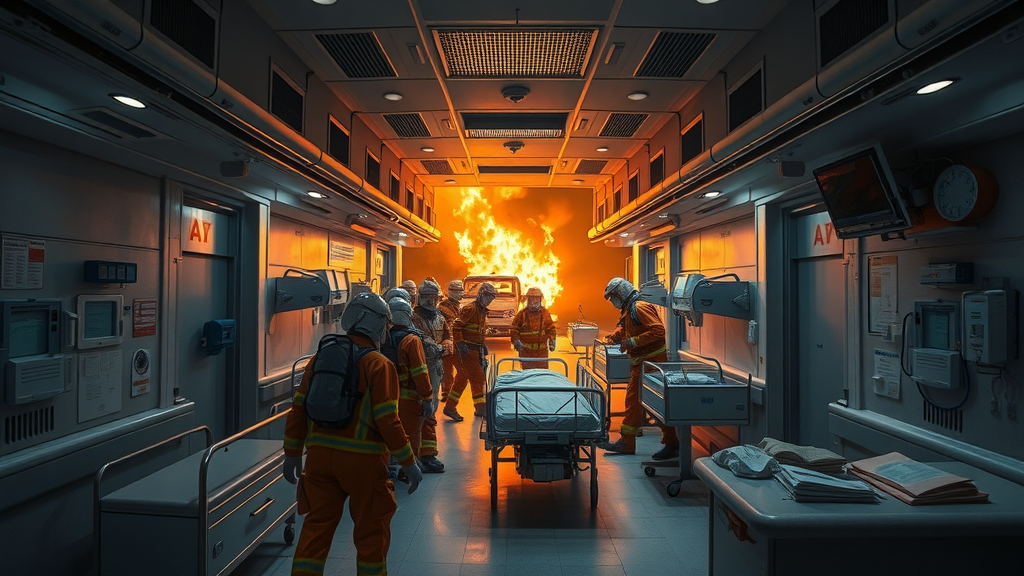
At 19:11 local time on March 11, 2025, laboratory staff at Ramathibodi Hospital, a university-affiliated tertiary hospital in Bangkok, reported smoke and sparks near the Blood Bank Unit on the second floor of Building 1, the facility’s main tower housing general wards and intensive care units for adult, pediatric, and neonatal patients. Within minutes, security personnel confirmed heavy smoke spreading through the southern wing and attempted initial suppression before escalating the incident to local emergency services and fire rescue teams. What followed was one of the most instructive hospital evacuation case studies in recent memory: a full-building emergency response that moved 191 inpatients to safety by 03:00 the next morning, all within the hospital’s own walls, without a single interhospital transfer. A detailed case report published in the Journal of Emergency and Disaster Medicine by Phakwan Pitanukroh, Yaowapha Siripakarn, and Welawat Tienpratarn now reconstructs the timeline, the command decisions, and the hard lessons that emerged from that night.
Hospital fires are rare, but their consequences can be catastrophic when preparedness plans are outdated or untested. Unlike office buildings or residential towers, hospitals concentrate people who cannot simply run: patients who are bedridden, sedated, ventilator-dependent, or tethered to life-support equipment. Evacuation decisions must therefore balance patient safety against staff availability, environmental hazards, and the clinical imperative to keep critical care running continuously. Previous case studies from Iran and the United States have reinforced the value of structured planning, interdisciplinary coordination, and rigorous post-incident analysis. The Ramathibodi incident adds a fresh and unusually well-documented data point to that literature, because the authors were able to draw on institutional observations and operational records from a real, large-scale evacuation in a complex urban healthcare environment.
The immediate technical challenge was access. When fire rescue teams arrived, they were hampered by outdated building blueprints that failed to mark critical items such as flammable materials and chemical storage. The confusion delayed responders trying to reach the seat of the fire, a failure with potentially severe consequences in a structure housing intensive care units. The problem was ultimately solved through improvisation: hospital personnel familiar with the building physically guided responders and relayed information about key structural features in real time. The blaze was brought under control, but thick smoke and a strong odor persisted, forcing the closure of the southern wing of Building 1 from the first through the ninth floor. Structural inspections were required before any reentry, which meant that all 191 patients in the affected zone had to be relocated to safer areas of the campus.
Command and control revealed both strengths and weaknesses in the hospital’s emergency architecture. Hospital policy assigned incident command to the deputy director during off-hours, but in the opening phase the response was led by an on-duty emergency medicine physician who was physically present on-site and could begin coordinating immediately. As more personnel converged, the operational structure was split into two parallel lines: the head of the emergency medicine department handled external coordination with disaster management authorities, fire services, and rescue teams, while the deputy director oversaw internal coordination of nursing, patient evacuation, and clinical logistics. Both reported to the Dean of the Faculty of Medicine throughout the event. This temporary divergence from the formal Incident Command System, the authors note, mirrors findings by other researchers showing that crisis leadership in complex hospitals often evolves dynamically under time-critical constraints rather than following a rigid template.
Communication was the most visibly strained link in the chain. The hospital used multiple channels simultaneously, including handheld radios, public address systems, mobile phones, and the LINE messaging application, adapting a preexisting hierarchy known as the 1:20 LINE system for real-time coordination. Dormitory-based healthcare staff voluntarily joined the operation as the night wore on. But in the initial phase, command messages were confused and many personnel, including on-duty physicians unfamiliar with fire evacuation procedures, were not clearly informed of their assigned roles. Only once clearer communication channels were established did responsibilities crystallize and coordination improve. The authors argue that this experience underscores the need for a predefined, structured, multi-channel communication plan, with a single authoritative channel for command orders, role-specific authority, and regular drills that test every platform under realistic conditions.
The evacuation itself was executed in two technical phases. Patients were first moved laterally, a horizontal evacuation, from the smoke-affected southern wing to the northern wing of the building, and then vertically using elevators and stairwells as needed. Identification relied on admission wristbands and event-specific neck-tag labels, and patients were grouped by ward with their care teams accompanying them to temporary staging areas. Notably, these staging areas were improvised on-site and had never appeared in prior plans or drills. They were categorized by resource dependency rather than patient vital signs: Red zones for critical care devices, Yellow zones for general supportive equipment, and Green zones for unused devices. The most critical patients were prioritized in a large auditorium in a nearby building equipped with emergency supplies. This resource-oriented triage approach, the authors point out, aligns with simulation-based recommendations from prior evacuation studies, which argue that classifying patients by equipment dependency streamlines movement far more effectively than vital-sign-based schemes when large populations must be relocated.
The hospital’s existing Buddy Ward system, in which each ward is paired with a designated receiving ward, proved helpful but insufficient for a high-volume event. Because the fire affected so many wards simultaneously, the hospital needed centralized waiting areas where patients from multiple units could be gathered, re-screened, and then allocated to suitable destination wards. Patients were ultimately redistributed between the northern wing of Building 1 and the Somdech Phra Debaratana Medical Center, located 300 meters away, with ward-mates kept together wherever possible to preserve clinical continuity. The Ambulance Referral Unit and the Emergency Medical Operations team carried out the transfers, coordinating by patient category and the readiness of receiving wards. The authors emphasize that previous drills had focused only on single-ward scenarios, and the real incident exposed the gap between partial exercises and the demands of a full-building evacuation.
The aftermath reshaped hospital operations. Engineering teams assessed the affected areas, leading to a one-week closure of the southern wing and the temporary suspension of elective surgeries and outpatient services. Radiology and laboratory departments were the hardest hit, requiring long-term relocation. The hospital’s risk management team subsequently revised its business continuity plan to emphasize large-scale evacuation scenarios, staff training, and building-wide simulation exercises. Analyzing the event through the 4S framework of staff, stuff, structure, and systems, the authors identified gaps at every level: staff needed clearer roles and standardized recruitment for emergencies; supplies required rapid mobilization protocols; structures suffered from outdated blueprints and the absence of dedicated evacuation elevators; and systems revealed the need for incident command protocols that are simultaneously standardized and flexible.
The report also translates these lessons into concrete recommendations for hospital design and preparedness. For new construction, the authors advocate dividing buildings into separate wings connected by adequate corridors to enable horizontal evacuation, installing dedicated evacuation elevators in each wing, and incorporating ramps with gradients gentle enough for patient beds to be wheeled directly to ground level, a structural feature they describe as greatly enhancing the feasibility of vertical evacuation. Blueprint maintenance should be systematic, with regular updates after any renovation and clear marking of medical gas pipelines, electrical systems, and hazardous material storage, so that both hospital staff and external responders can navigate efficiently during emergencies. A rapid-response engineering unit should be established to assess building integrity immediately after any incident.
Perhaps the most consequential takeaway is philosophical: the command system that works is the one everyone understands, even if it departs from the textbook. Ramathibodi is now adjusting its Incident Command System into a three-component framework, with emergency incident management under Engineering and Security Unit Services, patient management under the Hospital Director, and support services covering data, information technology, finance, supplies, and corporate communications, all coordinated under the Dean’s leadership. The authors conclude that hospitals, especially those in dense urban settings with complex infrastructure, should implement comprehensive building-wide evacuation plans, establish cross-platform communication protocols, and conduct regular full-scale simulation exercises. The lessons from this Bangkok fire, they argue, are transferable to tertiary hospitals and smaller regional facilities alike, provided each institution adapts them to its own resources and capacities. In a warming, increasingly disaster-prone world, that message resonates far beyond a single hospital’s smoke-filled corridors.
Subject of Research: Hospital fire evacuation and emergency response at a tertiary hospital in Thailand
Article Title: Hospital fire evacuation and emergency response: a case study from the university-affiliated tertiary hospital in Thailand
Article References: Hospital fire evacuation and emergency response: a case study from the university-affiliated tertiary hospital in Thailand. (n.d.). https://doi.org/10.1007/s44467-025-00002-9
Image Credits: AI Generated
DOI: 10.1007/s44467-025-00002-9
Keywords: hospital fire, patient evacuation, incident command system, disaster preparedness, emergency medicine, triage, vertical evacuation, hospital infrastructure, crisis communication, Thailand, Ramathibodi Hospital, business continuity
Cite Scienmag News
Ophelia Keating. (September 24, 2026). Inside a Bangkok Hospital’s Overnight Battle to Evacuate 191 Patients From a Fire. Scienmag. https://scienmag.com/inside-a-bangkok-hospitals-overnight-battle-to-evacuate-191-patients-from-a-fire/
Ophelia Keating. "Inside a Bangkok Hospital’s Overnight Battle to Evacuate 191 Patients From a Fire." Scienmag, 24 September 2026, https://scienmag.com/inside-a-bangkok-hospitals-overnight-battle-to-evacuate-191-patients-from-a-fire/. Accessed 5 October 2026.
Ophelia Keating. "Inside a Bangkok Hospital’s Overnight Battle to Evacuate 191 Patients From a Fire." Scienmag. September 24, 2026. https://scienmag.com/inside-a-bangkok-hospitals-overnight-battle-to-evacuate-191-patients-from-a-fire/


