


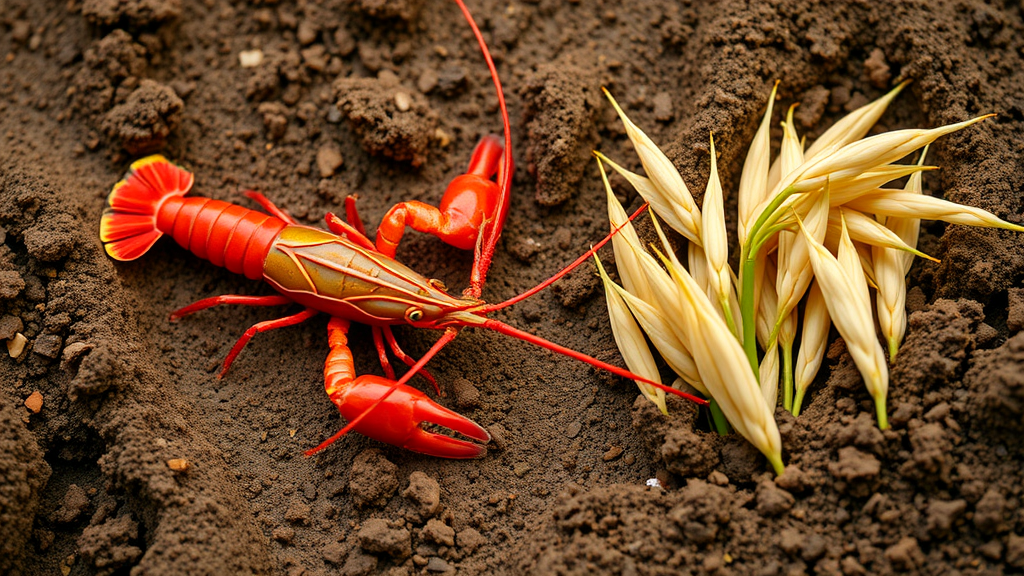
In the flooded paddies of Qianjiang, in China’s Hubei Province, farmers have long paired two very different crops: rice above the water and red swamp crayfish below it. A new 13-month field study published in Advanced Biotechnology now reveals just how deeply this ancient pairing rewires the invisible world beneath the mud. By tracking soil chemistry, microbial communities, and functional genes month after month, researchers found that crayfish-rice coculture does more than produce two harvests from one field. It actively engineers a more stable, fertile, and predictable soil ecosystem, one that stands in sharp contrast to the volatile chemistry of conventional rice monoculture.
The research team, led by scientists from Sun Yat-Sen University and working with the Qianjiang Crayfish Industry Development and Promotion Center, compared three farming systems: crayfish-rice coculture, crayfish-waterweed coculture, and rice grown alone. From March 2018 to March 2019, they collected 156 soil samples from twelve ponds and paddies, measuring nine physicochemical parameters each month and pairing the data with 16S rRNA gene sequencing, metagenomic sequencing, microbial network analysis, and null-model simulations of community assembly. The scale and duration of the effort matter, because single-time-point snapshots, the approach that dominated earlier studies, cannot distinguish a transient hiccup from a genuine shift in how an ecosystem behaves over seasons.
The physicochemical results were striking. Soils in the crayfish-rice fields held substantially more carbon, with total carbon reaching 25.0 to 45.0 milligrams per gram and total organic carbon 15.0 to 35.0 milligrams per gram, well above the levels recorded in monoculture paddies. That carbon enrichment is a direct signature of improved fertility, since organic matter fuels nutrient supply, aggregate structure, and water retention. Equally important, the coculture fields maintained a consistently low oxidation-reduction potential, hovering between minus 150 and minus 50 millivolts across the entire year. The monoculture fields, by contrast, careened between strongly oxidizing conditions above 200 millivolts and strongly reducing conditions below minus 100 millivolts, a rollercoaster that stresses microbes and destabilizes nutrient cycling.
The researchers attribute this buffering to the combined work of the two species. Crayfish burrow up to half a meter into the soil and feed heavily on detritus, continuously churning the mud and introducing organic material while opening microscopic channels for oxygen. Rice roots, equipped with aerenchyma tissue that pipes air downward, create oxidized microsites within an otherwise waterlogged, oxygen-poor soil. The result is a mosaic of tiny reducing and oxidizing zones packed side by side. In that mosaic, aerobic processes such as nitrification can proceed on burrow walls and root surfaces while anaerobic processes such as iron reduction, denitrification, and methanogenesis continue in the surrounding matrix. This spatial coupling lets microbes share the electron-acceptor budget rather than fight over it.
That environmental stability, the study shows, reshapes the rules by which the microbial community assembles itself. Using the iCAMP phylogenetic null-model framework, the team quantified how much of the community structure is driven by deterministic selection versus random drift. In the crayfish-rice soils, homogeneous selection contributed 30 to 50 percent of assembly, with drift accounting for 40 to 60 percent. In the monoculture paddies, drift dominated at 70 to 90 percent, while selection fell to just 10 to 20 percent. In plain terms, the stable coculture environment consistently filters for microbes suited to those conditions, steering the community along a predictable successional path, whereas monoculture communities are largely at the mercy of chance arrivals and random extinctions.
Deterministic filtering paid off in the identity of the microbes that thrived. The coculture soils were significantly enriched in keystone taxa with complementary metabolic powers: Geobacter, iron-reducing bacteria that shuttle electrons to minerals while oxidizing organic matter; Sulfuricurvum, sulfur-oxidizing autotrophs that favor microoxic niches; and Nitrospira, key nitrifiers. Geobacter reached 2.73 percent relative abundance in crayfish-rice soils compared with just 0.40 percent in monoculture, and Sulfuricurvum showed an even starker contrast at 0.847 percent versus 0.03 percent. Together these organisms form what the authors describe as coupled iron-nitrogen-sulfur metabolic networks, capable of efficiently mineralizing organic matter while damping redox swings. Monoculture soils, in contrast, filled up with opportunistic fast growers such as Pseudomonas, Stenotrophomonas, and Flavobacterium, r-strategists that explode after disturbance and signal a system living hand to mouth.
The architecture of microbial social networks told a similar story. The crayfish-rice co-occurrence network contained 1,625 nodes and 7,986 edges, with a remarkable 98.6 percent of interactions classified as positive, a pattern typically reflecting niche sharing, cross-feeding, and cooperative metabolism. Monoculture networks were denser on paper but dominated by taxa performing similar jobs, a topology the authors interpret as functional redundancy rather than genuine cooperation, and one that buffers poorly against real disturbance. Network complexity alone, the study cautions, is not a reliable indicator of stability. What matters is a moderately complex network built around functionally differentiated keystone species, the arrangement the coculture fields reliably produced.
Metagenomic sequencing added the functional layer of evidence. Genes for carbon fixation and central carbon metabolism, including pps/ppsA, PGK/pgk, and transketolase genes of the pentose phosphate pathway, were significantly enriched in the coculture soils, matching their higher organic carbon stocks. The nitrogen story was equally telling: coculture soils carried more copies of hao, a nitrification gene, and nasB, which enables assimilatory nitrate reduction, meaning inorganic nitrogen gets built into microbial biomass rather than lost as gas. Monoculture soils leaned toward nirK, nirA, and narB, genes associated with denitrification and dissimilatory pathways that can vent nitrogen back to the atmosphere. Environmental factors also tracked these differences more tightly in coculture fields, with total carbon and nitrogen showing significant Mantel-test correlations with functional gene composition there, but weaker and different patterns in the monoculture.
The authors distill all of this into a hierarchical causal chain: crayfish bioturbation and rice roots stabilize the physical and chemical environment; that stability imposes deterministic selection on microbes; deterministic selection enriches cooperative keystone taxa; and those taxa knit together into interaction networks and functional gene repertoires that sustain carbon, nitrogen, phosphorus, and sulfur cycling. It is a mechanistic explanation, grounded in time-series data, for a farming model the Food and Agriculture Organization has designated a Globally Important Agricultural Heritage System, and one that earlier work has credited with cutting pesticide use by 68 percent and lifting nitrogen use efficiency by 24 percent.
For farmers and researchers, the implications are practical. Because the beneficial microbial state is maintained through stable redox conditions and steady carbon inputs, management choices such as regulating the carbon-to-nitrogen ratio of organic amendments or optimizing flooding depth could, in principle, steer soil communities toward desired functions, whether stronger nitrification or better carbon preservation. The finding that the rice-based coculture outperformed the waterweed version also hints that plant choice matters, with rice root exudates and aerenchyma appearing to fine-tune the oxygen mosaic that keystone taxa depend on. As agriculture searches for ways to feed growing populations without degrading the ground beneath them, this study suggests that sometimes the best soil engineer is already in the pond, claws and all.
Subject of Research: Microbial mechanisms of soil fertility regulation in crayfish-rice coculture farming systems
Article Title: The crayfish-rice coculture model contributes to regulating the soil fertility of rice fields and maintaining the stability of soil microbial community composition and function
Article References: The crayfish-rice coculture model contributes to regulating the soil fertility of rice fields and maintaining the stability of soil microbial community composition and function. (n.d.). https://doi.org/10.1007/s44307-026-00106-x
Image Credits: AI Generated
DOI: 10.1007/s44307-026-00106-x
Keywords: rice-crayfish coculture, soil fertility, soil microbiome, community assembly, keystone taxa, metagenomics, redox homeostasis, carbon sequestration, nitrogen cycling, co-occurrence networks, sustainable agriculture, bioturbation
Cite Scienmag News
Alan Morgan. (September 24, 2026). Crayfish and Rice Team Up to Build Stronger, Healthier Soil. Scienmag. https://scienmag.com/crayfish-and-rice-team-up-to-build-stronger-healthier-soil/
Alan Morgan. "Crayfish and Rice Team Up to Build Stronger, Healthier Soil." Scienmag, 24 September 2026, https://scienmag.com/crayfish-and-rice-team-up-to-build-stronger-healthier-soil/. Accessed 24 September 2026.
Alan Morgan. "Crayfish and Rice Team Up to Build Stronger, Healthier Soil." Scienmag. September 24, 2026. https://scienmag.com/crayfish-and-rice-team-up-to-build-stronger-healthier-soil/


