


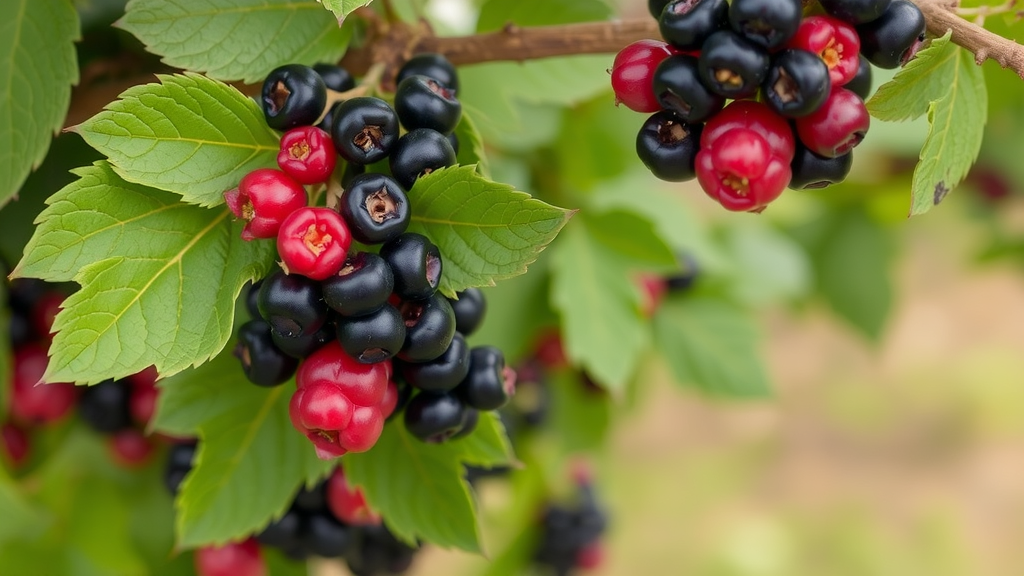
In the waxberry orchards of Wuxi City, in China’s Jiangsu Province, a shiny green-and-bronze flower beetle has been quietly waging war on one of the country’s most prized specialty fruits. Since around 2019, the beetle Dicranocephalus wallichii bowringi, a member of the scarab family Cetoniidae, has emerged as the dominant insect threat during the waxberry harvest season, gouging holes in ripening fruit with its chewing mouthparts and tearing the skin with its sharp claws. The wounds leave berries vulnerable to secondary disease and premature drop, turning high-yield orchards into economic liabilities. Now, a three-year field trial published in the journal Crop Health reports that a remarkably simple weapon—a green plastic trap baited with a mixture of sugar, vinegar and wine—can suppress this pest so dramatically that it effectively vanished from the study orchard by the third year.
The research, led by Yu-Xi Zhu and Yu-Zhou Du of Yangzhou University together with colleagues at the University of Florida and the Bureau of Agriculture and Rural Affairs of Binhu District, began with a basic problem: nobody had systematically documented when these beetles appear in the field or how many species were actually causing the damage. That gap mattered because effective pest management depends on knowing the timing of pest emergence relative to the crop’s vulnerable stages. The team therefore set up monitoring in an open-field waxberry orchard in Binhu District, a roughly six-hectare plantation of approximately fifteen-year-old trees of the Biqi cultivar. To avoid edge effects that could skew results, all trials were conducted in the orchard’s central area, covering about 0.3 hectares and encompassing seventy-five trees.
Before committing to a monitoring method, the researchers tested three common surveillance approaches in 2021: light traps, sweep nets, and a fermented sugar-vinegar-alcohol solution deployed in simple bottle traps. Light traps and sweep nets yielded disappointingly low captures, while the fermented bait proved strikingly effective at drawing in adult beetles. That preliminary result shaped the entire study design. The team settled on traps made from five-liter transparent plastic bottles, each fitted with six equidistant three-centimeter square window openings cut eighteen centimeters above the base and suspended about 1.5 meters above the ground at the center of selected trees. The bait itself was an artisanal blend: for every liter of attractant, 200 grams of fresh watermelon, 300 grams of brown sugar, 100 milliliters of aged liquor, 400 milliliters of white vinegar and 200 milliliters of water. Beetle species were confirmed through both morphological examination and PCR-based molecular techniques.
From May through August of 2022, 2023 and 2024, ten traps arranged in a Z-shaped sampling pattern tracked the population dynamics of three beetle species: Dicranocephalus wallichii bowringi, Protaetia orientalis and Protaetia brevitarsis. All three completed a single generation per year in the local environment, but their seasonal timing diverged in ways that proved decisive for management. Adult D. wallichii bowringi emerged sporadically in early May, then built steadily toward a peak on June 8, 2022, when traps caught an average of roughly 82 beetles apiece, before numbers collapsed sharply by June 13. That window—mid-May to mid-June—overlaps almost exactly with the waxberry harvest period, which is precisely when the fruit is most attractive and most vulnerable.
The two Protaetia species told a different story. Protaetia orientalis populations surged in late June and peaked in early July each year, consistently after the waxberry harvest had ended, while P. brevitarsis remained at low levels throughout the entire three-year survey. Neither species inflicted meaningful damage on the crop. The conclusion was unambiguous: D. wallichii bowringi was the dominant pest, and its peak activity coincided with the one period when chemical insecticides are strictly prohibited to guarantee low pesticide residues in the harvested fruit. Waxberry, valued for both its nutritional and medicinal properties, commands premium prices partly because of its green production credentials, so growers had few options beyond watching beetles devour their crop.
With the target identified and its phenology mapped, the team turned to optimizing the trap itself. They compared four attractant formulations differing in the ratios of sugar, vinegar, wine and water, alongside a water-only control. The results were statistically robust: traps baited with plain water caught nothing at all, while Formula 1—a ratio of three parts sugar to four parts vinegar to one part wine to two parts water—captured an average of 29.2 beetles per trap per week, roughly two to three times the weekly captures achieved by the other three formulations. The differences among odor treatments were highly significant in Kruskal-Wallis tests, underscoring that the precise fermentation chemistry matters. The researchers note that environmental factors such as temperature may further modulate attraction by changing the rate at which volatile compounds evaporate from the bait, a variable that future work should quantify.
Trap color turned out to be just as important as bait composition. When the team suspended traps of six different colors, all filled with the same winning formulation, green buckets outperformed every alternative by a wide margin, capturing an average of 85.4 beetles per trap per week. White traps came in a distant second at 29.2, followed by red at 23.4, purple at 10.8, blue at 9.4 and yellow at a mere 7.2. The color preference was highly significant statistically, and the authors suggest that D. wallichii bowringi may possess heightened visual sensitivity to green wavelengths, though they caution that this hypothesis requires dedicated experimental validation. The finding is ecologically intuitive: a beetle that spends its adult life on green foliage and ripening fruit may orient toward green silhouettes, and pairing that visual cue with a potent fermented odor creates a two-channel lure that is difficult for the insect to ignore.
The real test came from deploying the optimized traps across three consecutive seasons. In 2022, mass trapping removed approximately 207 adult beetles per trap over the season, totaling 2,072 individuals captured in the survey area. In 2023, that figure plummeted roughly seventy-fold to about 3 beetles per trap, or just 34 individuals in total. By 2024, the researchers detected no D. wallichii bowringi in the orchard at all. The population, for practical purposes, had collapsed. The authors attribute this trajectory partly to the beetle’s life-history strategy: as a K-strategist species, it produces relatively few offspring and its populations, once knocked down, are unlikely to rebound rapidly and re-infest an area. That makes sustained mass trapping not merely a seasonal Band-Aid but a genuine long-term suppression tool.
The practical appeal of the system lies in its radical accessibility. The traps can be assembled from recycled plastic bottles and everyday grocery items—sugar, vinegar and cheap cooking wine—making the approach nearly free for farmers to adopt and requiring no specialized equipment or training. The method also carries environmental co-benefits: it reduces reliance on chemical pesticides, cutting the risks of residue contamination and the evolution of resistance, and it promotes the reuse of discarded bottles. As a bonus, the fermented bait attracts other orchard pests such as fruit flies, although the authors acknowledge that the strategy’s efficacy against those secondary pests is limited during outbreak periods, meaning their dynamics should be monitored in subsequent years. The team also concedes that because beetle populations are closely tied to temperature, humidity and rainfall, interannual climatic variation cannot be entirely excluded as a contributor to the observed decline, even though climatic differences across the three survey years were relatively minor.
Looking forward, the researchers outline a research agenda that extends well beyond the bottle trap. Identifying the specific volatile compounds responsible for the bait’s attraction, and determining the optimal concentrations of each, could yield a standardized synthetic lure with even greater efficiency. The authors also point to emerging tools—RNA interference-based pesticides, releases of natural enemies, and microbiota-based approaches such as those involving Wolbachia bacteria—as promising complements that could be woven into a broader integrated pest management framework for waxberry cultivation. For now, though, the message to growers is refreshingly simple: a green bottle, a splash of kitchen chemistry, and disciplined seasonal deployment were enough to drive a devastating orchard pest from detectability to zero in three years. In an era when agriculture desperately needs low-cost, low-chemistry solutions, the humble fermented trap may prove one of the most exportable ideas in sustainable fruit production.
Subject of Research: Sustainable mass trapping of the flower beetle Dicranocephalus wallichii bowringi in waxberry orchards
Article Title: Sustainable trap strategies for controlling the dominant waxberry pest Dicranocephalus wallichii bowringi: Evidence from three-year field trials
Article References: Zhu, Y.-X., Yang, R., Song, Z.-R., Gong, M.-H., Shen, Y., Xu, Z., & Du, Y.-Z. (2026). Sustainable trap strategies for controlling the dominant waxberry pest Dicranocephalus wallichii bowringi: Evidence from three-year field trials. Crop Health, 4(1), Article 7. https://doi.org/10.1007/s44297-026-00069-4
Image Credits: AI Generated
DOI: 10.1007/s44297-026-00069-4
Keywords: Dicranocephalus wallichii bowringi, waxberry, beetle pest, mass trapping, sugar-vinegar-wine bait, trap color, integrated pest management, fermented attractant, Jiangsu China, sustainable agriculture, population collapse, field trials
Cite Scienmag News
Alan Morgan. (September 24, 2026). Sugar, Vinegar and Wine: A Kitchen-Recipe Trap Wiped Out a Major Waxberry Pest in Three Years. Scienmag. https://scienmag.com/sugar-vinegar-and-wine-a-kitchen-recipe-trap-wiped-out-a-major-waxberry-pest-in-three-years/
Alan Morgan. "Sugar, Vinegar and Wine: A Kitchen-Recipe Trap Wiped Out a Major Waxberry Pest in Three Years." Scienmag, 24 September 2026, https://scienmag.com/sugar-vinegar-and-wine-a-kitchen-recipe-trap-wiped-out-a-major-waxberry-pest-in-three-years/. Accessed 24 September 2026.
Alan Morgan. "Sugar, Vinegar and Wine: A Kitchen-Recipe Trap Wiped Out a Major Waxberry Pest in Three Years." Scienmag. September 24, 2026. https://scienmag.com/sugar-vinegar-and-wine-a-kitchen-recipe-trap-wiped-out-a-major-waxberry-pest-in-three-years/


