


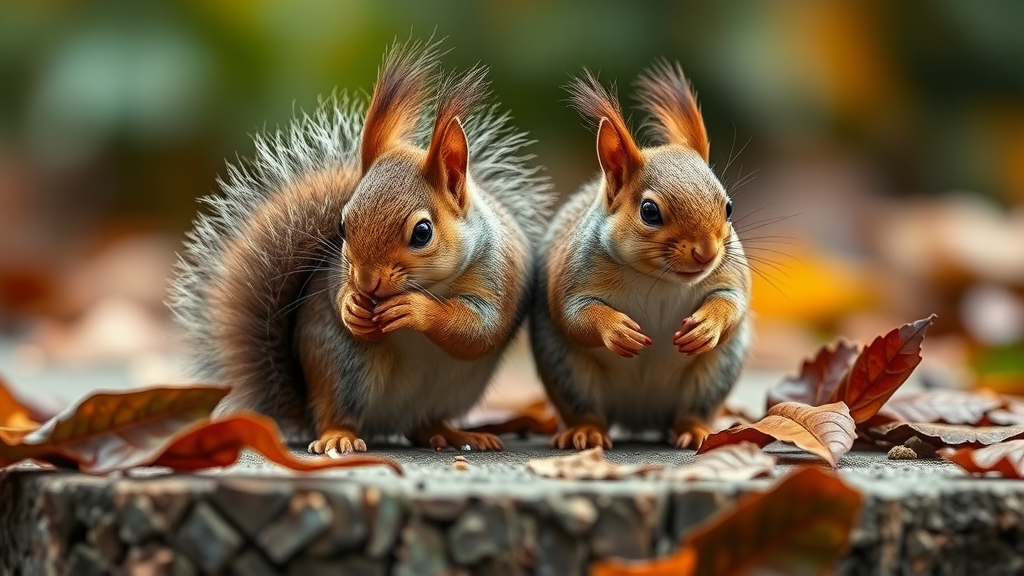
In the parks and green spaces of Montreal, the eastern grey squirrel has quietly become one of the most instructive subjects in urban evolutionary biology. A new study led by researchers at McGill University has found that the coat colours of these familiar rodents vary across the city in ways that reflect remarkably local environmental conditions, suggesting that the fine-grained texture of a city, from its tree canopy to its rivers, can shape the traits of wild animals at a scale far smaller than scientists have typically assumed. The research, published in the Journal of Animal Ecology, examined patterns of melanism, the dark pigmentation that turns some grey squirrels jet black, across nearly two hundred parks in the Montreal region.
Despite its name, the eastern grey squirrel, known scientifically as Sciurus carolinensis, does not always wear a grey coat. Individuals of the species can appear in a black, or melanic, form, and the relative abundance of these two colour morphs has long intrigued biologists. In many North American cities, black squirrels are a familiar sight, and previous work on urban wildlife has often treated cities as broadly uniform environments, comparing animals living in urban cores with those in surrounding rural areas. The Montreal study challenges that framing. Rather than asking whether urbanization alone explains coat colour, the researchers asked whether conditions differing from one neighbourhood to the next, and even from one side of a river to the other, leave a measurable signature in the squirrel populations that live there.
The data behind the study came from an unusually direct and low-tech source: bicycle wheels and patient observation. Francis Quang-Hai Dinh, the study’s first author, was an undergraduate student at McGill when he began the fieldwork. During his first summer at the university, he visited almost 200 parks around the city in his free time, cycling between them and recording what he saw. In total, he observed more than 800 squirrels, noting which individuals were grey and which were black. This effort was complemented by park surveys and citizen science observations, allowing the team to assemble a fine-scale map of squirrel colouration across a complex urban landscape. The project has since been included in a special feature published by five ecology journals highlighting how researchers are using large, open-access datasets and collaborative approaches to address major ecological questions.
The analysis revealed that grey coats predominate across Montreal, as they do in most of the species’ range. But the proportion of black squirrels was not distributed randomly. It was highest in parts of the city with cooler winter temperatures and greater forest canopy cover. This pattern is consistent with the idea that darker coats may confer a biological advantage in colder conditions, because dark fur can retain heat more effectively, an advantage that becomes meaningful during long northern winters. In shaded, leafy neighbourhoods where winter temperatures drop, black squirrels appear to fare relatively better, and their colouration becomes more common in the population.
Perhaps the most surprising finding, however, was what the researchers did not see. Contrary to patterns reported in many other cities, the prevalence of black squirrels in Montreal was generally lower in more heavily urbanized areas. In several urban studies elsewhere, melanic squirrels have been found at elevated frequencies in dense city centres, and explanations have ranged from thermoregulation to the behaviour of predators and people. The Montreal result runs against that expectation, and the researchers themselves note that this intriguing outcome will require future examination. The finding serves as a reminder that urban patterns observed in one city cannot simply be assumed to hold in another, and that the drivers of adaptation may interact with local geography and climate in ways that vary from place to place.
Coat colour was not the only factor at work in shaping the city’s squirrel populations. The study found that squirrel colouration across the Montreal region is influenced not only by urbanization but also by features of the physical landscape, including forest canopy cover and the presence of the St. Lawrence River and its tributaries. Rivers can act as barriers to movement, and for an animal that travels on foot and by branch, a wide waterway can effectively divide a population into distinct groups. Over time, such separation can allow different populations to diverge, with local conditions favouring different traits on either side of the barrier. In this way, the geography of a city, its rivers, its parks, and its tree cover, can create a mosaic of subtly different selective environments within a single metropolitan area.
The implications extend well beyond squirrels. The findings highlight how wildlife can respond to environmental conditions at a very local scale, showing that cities are not uniform habitats but complex landscapes in which differences between neighbourhoods, as well as geographic features such as rivers, can influence how animals adapt and evolve over time. For evolutionary biologists, this is a significant reframing. Classic studies of urban adaptation often rely on broad urban-to-rural gradients, treating the city as one end of a line and the countryside as the other. The Montreal work suggests that such coarse comparisons may miss much of the story. Two parks a few kilometres apart, separated by a river or differing in canopy cover, may host populations experiencing meaningfully different selective pressures.
Allison Roth, the study’s senior author, who was a GRIL postdoctoral fellow in McGill’s Department of Biology during the data collection and is now an Assistant Professor at the University of Missouri, emphasized this point. People often think of cities as a single type of environment, she noted, but the findings show that the conditions animals experience can vary dramatically from one neighbourhood to another. These local differences, along with barriers such as rivers, can shape how wildlife populations evolve, which means, she argued, that researchers need to look beyond simple urban-rural comparisons to understand adaptation in cities. The statement captures a growing recognition in urban ecology that the city is best understood not as a single habitat type but as a patchwork of micro-environments, each with its own temperature profile, vegetation structure, and connectivity.
The study also offers a case study in how modern ecological research can be conducted. Dinh’s fieldwork was carried out on a bicycle, in his free time, during a single summer, supplemented by observations contributed by members of the public through citizen science platforms. The project demonstrates how discoveries can be accessible, as Dinh put it, and that science can be done in one’s own backyard. The integration of personal field observation with open-access citizen science data reflects a broader trend in ecology, in which large collaborative datasets allow researchers to detect patterns that would be invisible to any single observer working alone. The special feature of five ecology journals in which the study appears celebrates exactly this kind of approach, showcasing how open data and teamwork are being used to tackle big ecological questions.
For city dwellers, the research adds a layer of meaning to an everyday encounter. The black squirrel crossing a path in a leafy park and the grey squirrel foraging in a sparser, warmer neighbourhood are not merely variants of the same animal; they are, in a sense, records of local evolutionary history, shaped by winter temperatures, tree cover, and the rivers that carve the city into distinct territories. As urban areas continue to expand and climates continue to change, understanding how animals adapt at these fine scales will become increasingly important for conservation and city planning alike. The Montreal squirrels suggest that the answers may lie not in sweeping urban-rural contrasts but in the details: the shade of a particular park, the chill of a particular valley, and the width of the water that separates one population from the next.
Subject of Research: Fine-scale spatial variation in melanism of eastern grey squirrels across an urban landscape
Article Title: Montreal’s squirrels provide insight into evolutionary change in urban species
Article References: Montreal’s squirrels provide insight into evolutionary change in urban species. (n.d.). Original publication
Image Credits: AI Generated
DOI: Not provided
Keywords: eastern grey squirrel, melanism, urban evolution, Montreal, coat colour, forest canopy, urban ecology, citizen science, Journal of Animal Ecology, St. Lawrence River, thermoregulation, local adaptation
Cite Scienmag News
Gavin Prescott. (September 24, 2026). Montreal Squirrels Reveal How City Neighbourhoods Drive Evolutionary Change. Scienmag. https://scienmag.com/montreal-squirrels-reveal-how-city-neighbourhoods-drive-evolutionary-change/
Gavin Prescott. "Montreal Squirrels Reveal How City Neighbourhoods Drive Evolutionary Change." Scienmag, 24 September 2026, https://scienmag.com/montreal-squirrels-reveal-how-city-neighbourhoods-drive-evolutionary-change/. Accessed 6 October 2026.
Gavin Prescott. "Montreal Squirrels Reveal How City Neighbourhoods Drive Evolutionary Change." Scienmag. September 24, 2026. https://scienmag.com/montreal-squirrels-reveal-how-city-neighbourhoods-drive-evolutionary-change/


