


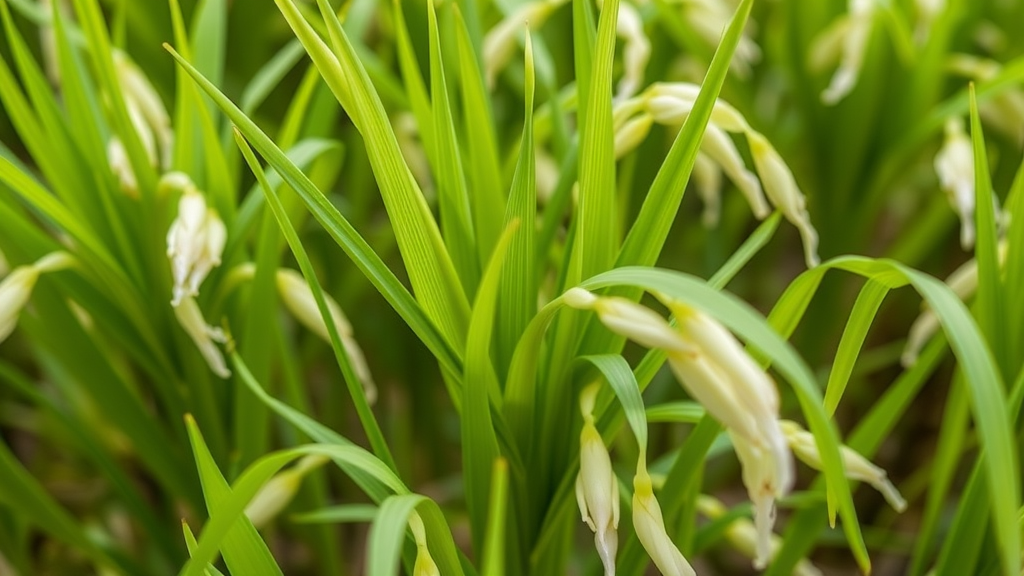
When plants double their entire genome, the result is often assumed to be a hardier organism, better armed against drought, salinity, and other environmental assaults. Polyploid crops frequently do outperform their diploid ancestors under stress, and breeders have long exploited this apparent superpower. But a new study of laboratory-created tetraploid rice challenges a central assumption: the extra DNA itself may not be the whole story. Instead, the research shows that some of the most striking gains in salt tolerance emerge only after the duplicated genome has spent several generations reshuffling itself, with changes in the metabolism of the stress hormone abscisic acid taking center stage.
The study, published in Plant Cell Reports, was conducted by Bingqi Zhang, Tiantian Zhu, and colleagues at Northeast Normal University in Changchun, China, working in the laboratories of Ying Wu and Bao Liu. The team examined a synthetic tetraploid rice line produced by hybridizing the two major subspecies of Asian rice, japonica and indica, and then doubling the genome of the hybrid. These early-generation plants carry a mosaic genome stitched together from two highly divergent rice subspecies, making them an ideal natural experiment for asking how quickly new traits can arise after whole-genome duplication.
The headline finding is deceptively simple. When the researchers screened a large population of these tetraploids under salt stress, only about 1.71 percent of the plants showed what the authors call transgressive salt tolerance—performance that exceeds not just the average of the population but the range that would be expected from either parental subspecies. Salt tolerance, in other words, is not a uniform bonus conferred by genome doubling. It is a rare, individually acquired trait that appeared in only a small fraction of the polyploid offspring, suggesting that something beyond genome size is driving the phenotype.
To find out what, the team turned to genome resequencing. Whole-genome duplication brings two related chromosome sets, called homoeologs, into the same nucleus, and these homoeologous chromosomes occasionally exchange segments through recombination—a phenomenon known as homoeologous exchange. Such exchanges are well documented in synthetic polyploids of Brassica, wheat, and cotton, and they have been implicated in rapid adaptation. The resequencing data confirmed that the synthetic rice tetraploids carry extensive homoeologous exchanges, as expected. Surprisingly, however, the researchers could find no consistent genomic features that separated the handful of salt-tolerant plants from the sensitive majority. The tolerant plants were not simply those with more exchanges, larger exchanged segments, or exchanges in particular chromosomal regions detectable at this resolution.
The decisive signal came instead from the transcriptome. Using RNA sequencing, the researchers profiled gene expression in tolerant and sensitive plants and found that the two groups separated cleanly along transcriptional lines, even though their genomes did not. This is a critical distinction: the phenotype appears to be governed by how the genome is regulated rather than by which versions of the genes are physically present. In an era when much of agricultural genetics focuses on DNA sequence variation, the result is a reminder that newly formed polyploids can generate adaptive variation through regulatory rewiring alone.
Pathway analysis pinpointed where that rewiring mattered most. Genes that were downregulated in the salt-tolerant plants were significantly enriched in the abscisic acid degradation pathway. Abscisic acid, or ABA, is the plant hormone that orchestrates responses to drought and salinity, triggering stomatal closure, modulating root growth, and coordinating a broad stress-response program. But ABA is a double-edged sword: sustained high levels conserve water yet suppress growth and photosynthesis. The key enzyme that breaks ABA down is encoded by a family of cytochrome P450 genes, and in the tolerant tetraploids, one member of that family, OsABA8ox3, emerged as the leading candidate. Expression and coding-sequence analyses both pointed to this gene as a plausible molecular switch underlying the tolerant phenotype.
The authors did not stop at correlation. They measured endogenous ABA levels in selected tetraploid recombinant inbred lines and found patterns consistent with altered ABA homeostasis in the tolerant plants. They then applied exogenous ABA to the plants, which should sensitize a plant that cannot degrade the hormone efficiently, and sodium tungstate, a chemical that inhibits ABA biosynthesis, which should have the opposite effect. The results of these pharmacological treatments further supported the association between ABA metabolism and salinity tolerance: the tolerant lines responded differently from the sensitive lines in ways consistent with a rewired ABA catabolic circuit. Together, these experiments build a case that the rare tolerant individuals owe their edge to a rebalancing of stress hormone turnover rather than to a wholesale amplification of stress signaling.
Why would ABA catabolism, rather than the canonical stress-response genes, be the target of post-polyploidization selection? The authors’ interpretation fits a growing body of theory about what happens in the generations immediately after whole-genome duplication. Genome doubling creates a period of profound instability: homoeologous chromosomes recombine, epigenetic marks are reshuffled, and gene expression across thousands of duplicated loci is rebalanced. In that turbulent environment, pathways that act as central hubs—hormone metabolism chief among them—are poised to produce large phenotypic effects from relatively modest regulatory changes. Dialing down ABA degradation could allow a plant to fine-tune the trade-off between stress protection and growth, a balance that is especially consequential under salinity, where plants must simultaneously exclude sodium, maintain water uptake, and keep growing.
The study also speaks to an ongoing debate in polyploid biology: are the superior traits of polyploids a direct consequence of whole-genome duplication itself, or do they evolve later, as the duplicated genome diversifies? By showing that transgressive salt tolerance appears in only a tiny fraction of early-generation tetraploids, and that this tolerance tracks transcriptomic rather than gross genomic differences, the work supports the second view. Genome duplication provides the raw material—duplicated genes, homoeologous pairs, and regulatory redundancy—but the adaptive phenotype must still be assembled through subsequent changes, whether those are homoeologous exchange-associated regulatory shifts, epigenetic alterations, or selection on standing variation. The finding that tolerant and sensitive plants could not be distinguished by their exchange patterns suggests that many different genomic configurations may converge on similar regulatory outcomes, with ABA metabolism acting as a common endpoint.
For agriculture, the implications are potentially significant. Rice is the staple crop for billions of people, and soil salinity is an escalating threat to rice yields worldwide as seawater intrusion and irrigation practices degrade arable land. If rare, transgressive salt tolerance can be generated de novo in synthetic polyploid rice within a few generations, breeders may have access to a reservoir of stress resilience that does not exist in diploid germplasm. The identification of OsABA8ox3 as a candidate gene offers a concrete molecular target: markers linked to ABA catabolic rewiring could be used to screen polyploid breeding populations for salt-tolerant individuals long before they reach the field. More broadly, the study suggests that harnessing polyploidy for crop improvement will require paying attention not just to gene content but to the regulatory dynamics that unfold in the generations after genome doubling. The duplicated genome, it turns out, is less a finished product than a starting point—one from which evolution, and perhaps breeders, can quickly sculpt new and valuable traits.
Subject of Research: Homoeologous exchange-associated ABA catabolism rewiring contributing to salinity tolerance in synthetic tetraploid rice
Article Title: Homoeologous exchange-associated ABA catabolism rewiring contributes to salinity tolerance in a synthetic tetraploid rice
Article References: Homoeologous exchange-associated ABA catabolism rewiring contributes to salinity tolerance in a synthetic tetraploid rice. (n.d.). https://doi.org/10.1007/s00299-026-03987-3
Image Credits: AI Generated
DOI: 10.1007/s00299-026-03987-3
Keywords: polyploidy, synthetic tetraploid rice, homoeologous exchange, abscisic acid, salinity tolerance, OsABA8ox3, transcriptome profiling, whole-genome duplication, rice breeding, stress hormone, japonica–indica hybridization, plant genetics
Cite Scienmag News
Alan Morgan. (September 22, 2026). Salt-Tolerant Synthetic Rice Reveals Hormone Rewiring After Genome Duplication. Scienmag. https://scienmag.com/salt-tolerant-synthetic-rice-reveals-hormone-rewiring-after-genome-duplication/
Alan Morgan. "Salt-Tolerant Synthetic Rice Reveals Hormone Rewiring After Genome Duplication." Scienmag, 22 September 2026, https://scienmag.com/salt-tolerant-synthetic-rice-reveals-hormone-rewiring-after-genome-duplication/. Accessed 22 September 2026.
Alan Morgan. "Salt-Tolerant Synthetic Rice Reveals Hormone Rewiring After Genome Duplication." Scienmag. September 22, 2026. https://scienmag.com/salt-tolerant-synthetic-rice-reveals-hormone-rewiring-after-genome-duplication/


