


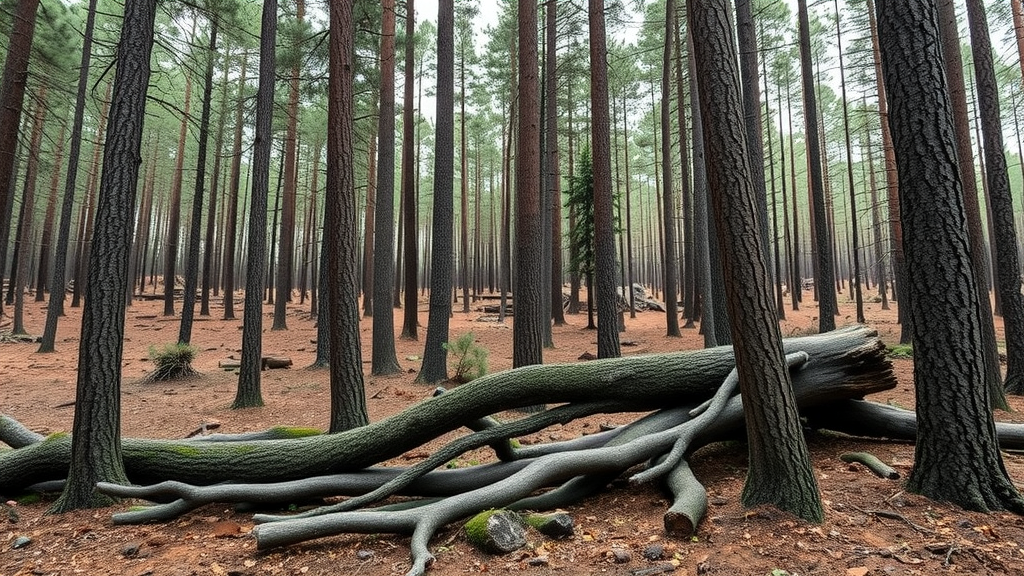
A new study from Istanbul’s Belgrade Forest delivers a sobering message for forest conservation: centuries of legal protection have not been enough to safeguard one of the most ecologically vital features of a temperate woodland—its dead wood. Researchers from Istanbul University-Cerrahpaşa surveyed coarse deadwood across 33 systematically distributed sample plots in this historically protected water-supply forest and found a strikingly simplified deadwood structure, dominated by early decay stages and almost devoid of the advanced decay habitats that countless forest species depend on. The findings, published in Plant Biosystems, suggest that on paper protection can coexist with functional impoverishment when management pressure never truly stops.
Coarse deadwood—fallen logs and standing dead trees at least 10 centimeters in diameter and 1 meter long—is far more than forest litter. It anchors biodiversity, sustains habitat continuity, drives nutrient cycling, and underpins the entire decomposition economy of a temperate forest. Saproxylic beetles, wood-decay fungi, mosses, vascular plants, cavity-nesting birds, and small mammals all trace their fortunes to the amount, arrangement, and decay state of dead timber. Conservation scientists have long argued that the full decay spectrum, from freshly dead wood to soft, crumbling, soil-like remnants, is what matters most, because different species are locked into different stages of the decomposition cascade.
The Belgrade Forest offers an unusual natural experiment in this respect. Legally protected for centuries as the water supply of Istanbul, the forest has nevertheless been continuously shaped by silvicultural interventions and sanitation-oriented management—removal of trees deemed hazardous, diseased, or commercially substandard. The research team asked whether this long-term protection, maintained alongside persistent human influence, has been sufficient to maintain decomposition continuity and structural heterogeneity in the deadwood resource.
The answer, measured with rigorous inventory methods, is largely no. Mean total coarse deadwood volume came in at just 4.24 cubic meters per hectare, against a mean living tree volume of 74.13 cubic meters per hectare—a deadwood-to-living-volume ratio of a mere 5.72 percent. In near-natural European beech forest reserves, deadwood volumes routinely reach several times this level, making the Belgrade figures stand out as exceptionally low for a temperate forest of recognized conservation importance.
The composition of what little deadwood remains tells an equally important story. Standing dead trees, or snags, accounted for 63.25 percent of total coarse deadwood volume, while downed logs made up the remainder. Crucially, the standing deadwood was strongly dominated by early decay-stage components—recently dead trees still retaining bark, branches, and structural integrity—while advanced decay classes were extremely limited. That imbalance matters because late-stage decay is where decomposition reaches its ecological payoff: nutrient release into the soil, moisture retention, nursery sites for seedlings, and the specialized microhabitats used by rare fungi, bryophytes, and insects that cannot survive elsewhere.
Statistical analysis reinforced the picture. Using non-parametric Mann-Whitney U tests appropriate for the non-normal distribution of deadwood data, the researchers detected significant differences among the major deadwood categories, with probability values ranging from 0.001 to 0.011. Volumes were estimated using species-specific allometric equations and decay-stage-adjusted volume models, a technically demanding approach designed to correct for the progressive volume loss that occurs as wood decays. The result is one of the more methodologically careful deadwood assessments conducted in the region.
Why would a protected forest end up so structurally impoverished? The study’s interpretation points directly at the tension between protection designation and ongoing management. Sanitation-oriented forestry, by design, removes dying and dead trees before they can fulfill their ecological role. Over centuries, such interventions act as a continuous filter, shaving off the late decay stages that take decades to form. Dead wood is not a static resource; it is a dynamic flux, and decomposition continuity requires that new deadwood inputs of all decay stages are allowed to accumulate and progress undisturbed. When every weak or dying tree is extracted, the pipeline from fresh snag to rotten log is repeatedly severed, leaving a forest that looks protected but functions like a managed production stand with respect to its deadwood ecology.
The consequences extend beyond dead wood itself. Decomposition dynamics regulate carbon storage and release, soil formation, and the recycling of nitrogen and other nutrients. Low deadwood volumes mean reduced carbon reserves held in slowly decaying timber, and disrupted habitat continuity threatens saproxylic species whose populations depend on a steady, uninterrupted supply of decaying wood across decades and centuries. The researchers’ conclusion is blunt: legal protection alone may not be sufficient under continuous management pressure to maintain structural heterogeneity and decomposition continuity without retention-oriented deadwood management practices.
That conclusion carries global significance. Managed forests across Europe and beyond face the same paradox—protected status on maps, production logic on the ground—and deadwood is consistently its most visible casualty. The Belgrade Forest case demonstrates that retention policies must be explicit: leaving dying trees, dead limbs, and fallen trunks in place deliberately, rather than assuming protection legislation will do the work. For a forest that has guarded Istanbul’s water for centuries, the study suggests it is now time to also protect the living dead—the decaying trees on which so much of the forest’s hidden biodiversity depends.
Subject of Research: Deadwood structure and decomposition dynamics in a long-term protected temperate forest under long-term management influence
Article Title: Deadwood structure and decomposition dynamics in a long-term protected temperate forest under long-term management influence
Article References: Deadwood structure and decomposition dynamics in a long-term protected temperate forest under long-term management influence. (n.d.). https://doi.org/10.1007/s44473-026-00255-w
Image Credits: AI Generated
DOI: 10.1007/s44473-026-00255-w
Keywords: coarse woody debris, decomposition continuity, deadwood dynamics, temperate forest, forest conservation, Belgrade Forest, snags, decay class, forest management, structural heterogeneity, biodiversity, nutrient cycling
Cite Scienmag News
Margaret Porter. (September 22, 2026). Legal Protection Alone Fails to Preserve Deadwood in Managed Temperate Forest. Scienmag. https://scienmag.com/legal-protection-alone-fails-to-preserve-deadwood-in-managed-temperate-forest/
Margaret Porter. "Legal Protection Alone Fails to Preserve Deadwood in Managed Temperate Forest." Scienmag, 22 September 2026, https://scienmag.com/legal-protection-alone-fails-to-preserve-deadwood-in-managed-temperate-forest/. Accessed 5 October 2026.
Margaret Porter. "Legal Protection Alone Fails to Preserve Deadwood in Managed Temperate Forest." Scienmag. September 22, 2026. https://scienmag.com/legal-protection-alone-fails-to-preserve-deadwood-in-managed-temperate-forest/


