


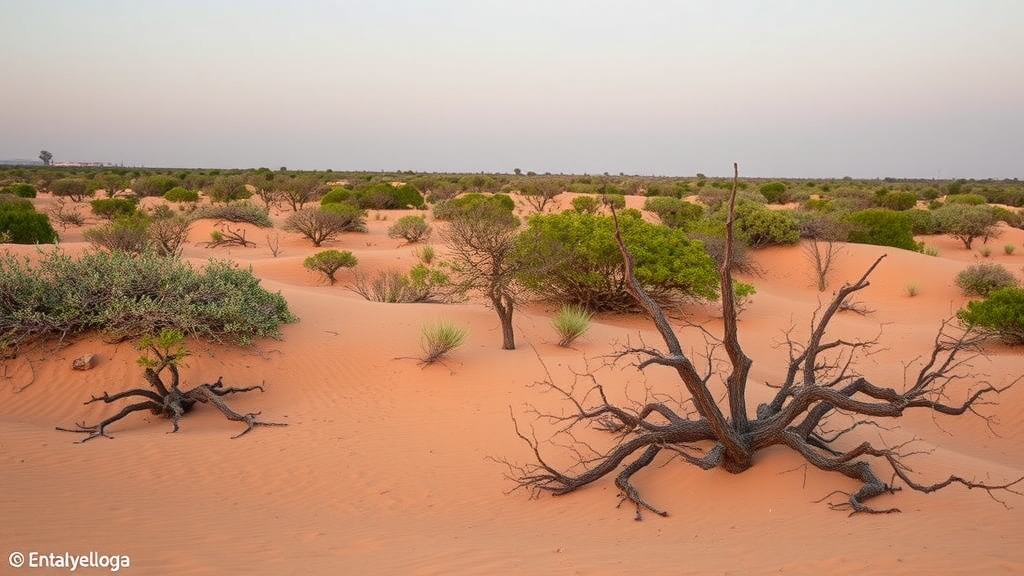
Deep beneath the soybean fields now spreading across the Brazilian state of Piauí lies a soil whose story has long been told incorrectly. A new open-access study published in Discover Soil has taken a detailed, laboratory-intensive look at five representative profiles of sandy-textured Ferralsols from the Cerrado of Piauí, and the findings challenge several widely held assumptions about how tropical soils form, how strongly they are weathered, and which quick, low-cost tools scientists can trust to measure them. The research team, led by soil scientists from the Federal University of Piauí and partner institutions in Brazil and the United States, examined the morphological, physical, chemical, and mineralogical characteristics of these soils while simultaneously testing whether low-frequency magnetic susceptibility could serve as a reliable proxy for soil development. What they found was a system whose properties are dictated less by the intensity of tropical weathering and more by the quartz-rich sedimentary rocks from which the soils were born.
The stakes of this work are far higher than the quiet subtitle of pedogenesis might suggest. The Cerrado has become one of the world’s most consequential agricultural frontiers, and Piauí sits at the center of its latest expansion. According to recent reporting cited in the study, nearly 1.29 million hectares of natural Cerrado were converted to soybean production between 2014 and 2023, with roughly 70 percent of Piauí’s own 11.2 million hectares of Cerrado concentrated in the southwestern region where the study was conducted. Soils similar to those examined here also dominate vast agricultural regions of South America, Africa, and Southeast Asia, occupying close to six percent of Earth’s continental land surface. Understanding their true genesis is therefore not an academic curiosity; it directly shapes how hundreds of thousands of hectares of newly cleared land will be fertilized, irrigated, and sustained, or degraded, over the coming decades.
Most textbook descriptions of Ferralsols, known as Latossolos in the Brazilian classification system and Oxisols in USDA Soil Taxonomy, describe intensely weathered, clay-rich profiles packed with iron oxides such as goethite and hematite and often containing the aluminum hydroxide gibbsite. The Piauí profiles defy that template in striking ways. All five profiles, sampled at stable landscape summits to avoid contamination from transported material, developed from sedimentary rocks of the Parnaíba Basin, specifically the Pedra-de-Fogo and Piauí Formations of the Balsas Group. Sand content ranged from 541.4 to 909.1 grams per kilogram, with fine sand alone making up between 51 and 80 percent of the total sand fraction. X-ray diffraction confirmed that quartz overwhelmingly dominates the sand fraction, accompanied by minor feldspar and ilmenite, while kaolinite dominates the clay fraction. Critically, no gibbsite was detected anywhere in these soils, and iron oxide concentrations were uniformly low.
That combination of features forced the researchers to reconsider what their weathering indices actually mean. The indices Ki and Kr, which express the ratio of silica to aluminum and to aluminum plus iron in the fine earth, came in at values below 1.4 and below 1.0 respectively for nearly all horizons, numbers that normally signal advanced desilication and long, intense weathering. Yet the sandy textures persist, and kaolinite persists with them. The authors resolve this apparent contradiction with a compelling thermodynamic argument: because the parent rocks are so rich in quartz, the weathering solution maintains a high ambient silica activity that stabilizes kaolinite and prevents its further breakdown into gibbsite. In other words, the dominance of kaolinite in these profiles does not indicate moderate weathering. It indicates a lithologically controlled weathering pathway, in which intense desilication proceeds through a kaolinitic stage that the quartz-rich parent material will not let the soil outgrow.
The practical consequences of this lithological inheritance are sobering. Chemically, the soils are strongly acidic, with pH values between 4.3 and 5.4, and their cation exchange capacity never exceeds 12.3 centimoles of charge per kilogram, frequently falling below 5. Exchangeable bases such as potassium, calcium, and magnesium are so scarce they often fall below detection limits, pushing base saturation below 10 percent in surface horizons and aluminum saturation to nearly 100 percent in the worst cases. Organic carbon contents are similarly meager, averaging between 2.8 and 5.3 grams per kilogram across profiles, because sandy textures provide minimal physical protection for organic matter against thermal oxidation and microbial breakdown. Phosphorus availability is critically low, though interestingly, the mechanism differs from that in clayey Ferralsols: rather than being locked up by abundant iron and aluminum oxides, phosphorus is simply absent, because the soil itself has almost no reactive mineral surfaces to hold it. Standard fertilization practices calibrated for clay-rich Cerrado soils may thus translate poorly to these sandy systems.
Physical measurements reinforce the picture of inherent fragility. Bulk densities ranged from 1.09 to 1.41 grams per cubic centimeter, with the sandiest profiles, P1 and P2, showing the highest values and correspondingly reduced porosity and water-holding capacity. Profiles with somewhat more clay, such as P3 and P5, fared slightly better, but even they remain vulnerable to rapid drainage and drought stress. Dispersible clay was generally low, although profile P3 showed notably higher values in its AB and BA horizons, suggesting greater susceptibility to clay dispersion and, by extension, to structural degradation under cultivation. Weak to moderate soil structure throughout the profiles reflects the limited cementing role of iron oxides, whose subdued diffraction peaks and low dithionite- and oxalate-extractable iron contents confirm that these soils lack the mineral glue that gives clayey Ferralsols their characteristic stable microaggregates.
Perhaps the most methodologically consequential part of the study concerns magnetic susceptibility. Low-frequency magnetic susceptibility, measured here with a Bartington MS2 system at 0.47 kilohertz, is prized in soil science as a fast, cheap, non-destructive proxy because it responds to ferrimagnetic minerals such as maghemite and magnetite, which often form pedogenically in highly weathered tropical soils. In clayey Ferralsols elsewhere in the Cerrado, magnetic susceptibility correlates strongly with clay content, iron oxide crystallinity, and weathering indices. In the Piauí profiles, however, values never exceeded 10 × 10⁻⁸ cubic meters per kilogram, and Spearman correlation analyses found no statistically significant relationship between magnetic susceptibility and any measured physical, chemical, or iron oxide property. The reason is mineralogical arithmetic: quartz and kaolinite, the two dominant minerals, are both diamagnetic, while the iron oxides present, goethite and hematite, are only antiferromagnetic and produce weak magnetic signals.
The authors are careful to frame this null result correctly. The failure of magnetic susceptibility to track soil development here is not a failure of the method itself; it is an accurate reflection of a baseline scarcity of ferrimagnetic minerals inherited from sedimentary parent rock. In these landscapes, the technique can still serve a purpose, but an inverted one: it functions as a reliable indicator of parent material constraints rather than of weathering intensity. The team also speculates, cautiously and given the small sample size of five profiles, about trace ferrimagnetic minerals below X-ray detection, which might arise from fire-induced alteration or from wetting-drying cycles, and which could explain slightly elevated surface values in one profile. But they explicitly caution that these observations warrant further investigation with larger datasets before any firm conclusions are drawn.
Ultimately, the study delivers a twofold lesson for tropical soil science and for the farmers working Brazil’s newest agricultural frontier. First, genesis cannot be inferred from morphology alone: these profiles look ferralic, with deep, uniform, diffusely bounded horizons extending beyond 1.6 meters, yet their properties are governed by what the underlying sandstones and shales of the Balsas Group could and could not supply. Second, proximal sensing tools must always be interpreted in the light of lithological inheritance, because a cheap magnetic reading that means maturity in Minas Gerais may mean something entirely different on the quartz plains of Piauí. As soybean frontiers continue to push across sandy Cerrado landscapes, from Brazil to Benin to tropical China, research like this provides the ground truth needed to manage low-fertility tropical soils before their fragility becomes an ecological and economic liability rather than a scientific footnote.
Subject of Research: Genesis and properties of sandy-textured Ferralsols developed on sedimentary rocks in the Brazilian Cerrado of Piauí, including evaluation of low-frequency magnetic susceptibility as a pedogenic proxy.
Article Title: Genesis and properties of representative Ferralsols from the Brazilian Cerrado of Piauí
Article References: Gualberto, A. V. S., Barbosa, R. S., da Silva, Y. J. A. B., Silva, L. S., de Melo Wanderley Neves, L. V., Marques, J., Jr., & da Silva Costa, O., Jr. (2026). Genesis and properties of representative Ferralsols from the Brazilian Cerrado of Piauí. Discover Soil, 3(1), Article 159. https://doi.org/10.1007/s44378-026-00313-x
Image Credits: AI Generated
DOI: 10.1007/s44378-026-00313-x
Keywords: Ferralsols, Brazilian Cerrado, Piauí, soil genesis, soil mineralogy, kaolinite, quartz, weathering indices, magnetic susceptibility, tropical soils, soil fertility, sedimentary parent material
Cite Scienmag News
Alan Morgan. (September 22, 2026). Sandy Secrets Beneath Brazil’s Cerrado: New Study Rewrites the Story of Tropical Ferralsols. Scienmag. https://scienmag.com/sandy-secrets-beneath-brazils-cerrado-new-study-rewrites-the-story-of-tropical-ferralsols/
Alan Morgan. "Sandy Secrets Beneath Brazil’s Cerrado: New Study Rewrites the Story of Tropical Ferralsols." Scienmag, 22 September 2026, https://scienmag.com/sandy-secrets-beneath-brazils-cerrado-new-study-rewrites-the-story-of-tropical-ferralsols/. Accessed 4 October 2026.
Alan Morgan. "Sandy Secrets Beneath Brazil’s Cerrado: New Study Rewrites the Story of Tropical Ferralsols." Scienmag. September 22, 2026. https://scienmag.com/sandy-secrets-beneath-brazils-cerrado-new-study-rewrites-the-story-of-tropical-ferralsols/


