


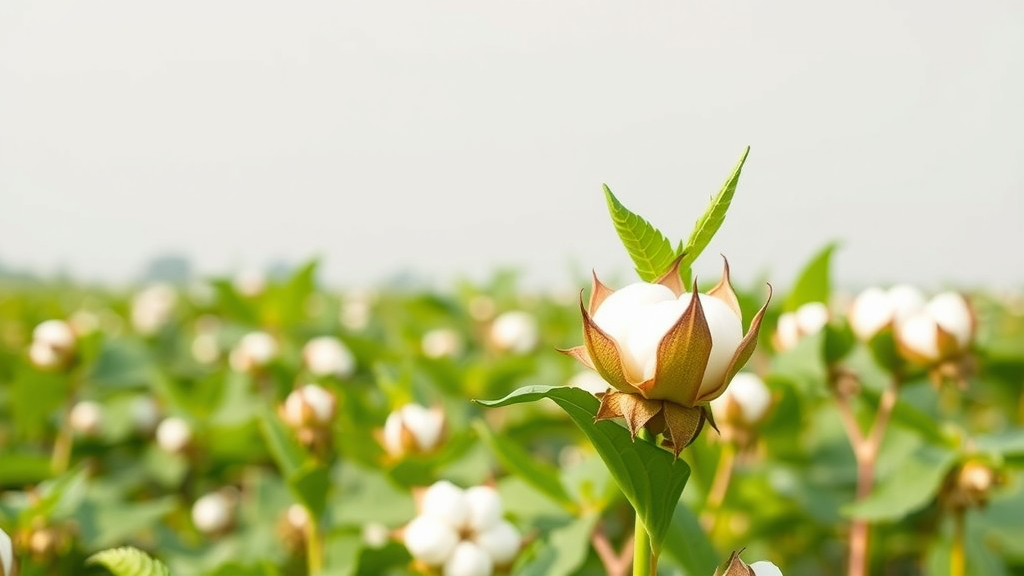
A high-yielding genetically protected cotton variety developed by Indian public-sector breeders is drawing attention across the cotton-growing belt of North India. Known as PAU Bt 5, and identified in trials under the designation PBH Bt 21, the variety was bred at Punjab Agricultural University in Ludhiana and formally released in 2023 for irrigated cultivation in the states of Punjab, Haryana and Rajasthan. A recent varietal notification and germplasm registration record, published in the Indian Journal of Genetics and Plant Breeding, now documents the full performance profile of the variety, from its pedigree and selection history to its multi-season yield results, fibre characteristics and disease reactions. For a crop that underpins the livelihoods of millions of farmers in the region, the arrival of a publicly bred Bt variety with demonstrated yield advantages carries substantial practical significance.
The genetic origin of PAU Bt 5 reflects a deliberate, multi-generation breeding strategy. The variety emerged through pedigree selection from the cross LH 2298 × PAU Bt 1, combining an elite adapted breeding line with an established Bt parent. Pedigree selection is one of the classical methods of plant breeding: after the initial hybridization, segregating generations are advanced and individual plants with superior combinations of traits are selected and selfed across successive seasons until genetic uniformity is achieved. Because the method retains the segregation products of a controlled cross, it allows breeders to shuffle the genomes of two parents and recover novel recombinant lines that outperform both. In the case of PAU Bt 5, that recombinant advantage translated into a statistically meaningful yield margin over its own Bt parent, PAU Bt 1, as well as over other commercial and local checks.
The evidence base for the release rests on the All India Coordinated Research Project on Cotton, the national testing network that evaluates candidate varieties across locations before they are recommended to farmers. Fifteen coordinated trials conducted between 2019 and 2022 across five locations in the North Zone formed the evaluation set. Across those environments, PAU Bt 5 recorded a mean seed cotton yield of 2,572 kilograms per hectare, a figure that represents the combined weight of harvested lint and seed picked from the fields. The variety outperformed PAU Bt 1 by 20.1 percent and PAU Bt 2 by 21.8 percent, while exceeding the check variety F 2228 by a marginal 0.25 percent and local checks by 8.18 percent. Consistent superiority across locations and seasons is a key criterion in varietal release because farmers need performance that is stable, not a one-season fluke.
Yield alone does not determine commercial success; the quality of the fibre and the efficiency of ginning are equally decisive for both farmers and the textile industry. In ginning trials, PAU Bt 5 produced a ginning outturn of 35.8 percent, meaning that roughly a third of the weight of seed cotton delivered to the gin emerges as saleable lint. Fibre analysis showed an upper half mean length of 26.2 millimetres, a micronaire value of 4.9 and a fibre strength of 26.4 grams per tex. Each of these parameters has a direct industrial interpretation. Upper half mean length measures the length of the longer half of the fibres and influences yarn evenness and spinning performance. Micronaire, a combined measure of fineness and maturity, sits within the range preferred by spinners when it falls between roughly 4.3 and 4.9, and PAU Bt 5 lies at the upper boundary of that range. Fibre strength in grams per tex indicates the force needed to break a bundle of fibres of unit linear density, and higher values allow finer, stronger yarns to be spun without breakages.
Disease resistance is the third pillar of the variety’s agronomic package, and it addresses some of the most persistent threats to cotton in northwestern India. PAU Bt 5 was classified as moderately resistant to cotton leaf curl disease, a viral condition transmitted by the whitefly that causes leaf deformation, stunting and yield losses across the region. More favourably, the variety showed resistance to fungal foliar leaf spot and to bacterial leaf blight, two foliar diseases that can compromise canopy health and photosynthetic capacity during the growing season. Resistance breeding matters because chemical control of these diseases is often imperfect and costly, and because farmers in the region already face heavy management burdens from insect pests. Embedding genetic resistance into an elite Bt variety reduces the need for protective sprays and provides a more durable, low-input form of protection.
The technical foundation of the variety lies in Bt technology itself, the insect-resistance system that has reshaped cotton production in India since its introduction. Bt cotton carries genes derived from the soil bacterium Bacillus thuringiensis, which encode proteins toxic to specific lepidopteran pests, notably the American bollworm complex that historically devastated Indian cotton crops. When susceptible larvae feed on any plant tissue, the ingested Bt proteins are activated in the alkaline midgut, binding to receptors and disrupting the gut epithelium, which halts feeding and kills the insect. For farmers, the practical consequence is a dramatic reduction in insecticide applications targeted at bollworms, lower production costs and reduced chemical exposure. Because PAU Bt 5 combines this insect protection with publicly bred genetic background, it offers farmers an alternative to proprietary hybrid Bt seed while remaining subject to the same resistance-management obligations that govern all Bt cotton cultivation.
The varietal context of the release also deserves attention. Unlike single-cross hybrids, which must be purchased fresh each season because their advantage collapses in the second generation, a pureline variety such as PAU Bt 5 breeds true, and its registration as germplasm secures its identity and availability for future breeding. The registration process formally documents the genetic stock in a national repository, making the material accessible to other breeders who may wish to use it as a parent in their own crossing programmes. In this sense the contribution of the Ludhiana team extends beyond the immediate commercial release: the variety becomes a building block for the wider improvement of American cotton, or Gossypium hirsutum, in South Asia. Public varieties also tend to keep seed costs down, an important consideration given the economic pressures on smallholder cotton farmers.
The regional focus of the release is equally deliberate. Punjab, Haryana and Rajasthan together constitute the North Zone of Indian cotton cultivation, an intensively irrigated system in which cotton is grown during the monsoon-assisted kharif season under assured water supply. Conditions in this zone differ sharply from the rainfed central and southern cotton regions, in terms of both soil type and the spectrum of pest and disease pressure. The whitefly-transmitted cotton leaf curl virus, for example, is a distinctly North Zone problem, which makes moderate resistance to that disease a regionally targeted trait rather than a generic one. The coordinated trial system ensures that varieties are tested under precisely these conditions before recommendation, and the 2019 to 2022 trial window captured meaningful environmental variation across the zone, lending robustness to the performance claims.
For the farming community, the sum of these attributes is a coherent value proposition. A mean seed cotton yield approaching 2.6 tonnes per hectare, double-digit percentage advantages over the two preceding Bt varieties from the same programme, ginning outturn and fibre traits that meet spinning-industry expectations, and layered resistance to three significant diseases together describe a variety engineered for dependability as much as for peak performance. The work was conducted under the All India Coordinated Research Project on Cotton and the State Research Scheme of Punjab Agricultural University, without any dedicated external grant, underscoring the role of sustained public investment in agricultural research. As insect resistance management, refuge planting and stewardship of Bt technology continue to evolve, varieties such as PAU Bt 5 demonstrate that conventional breeding excellence and transgenic protection can be integrated to deliver measurable gains, and that publicly developed germplasm remains a vital source of resilience for one of India’s most economically important crops.
Subject of Research: Development and evaluation of the high-yielding Bt cotton variety PAU Bt 5 for irrigated cultivation in North India
Article Title: American Cotton Bt Variety- PAU Bt 5 (PBH Bt 21)
Article References: Singh, P., Kumar, V., Grover, G., Rathore, P., Pathak, D., & Kumar, H. (2026). American Cotton Bt Variety- PAU Bt 5 (PBH Bt 21). Indian Journal of Genetics and Plant Breeding, 86(3), 385-386. https://doi.org/10.1007/s44489-026-00034-z
Image Credits: AI Generated
DOI: 10.1007/s44489-026-00034-z
Keywords: Bt cotton, Gossypium hirsutum, plant breeding, Punjab Agricultural University, cotton yield, fibre quality, disease resistance, cotton leaf curl disease, pedigree selection, AICRP Cotton, North India, varietal release
Cite Scienmag News
Alan Morgan. (September 20, 2026). New Bt Cotton Variety PAU Bt 5 Delivers Higher Yields for North India. Scienmag. https://scienmag.com/new-bt-cotton-variety-pau-bt-5-delivers-higher-yields-for-north-india/
Alan Morgan. "New Bt Cotton Variety PAU Bt 5 Delivers Higher Yields for North India." Scienmag, 20 September 2026, https://scienmag.com/new-bt-cotton-variety-pau-bt-5-delivers-higher-yields-for-north-india/. Accessed 20 September 2026.
Alan Morgan. "New Bt Cotton Variety PAU Bt 5 Delivers Higher Yields for North India." Scienmag. September 20, 2026. https://scienmag.com/new-bt-cotton-variety-pau-bt-5-delivers-higher-yields-for-north-india/


