


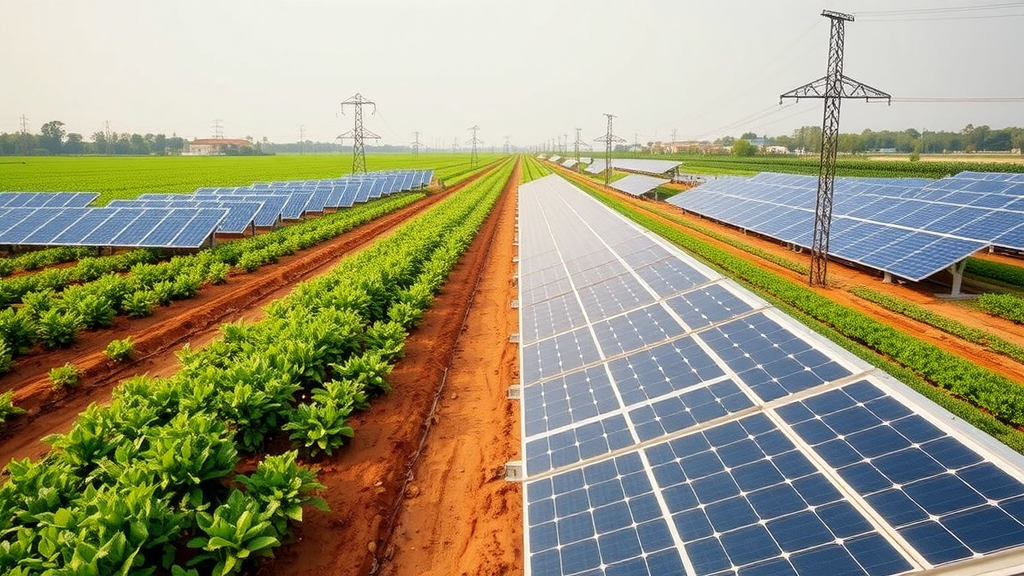
Agrivoltaics, the practice of mounting solar panels above working farmland so that electricity and crops can be produced on the same parcel of land, has long promised a way out of the land-use conflict between renewable energy and food production. Yet the promise comes with a catch: photovoltaic arrays are large engineered structures that reshape how sunlight falls across a field, altering microclimate, evaporation and photosynthesis in ways that can either help or seriously harm a harvest. Poorly designed layouts have been shown to cut crop yields and occasionally cause outright crop failure. A new study published in Artificial Intelligence in Agriculture tackles this design problem head-on, replacing trial-and-error array sizing with a computational framework that searches millions of possible geometries to find layouts that keep both the panels and the plants happy.
The research team, led by Long Zhang of Nanjing Agricultural University together with colleagues from industry partner Three Gorges Group, worked at a 20-megawatt agrivoltaic demonstration park in Lishui District, Nanjing, in eastern China. The park, established in 2016 across roughly 47 hectares, generates about 24 million kilowatt-hours per year. Its fixed-support arrays run north-south with south-facing modules installed 2.5 meters above the ground at a 24-degree tilt, covering 53.3 percent of the soil below with panel projections. The researchers spent a full year measuring solar radiation beneath and between the panels using Onset HOBO sensors logging every ten minutes, comparing the field data against an open-field control station to define the daylighting rate, the ratio of light inside the array to light in the open.
To turn those measurements into a design tool, the team built a one-to-one three-dimensional model of the array in SketchUp and imported it into ECOTECT, an environmental simulation package capable of calculating solar radiation, daylighting and shading across complex geometries. The model simplified the panels into uniform rectangular layers of glass, silicon cells and backsheet with measured optical properties, ignored minor shading from diagonal braces, and drew its meteorological boundary conditions from historical China Meteorological Administration data for Nanjing. After a grid independence analysis settled on a 64-by-48 node resolution for the north-south vertical section, the researchers validated the simulation against twelve months of field data from July 2023 to June 2024. The agreement was striking: a coefficient of determination of 0.982, a root mean square error of 2.28, and an average relative error of just 4.9 percent, with no monthly comparison exceeding 8 percent error.
With a trustworthy light model in hand, the team defined the design problem. Four geometric parameters emerged as the truly independent variables an engineer can adjust: array span, panel tilt angle, installation height, and the transverse gap between panel rows. Azimuth was fixed by convention and site orientation, module width was locked by commercial standardization, and coverage ratio was treated as a derived quantity rather than a free variable. The chosen ranges reflected real-world engineering: spans of 8 to 12 meters to accommodate machinery, tilt angles of 18 to 36 degrees, heights of 2.5 to 4.0 meters to clear crops and equipment, and transverse gaps of 0 to 0.6 meters. Three conflicting objectives defined success: maximizing the maximum canopy daylighting rate, maximizing annual energy generation per hectare, and minimizing the coefficient of variation of daylighting, a statistical measure of how unevenly light is distributed across the crop canopy.
The first analytical pass was a single-factor sensitivity study, which revealed that no single knob moves all three objectives in the same direction. Raising the tilt angle from 18 to 36 degrees steadily improved power output and modestly improved light availability. Widening the span improved the daylighting rate substantially but eroded energy generation, because fewer panels fit per hectare. The transverse gap behaved similarly, boosting light penetration up to about 0.4 meters before power losses became steep. Installation height barely mattered for electricity but dominated light uniformity, since taller panels cast longer, softer shadows that blend more evenly across the canopy. Analysis of variance later confirmed these hierarchies: span mattered most for the daylighting rate, the transverse gap and span dominated energy generation, and installation height was the decisive factor for uniformity, with tilt acting as a moderate regulatory parameter throughout.
Because interactions between parameters proved statistically significant, the team then fitted quadratic response surface models using a Box-Behnken design of 29 simulation runs, an efficient scheme that captures linear, interaction and curvature effects while keeping every design point inside the engineering-safe range. The resulting regression models were exceptionally accurate, with coefficients of determination of 0.9978 for daylighting rate, essentially 1.0 for energy generation, and 0.9987 for the coefficient of variation, all significant at well below the 0.0001 probability level. But response surfaces alone could not guarantee a global optimum in such a nonlinear, multi-peaked landscape, so the researchers embedded their surrogate models inside a hybrid evolutionary search. The non-dominated sorting genetic algorithm II, or NSGA-II, provided the global engine, using fast non-dominated sorting, elitist preservation and crowding-distance ranking to maintain a diverse Pareto front of trade-off solutions. In each generation, the most promising layouts seeded an artificial fish swarm algorithm, whose foraging, swarming and following behaviors performed local refinement around those candidates before the improved designs were folded back into the main population.
The hybrid AFSA-NSGA-II search converged on a Pareto set of layouts balancing all three objectives. To pick a single recommended configuration without subjective judgment, the team applied the entropy weight method, which derives objective weights from the information content of the data itself, assigning weights of 0.35 to daylighting rate, 0.27 to energy generation, and 0.38 to uniformity. A TOPSIS ranking, which scores each candidate by its distance from the ideal and anti-ideal solutions, then selected the winner: a tilt angle of 30.1 degrees, a span of 9.1 meters, an installation height of 3.1 meters, and a transverse gap of 0.24 meters. Under this configuration the predicted maximum daylighting rate reached 80.1 percent with a coefficient of variation of 18.3 percent and an energy yield of 1.35 megawatt-hours per hectare. Follow-up simulation confirmed the predictions with relative errors of just 1.7 percent for light availability and 3.2 percent for uniformity, and zero error for power. Compared with the original 24-degree, 8-meter, gap-free design, the optimized layout raised light availability by 4.6 percent and cut light non-uniformity by 12.7 percent while sacrificing only 0.40 megawatt-hours per hectare of electricity.
The spatiotemporal gains carried through the growing seasons. During the overwintering crop period, the optimized array achieved a daylighting rate of 81.6 percent, up 1.9 percent from the original, while the coefficient of variation dropped from 41.9 to 25.9 percent, a 16.0 percent improvement in evenness. In the summer-sown period the daylighting rate reached 81.2 percent, up 2.2 percent, and the coefficient of variation fell 20.5 percent to 15.1 percent. To test whether these simulated benefits translate into grain and legumes, the team ran field trials with winter wheat and peanuts, the dominant rotation crops of the Yangtze River middle and lower reaches, under three panel densities: full density, high density and semi density. Light and yield tracked panel density closely. Under the semi-density layout between panels, wheat yielded 5.4 tonnes per hectare against 6.4 in the open field, a 15.6 percent loss, while the full-density between-panel treatment fell 25.0 percent to 4.8 tonnes. Peanuts showed the same gradient, dropping 20.0 percent under semi-density and 30.0 percent under full density relative to the open-field control of 4.0 tonnes per hectare.
The authors are careful about scope. Their optimum is calibrated to the subtropical monsoon climate of Nanjing and to two specific crops, and they note that shade-tolerant species such as forages, vegetables and certain high-value crops may respond differently to panel density. They also flag inter-annual climate variability and the need to couple the layout framework with crop growth models and multi-year environmental data. Still, the practical message is clear and, for a field often driven by rules of thumb, quietly radical: agrivoltaic design is a genuine multi-objective optimization problem, and treating it as one, with validated light simulation, surrogate modeling and hybrid evolutionary search, can buy meaningfully better growing conditions for a modest and quantified energy cost. As agrivoltaics scales worldwide, frameworks like this one offer engineers a numerical basis for deciding where every panel should sit.
Subject of Research: Multi-objective optimization of photovoltaic array layouts in agrivoltaic systems to balance crop light availability and solar energy generation
Article Title: Multi-objective optimization of photovoltaic array layouts on farmland via a hybrid algorithm framework for enhanced agricultural production and energy generation
Article References: Zhang, L., Geng, X., Ding, H., Cao, K., Wang, L., Chen, H., Deng, L., Wu, C., Xiao, M., & Bao, E. (2026). Multi-objective optimization of photovoltaic array layouts on farmland via a hybrid algorithm framework for enhanced agricultural production and energy generation. Artificial Intelligence in Agriculture. https://doi.org/10.1016/j.aiia.2026.09.002
Image Credits: AI Generated
DOI: 10.1016/j.aiia.2026.09.002
Keywords: agrivoltaics, photovoltaic arrays, multi-objective optimization, NSGA-II, artificial fish swarm algorithm, response surface methodology, light environment simulation, ECOTECT, crop yield, winter wheat, peanuts, solar energy
Cite Scienmag News
Alan Morgan. (September 20, 2026). Smarter Solar Farm Layouts Boost Crops and Power Together. Scienmag. https://scienmag.com/smarter-solar-farm-layouts-boost-crops-and-power-together/
Alan Morgan. "Smarter Solar Farm Layouts Boost Crops and Power Together." Scienmag, 20 September 2026, https://scienmag.com/smarter-solar-farm-layouts-boost-crops-and-power-together/. Accessed 4 October 2026.
Alan Morgan. "Smarter Solar Farm Layouts Boost Crops and Power Together." Scienmag. September 20, 2026. https://scienmag.com/smarter-solar-farm-layouts-boost-crops-and-power-together/


