


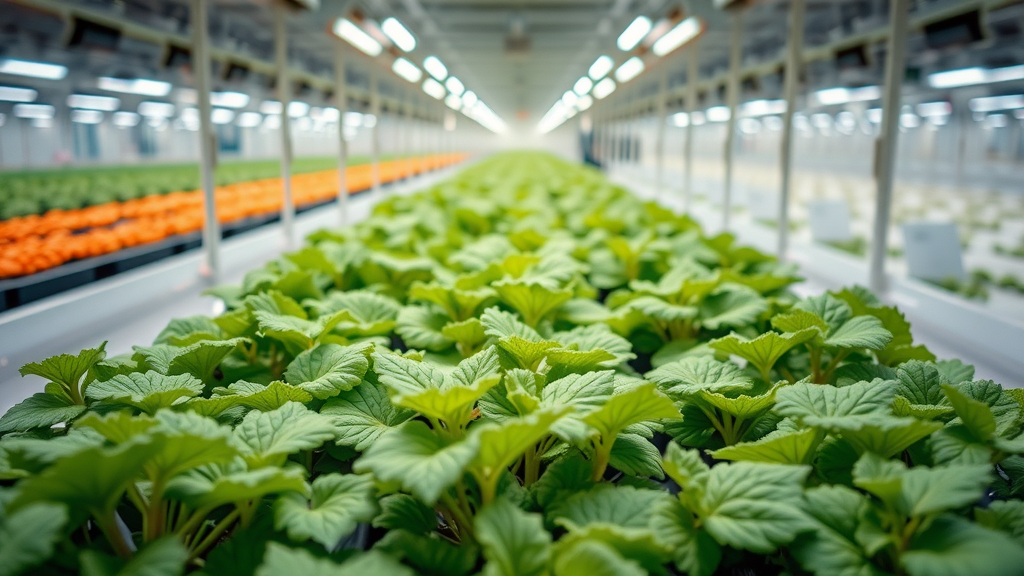
Food security has become one of the defining challenges of the twenty-first century, and a new research facility in the United Kingdom is positioning itself at the forefront of the response. Nottingham Trent University has officially unveiled a state-of-the-art Smart Agriculture Research Centre at its Brackenhurst Campus, a modular facility designed to drive pioneering research and education in smart farming and sustainable food production. At a moment when the global population continues to rise, arable land is shrinking and the climate is shifting in unpredictable ways, the centre represents a substantial institutional commitment to rethinking how fresh food can be grown, measured and optimised under precisely controlled conditions.
The centrepiece of the new facility is a fully-controlled growth environment that brings together the latest technologies and innovations in smart farming and plant science. Rather than depending on favourable weather, fertile soil, abundant water or high running costs, the centre allows scientists to assess how nutritious and fast-growing fresh food can be produced independently of these traditional constraints. Customised combinations of LED lighting and nutrients create optimum growth conditions tailored to the needs of a wide range of crops, from microgreens to larger leafy greens and fruiting plants. This level of environmental control means that experiments which would take an entire growing season in the field can be run, adjusted and repeated far more rapidly under laboratory conditions.
The facility incorporates both hydroponic and aeroponic growing systems, two soilless cultivation methods that sit at the heart of modern controlled environment agriculture. In these systems, different recipes of nutrient-rich solutions are delivered directly to plant roots, which in the aeroponic configuration are suspended mid-air. By decoupling plant growth from soil quality entirely, researchers can isolate the effects of individual nutrients, light spectra, humidity levels and temperature regimes with a precision that open-field agriculture simply cannot offer. The result is a platform capable of generating highly reproducible data on how specific crops respond to specific inputs, knowledge that can then be translated into commercial growing practices.
Artificial intelligence plays a central role in the centre’s research strategy. Environmental and growth data collected continuously from the growing spaces will be processed by AI systems designed to extract the key features driving individual crop performance. This goes beyond simple monitoring: the goal is to build a deeper understanding of the specific requirements of particular plants and crops, allowing researchers to identify the combinations of conditions that maximise yield, nutritional quality and resource efficiency. As machine learning models accumulate data across experiments, they are expected to reveal patterns and relationships in plant behaviour that would be difficult or impossible for human observers to detect.
Beyond the three large growing spaces and individual environmental chambers built for contained experiments, the facility includes a dedicated biochemical analysis suite for molecular plant science. This analysis area enables researchers to understand crop variations at molecular detail, linking what happens inside the plant at the biochemical level to the growth outcomes observed in the growing rooms. Molecular profiling technology supplied by Waters Corporation provides a range of equipment supporting various discovery and targeted quantitation analysis workflows, allowing the team to move seamlessly between observing a phenotype and probing its underlying molecular mechanisms.
Complementing the molecular work, advanced imaging techniques will allow researchers to measure and monitor plant morphology, growth rates and health metrics under varying environmental conditions. Non-destructive imaging means that the same plant can be tracked throughout its life cycle, generating time-series data on how it responds to changes in light, nutrition or climate. Combined with the molecular profiling capability, this creates a powerful multi-scale picture of plant performance, from genome-informed biochemistry up to whole-plant architecture, all captured under tightly defined experimental conditions.
The facility is led from Nottingham Trent University’s School of Animal, Rural and Environmental Sciences and is designed to support a diverse portfolio of interdisciplinary research projects. Its remit extends beyond academic inquiry: the centre is intended to help drive commercial research and partnerships across the agri-tech sector, providing companies with a testbed for developing and validating new products and processes. The £1.5 million facility was made possible through a capital funding grant from the Office for Students, a signal of the growing recognition that controlled environment agriculture has a strategic role to play in the nation’s research infrastructure.
University leadership has been explicit about the strategic ambitions behind the investment. Professor Andy Gill, Associate Dean for Research in the School of Animal, Rural and Environmental Sciences, said the facility will enable NTU to consolidate its position as a national centre of excellence in controlled environment agriculture. He noted that it will address key questions and challenges around global food security and climate resilience while helping the university expand its research into crop optimisation, plant physiology and agri-tech innovation, and that it will also serve as an important platform for industry collaboration and student engagement.
Professor Richard Emes, Pro Vice-Chancellor Research and International at the university, described the funding as further recognition of the expertise and exceptional collaborative research happening at NTU. He emphasised that the facilities will accelerate discovery and serve as a testbed for the university and industrial partners to work together and develop solutions that improve food production and security. UK company Light Science Technologies was awarded the contract for the design, supply, installation and commissioning of the facility, along with continued maintenance, underscoring the close relationship between the academic centre and the commercial technology providers shaping the sector.
The centre will also play a direct role in educating the next generation of agricultural scientists, supporting the teaching and delivery of the university’s postgraduate course in smart agriculture. Students will gain hands-on experience with the same hydroponic, aeroponic, imaging, molecular and AI-driven systems being used in active research programmes, a combination that reflects how modern agriculture increasingly blends plant science, engineering and data analytics. Industry partners interested in learning more about the facilities and exploring collaboration opportunities have been invited to contact the research team directly. As pressures on the global food system intensify, facilities of this kind offer a glimpse of how agriculture may evolve: data-rich, resource-efficient and increasingly independent of the weather outside.
Subject of Research: Smart agriculture and controlled environment agriculture for sustainable food production and food security
Article Title: Smart agriculture research center seeks to address food security challenges
Article References: Smart agriculture research center seeks to address food security challenges. (n.d.). Original publication
Image Credits: AI Generated
DOI: Not provided
Keywords: smart agriculture, food security, controlled environment agriculture, hydroponics, aeroponics, artificial intelligence, LED lighting, plant science, molecular profiling, sustainable food production, agri-tech, Nottingham Trent University
Cite Scienmag News
Alan Morgan. (September 20, 2026). New Smart Agriculture Centre Tackles Global Food Security With AI and Controlled Growing. Scienmag. https://scienmag.com/new-smart-agriculture-centre-tackles-global-food-security-with-ai-and-controlled-growing/
Alan Morgan. "New Smart Agriculture Centre Tackles Global Food Security With AI and Controlled Growing." Scienmag, 20 September 2026, https://scienmag.com/new-smart-agriculture-centre-tackles-global-food-security-with-ai-and-controlled-growing/. Accessed 5 October 2026.
Alan Morgan. "New Smart Agriculture Centre Tackles Global Food Security With AI and Controlled Growing." Scienmag. September 20, 2026. https://scienmag.com/new-smart-agriculture-centre-tackles-global-food-security-with-ai-and-controlled-growing/


