


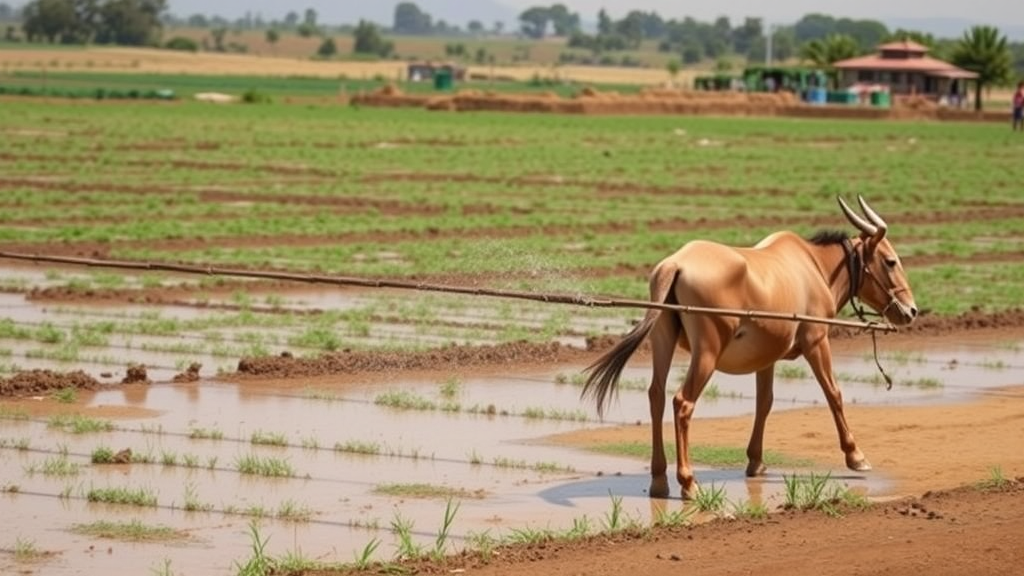
In the highlands and lowland plains of northwest Ethiopia, the future of food and nutrition security rests almost entirely on the shoulders of smallholder farmers cultivating fragmented plots with traditional tools and rain-fed fields. A new study published in BMC Agriculture offers one of the most detailed portraits yet of what these farm households actually produce, and which forces shape the quantity and diversity of the foods that reach their tables. Drawing on detailed surveys of 478 randomly selected households across four districts, the research quantifies, with unusual precision, how much food smallholders generate and which demographic, socioeconomic and institutional factors determine whether that food is abundant, diverse, or narrowly confined to a handful of staple cereals.
The study area, encompassing the districts of Alefa, North Achefer, Takusa and Quara, is home to an estimated 814,021 people and roughly 130,472 registered smallholder farm households. Spanning altitudes from 500 to 2,300 meters above sea level, the landscape supports a diversified crop-livestock mixed-farming system in which cereals, pulses, oilseeds, vegetables, fruits, tubers, spices, livestock and their products are all potential components of household food supply. Between April 2022 and January 2023, researchers administered structured questionnaires capturing the full range of plant-sourced and animal-sourced commodities produced by each household, grouping outputs into 12 food groups following guidelines from the Food and Agriculture Organization and the FANTA framework for dietary assessment.
The headline figure from the analysis is that the average smallholder household in northwest Ethiopia produces 43.53 quintals of crops per year, of which cereals account for 25.47 quintals, or 58.51 percent of total production. Maize dominates, with an average of 12.77 quintals per household annually, followed by millet at 4.61 quintals, sorghum at 3.96 quintals and teff, the culturally central Ethiopian grain, at 2.33 quintals. Pulses and nuts contribute an average of 5.74 quintals, led by soybeans and grass peas, both of which show clear agro-ecological sensitivity: soybeans are concentrated below 1,000 meters in altitude while grass peas dominate the mid-altitude band between 1,500 and 2,300 meters. Oilseeds, including sesame, niger seed, sunflower, linseed and rapeseed, average 2.33 quintals per household, with sesame standing out as the principal cash crop in this category.
Micronutrient-rich foods tell a more sobering story. Average annual production of vegetables is 5.22 quintals per household, while fruits lag dramatically at just 0.62 quintals, despite the region’s diverse agroecology being well suited to crops such as avocado, mango, banana, papaya and watermelon. Ethiopian cabbage, intercropped with maize, is among the most common vegetables, and crops such as okra appear only in specific low-altitude pockets of Quara and Alefa. Only 49 percent of households cultivate any tuber or root crop at all, and a mere 23.22 percent grow spices, averaging 0.77 quintals annually. The authors note that households have substantially less experience producing fruits and vegetables and do not regard these crops as being as significant as cereals, a perception with direct consequences for dietary quality given the role these food groups play in supplying vitamins and minerals.
To identify the drivers behind these patterns, the researchers deployed multiple linear regression models, testing demographic, socioeconomic and institutional predictors while screening for multicollinearity using variance inflation factors and checking robustness with quantile, robust and MM regression. The results reveal a consistent and striking pattern: access to irrigation is among the most powerful levers available. Households using small-scale irrigation produced 21.77 quintals more crops than non-users, largely because irrigation enables more than one production season in a system otherwise hostage to rainfall. Irrigation user households also produced 3.25 quintals more fruit per year than non-users, making water access a decisive factor in diversifying production toward nutrient-dense food groups such as fruits and vegetables. Yet only 13.60 percent of surveyed households actually use irrigation, representing an enormous unrealized potential.
Draft and transport animals emerge as equally consequential. Each additional ox increases a household’s total crop production by 6.02 quintals, and each additional donkey adds 6.06 quintals, reflecting the central role these animals play as traction power and as transport for inputs and harvested yields. Male-headed households produce 10.53 quintals more total crops than female-headed households, a gap partly attributed to cultural norms that direct female farmers toward backyard cultivation rather than field-scale cereal production. Contacts with agricultural extension workers also translate directly into output, with each additional contact during a production season associated with 1.63 quintals of additional crops. Distance to market operates in the opposite direction: every additional kilometer separating a household from the nearest market center is associated with 0.7 quintals less crop production.
The analysis also uncovers a subtle and counterintuitive finding about education. Each additional year of schooling by the household head reduces cereal production by 0.37 quintals, suggesting that more educated decision-makers diversify into a wider range of crops rather than concentrating on staples. Consistent with this interpretation, an additional year of schooling increases pulse and root crop production by 0.24 quintals. Household labor structure matters too, with each additional family member aged 15 to 64 adding 1.4 quintals of cereals, while households that factor crop management difficulties into their planting decisions produce 2.7 quintals less than those that do not, indicating a precautionary effect that constrains output.
On the livestock side, the picture changes considerably. Ninety-eight percent of households own at least one type of animal, with average holdings of 6.00 tropical livestock units, equivalent to roughly 1,500 kilograms of live weight. Animal-sourced food production averages 248.61 eggs, 117.46 liters of milk and milk products, 132.63 kilograms of meat including chicken, 2.96 kilograms of fish and 8.59 kilograms of honey per household per year. The regression results show that education of the household head and total crop output significantly boost egg production, with each additional year of schooling adding 10.84 eggs annually and each quintal of crops adding 1.78 eggs, likely because cereals serve as feed for poultry. Livestock ownership itself is the dominant predictor of meat availability, with each additional tropical livestock unit associated with 11.28 kilograms more meat produced or purchased, while each additional unit raises milk production by 15.05 liters. Contacts with extension workers add 7.21 liters of milk per contact, underscoring the value of advisory services in dairy management.
Intriguingly, several determinants of livestock production run counter to those for crops. Whereas market distance suppresses crop output, livestock holdings actually increase by 0.17 tropical livestock units for every kilometer a household sits from a market center, and cooperative members hold 1.07 more units than non-members. Arable land adds 1.18 units per hectare, while aging household heads hold fewer animals, with each year of age associated with a decline of 0.092 units. School-age children between five and fourteen play a pivotal role in the free-grazing system, with each additional child in that age band associated with 0.77 more livestock units, a reminder that child labor remains structurally embedded in traditional herding economies.
The authors conclude that promoting cost-effective small-scale irrigation through water-harvesting technologies, improving agricultural management practices, and adding value to livestock production by introducing nutrient-dense animal feeds could substantially raise both the quantity and diversity of food available to smallholder households. They argue that agricultural extension services should be explicitly nutrition-sensitive, framing agriculture not merely as a matter of production volume but of the range of food groups reaching households. The study acknowledges limitations inherent in its cross-sectional design, which captures a single production season and cannot fully reflect long-term household experience, nor determine whether production levels meet the dietary needs of household members. Even so, the findings provide a detailed evidence base for policymakers seeking to transform traditional, rain-fed, and vulnerable smallholder agriculture into a springboard for nutrition-sensitive food systems capable of tackling the underlying causes of food insecurity and malnutrition in Ethiopia and comparable settings across sub-Saharan Africa.
Subject of Research: Determinants of plant- and animal-sourced food production among smallholder farm households in northwest Ethiopia
Article Title: Food-based production of smallholders in northwest Ethiopia: the extent and determinants
Article References: Brhanu, G. A., Ayele, Z. B., & Gebremedhin, S. (2026). Food-based production of smallholders in northwest Ethiopia: the extent and determinants. BMC Agriculture, 2(1), Article 16. https://doi.org/10.1186/s44399-026-00040-2
Image Credits: AI Generated
DOI: 10.1186/s44399-026-00040-2
Keywords: smallholder agriculture, Ethiopia, food security, irrigation, nutrition-sensitive agriculture, livestock production, crop diversification, agricultural extension, mixed farming systems, food groups, market access, BMC Agriculture
Cite Scienmag News
Alan Morgan. (September 20, 2026). Irrigation and Draft Animals Drive Food Production on Ethiopian Smallholder Farms. Scienmag. https://scienmag.com/irrigation-and-draft-animals-drive-food-production-on-ethiopian-smallholder-farms/
Alan Morgan. "Irrigation and Draft Animals Drive Food Production on Ethiopian Smallholder Farms." Scienmag, 20 September 2026, https://scienmag.com/irrigation-and-draft-animals-drive-food-production-on-ethiopian-smallholder-farms/. Accessed 5 October 2026.
Alan Morgan. "Irrigation and Draft Animals Drive Food Production on Ethiopian Smallholder Farms." Scienmag. September 20, 2026. https://scienmag.com/irrigation-and-draft-animals-drive-food-production-on-ethiopian-smallholder-farms/


