


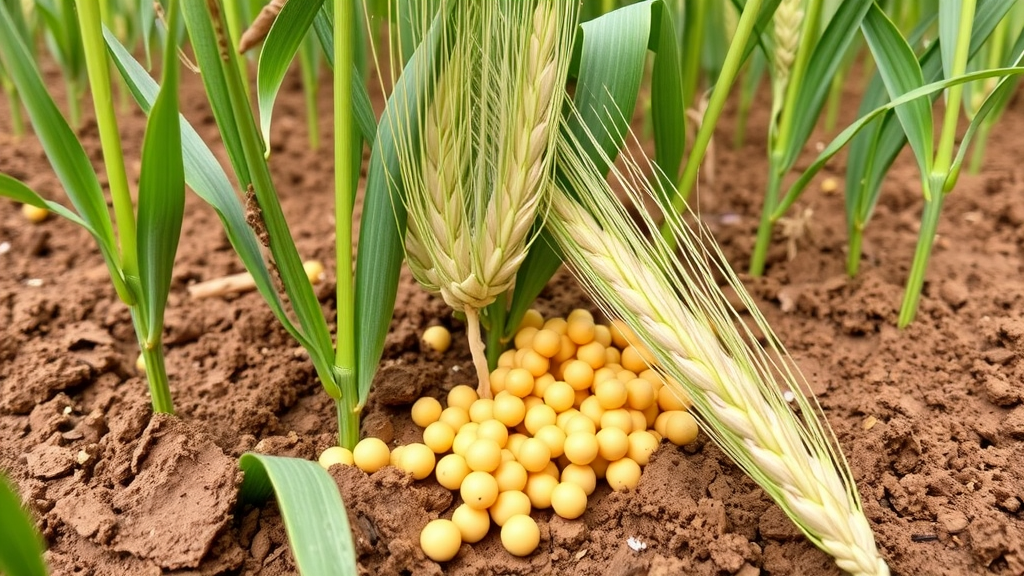
Wheat may owe part of its hidden armor to an unlikely ally growing beside it. A new glasshouse study published in Plant and Soil shows that when wheat plants share a pot with chickpea, they accumulate significantly more silicon in their leaves and stems than wheat grown alone or next to another wheat plant. The finding, led by Félix de Tombeur of CEFE, University of Montpellier, together with colleagues at The University of Western Australia and partner institutions, provides some of the most direct evidence yet that a legume can boost silicon uptake in a neighboring cereal, and it points to root chemistry as a possible, though not yet proven, explanation.
Silicon is not classed as an essential element for most plants, yet for many crops it behaves like one. Plants take it up from the soil solution as monosilicic acid and deposit it in their tissues as amorphous silica, a process called silicification. That mineral armor strengthens stems, helps plants resist fungal pathogens and chewing insects, and buffers against drought, salinity and metal toxicity. The world’s most widely grown cereals, including rice, wheat, barley, maize and sugarcane, typically store more than 10 grams of silicon per kilogram of dry tissue, which is why silicon fertilizers are now applied in agroecosystems worldwide. But those fertilizers depend on finite mineral reserves, and they are often scarce or inaccessible in tropical regions, precisely where soils tend to be poorest in plant-available silicon.
The problem, the researchers note, is that most soil silicon is locked away. It sits inside primary and secondary silicate minerals, sorbed onto iron oxides, or embedded in weathering-resistant phases such as quartz, rather than floating free in the soil solution as monosilicic acid. Whether a crop can actually access silicon therefore depends on the rate at which these poorly available pools are dissolved. Laboratory work has long shown that low-molecular-weight organic anions, especially carboxylates such as citrate, oxalate and malate, accelerate the dissolution of silicate minerals. In one classic experiment, quartz dissolved roughly ten times faster in a citrate solution than in pure water. Recent theoretical work has proposed that root-released carboxylates might similarly unlock soil silicon in the field, raising an intriguing agricultural possibility: could a carboxylate-pumping legume feed silicon to a high-silicon cereal growing next to it?
Chickpea was an obvious candidate. Previous research on 20 chickpea accessions had documented large variation in how much carboxylate these plants release into their rhizosheath, the tight sleeve of soil that clings to living roots. The new study exploited that natural diversity. In a controlled glasshouse experiment at the University of Western Australia, wheat was grown either as two individuals per pot or paired with one of the 20 chickpea accessions, using a silicon-poor, iron-oxide-rich quartz sand representative of more than two-thirds of Western Australia’s cropping soils. After two months, the team measured wheat biomass, leaf and stem silicon concentrations using portable X-ray fluorescence, rhizosheath carboxylate amounts by high-performance liquid chromatography, and foliar manganese, which serves as an established proxy for carboxylate release, since manganese uptake in plants is poorly regulated and strongly tracks rhizosphere availability.
The results were striking. Wheat grown with chickpea produced more leaf, stem, root and total aboveground biomass than wheat grown with another wheat plant, and it also carried higher silicon concentrations in its leaves and a far greater total silicon content aboveground. Crucially, a follow-up experiment ruled out the simplest alternative explanation, competition. Wheat grown entirely alone in a pot still had lower leaf and stem silicon concentrations, and lower total silicon content, than wheat paired with chickpea, showing that the cereal genuinely benefited from its neighbor rather than merely suffering less competition for a limited resource. Tellingly, when pots were fertilized with abundant silicon, the chickpea advantage disappeared, suggesting that facilitation matters most exactly where silicon availability is limiting.
The rhizosphere data lent cautious support to the carboxylate hypothesis. Pots containing wheat and chickpea held significantly more rhizosheath carboxylates per unit of root dry weight than pots with two wheat plants, and accessions previously classified as high carboxylate releasers produced more carboxylates than low releasers. Wheat leaf silicon concentration was marginally correlated with rhizosheath carboxylate amounts, and wheat aboveground silicon content was positively, if weakly, associated with chickpea foliar manganese. Yet the mechanistic picture remained incomplete. Wheat leaf silicon showed no clear relationship with chickpea foliar manganese, a stronger proxy for carboxylate exudation, and within wheat itself, leaf silicon tracked leaf manganese, hinting that silicon and manganese may be mobilized by overlapping rhizosphere processes rather than by chickpea exudates alone.
The authors are candid about these limitations. Extracting and quantifying root exudates from an intertwined root system shared by two species is notoriously difficult; carboxylates are rapidly degraded by microbes or sorbed onto mineral surfaces between release and measurement, so the harvested pool may capture only a snapshot of a dynamic process. Other unmeasured exudates, notably the phytosiderophores that grasses themselves release, could also mobilize silicon, as has been shown for iron-deficient barley drawing silicon and iron from clay minerals. Shifts in rhizosphere pH, altered competition for manganese, or even physiological and gene-expression responses triggered simply by having a legume neighbor could all contribute. The correlation evidence, in other words, suggests carboxylates play a part, but the researchers emphasize that further studies are needed to confirm the mechanism and weigh it against alternatives.
The study delivered a second, unexpected discovery: chickpea itself varies enormously in silicon. Foliar silicon concentrations differed significantly among the 20 accessions, and, counterintuitively, the low-carboxylate group accumulated more silicon in their leaves than the high-carboxylate releasers. A principal component analysis revealed that high-silicon chickpeas formed a distinct syndrome: they were smaller, more branched, invested proportionally more biomass in roots, and exuded fewer carboxylates. The authors suggest a dilution effect may partly explain the pattern, since fast-growing accessions produce biomass faster than they take up silicon, effectively lowering concentration. The finding confirms that silicification varies not only within cereals like rice and wheat but also within a major legume crop, an area largely ignored because silicon research has traditionally centered on grasses, even though mounting evidence shows silicon also benefits legumes, potentially by alleviating metal toxicity and salinity and by promoting root nodulation in the rhizobia symbiosis.
For agriculture, the implications are tantalizing. If the facilitation observed in pots holds under field conditions, wheat-chickpea intercropping, a practice already common in many dryland farming systems, could enhance crop silicification without any added fertilizer, improving resistance to pests, diseases, drought and salinity while potentially lifting yields. The variation among chickpea accessions in their capacity to boost wheat silicon uptake suggests a breeding angle as well: lines that are especially good silicon facilitators could become targets for selection in silicon-limited regions. The authors also flag follow-up questions, including whether silicon supply alters wheat root architecture and water relations under drought, whether other carboxylate-releasing legumes such as soybean show similar facilitative effects, and how the broader community of rhizosphere organisms shapes silicon mobility. Field trials will be the decisive test, since soil chemistry and biology in the open ground differ substantially from controlled pot conditions. For now, the study adds a compelling chapter to a growing recognition that the microscopic traffic of organic molecules around roots, and the quiet cooperation between neighboring crops, can move elements once thought immovable.
Subject of Research: Legume-cereal intercropping and rhizosphere-mediated silicon mobilization in crops
Article Title: Chickpea enhances silicon accumulation in neighboring wheat: a role for rhizosheath carboxylates?
Article References: de Tombeur, F., Yan, L., Tang, D., Plouzeau, L., Gille, C. E., Thorne, S., Lambers, H., Violle, C., Hartley, S., & Pang, J. (2026). Chickpea enhances silicon accumulation in neighboring wheat: a role for rhizosheath carboxylates?. Plant and Soil. https://doi.org/10.1007/s11104-026-09070-w
Image Credits: AI Generated
DOI: 10.1007/s11104-026-09070-w
Keywords: chickpea, wheat, silicon, silicification, rhizosheath carboxylates, intercropping, rhizosphere, root exudates, plant facilitation, soil chemistry, crop stress resilience, Plant and Soil
Cite Scienmag News
Alan Morgan. (September 12, 2026). Chickpea Helps Wheat Pull More Silicon From Soil, Greenhouse Study Finds. Scienmag. https://scienmag.com/chickpea-helps-wheat-pull-more-silicon-from-soil-greenhouse-study-finds/
Alan Morgan. "Chickpea Helps Wheat Pull More Silicon From Soil, Greenhouse Study Finds." Scienmag, 12 September 2026, https://scienmag.com/chickpea-helps-wheat-pull-more-silicon-from-soil-greenhouse-study-finds/. Accessed 12 September 2026.
Alan Morgan. "Chickpea Helps Wheat Pull More Silicon From Soil, Greenhouse Study Finds." Scienmag. September 12, 2026. https://scienmag.com/chickpea-helps-wheat-pull-more-silicon-from-soil-greenhouse-study-finds/


