


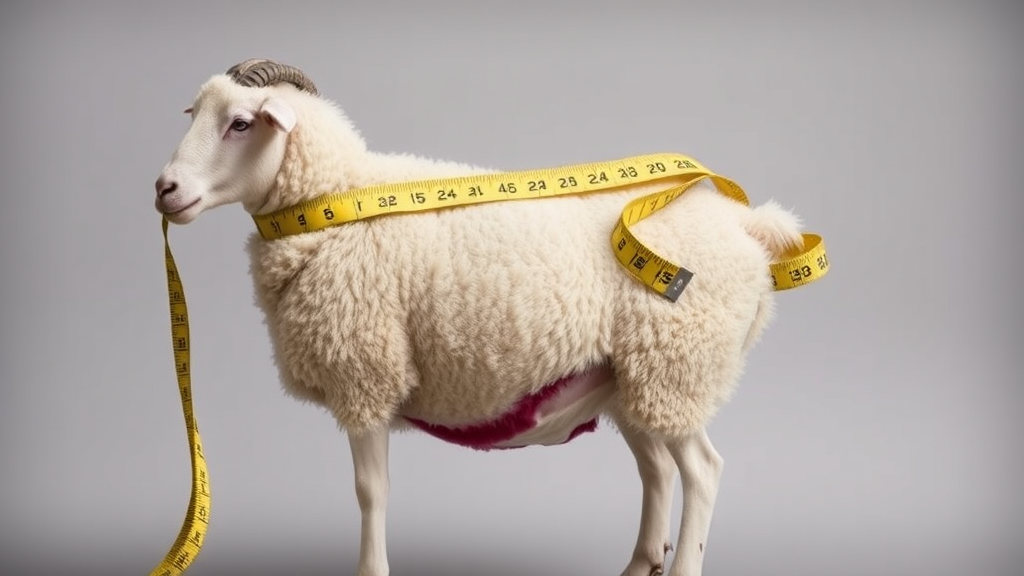
In the semi-arid rangelands of Zimbabwe, where millions of indigenous sheep and goats form the backbone of smallholder livelihoods, a deceptively simple question has long frustrated farmers and researchers alike: how do you weigh an animal when there is no scale? A new study published in BMC Agriculture offers a compelling answer, and it fits on a tailor’s tape. Researchers led by Never Assan of Zimbabwe Open University, working with colleagues at the University of Limpopo and Matopos Research Station, have shown that a single chest measurement—heart girth—can reliably predict body weight in two of the country’s most important indigenous livestock breeds, but only if the animal’s age is taken into account.
The research focused on Sabi sheep and Matebele goats, two hardy genotypes that dominate Zimbabwe’s communal production systems. Sabi sheep are fat-tailed, hair-covered animals prized for their fertility and resistance to local diseases and parasites, with mature weights typically ranging from 35 to 45 kilograms. Matebele goats, native to Matabeleland and parts of Midlands province, are medium- to large-framed meat animals whose mature females can reach 35 to 55 kilograms, standing roughly 65 centimeters at the withers. Despite their numerical dominance—the national goat population stands near four million, while sheep numbers have climbed by about 28 percent to roughly 700,000 head—these breeds have received little systematic attention in genetic improvement programs, largely because communal flocks lack structured recording, controlled mating, or performance evaluation.
That gap matters because body weight is a fundamental indicator in livestock management. It signals growth, market readiness, health status, and suitability as a replacement breeding female. In many communal settings, however, weighing equipment is simply unavailable, making indirect estimation from linear body measurements a practical necessity. Previous studies have confirmed strong associations between live weight and traits such as heart girth, body length, and withers height in small ruminants worldwide, but the relationships are known to shift with sex, age, and physiological state. What remained poorly understood—and what the new study set out to quantify—was how maternal age class alters the structural relationship between body dimensions and body mass, and which traits carry genuine predictive weight at each stage of maturity.
The team conducted a cross-sectional observational study at Matopos Research Station in Bulawayo Province, a site with sweet veld rangeland and low annual rainfall below 450 millimeters. Using purposive sampling from institutional flocks of 124 Matebele goats and 98 Sabi sheep, the researchers selected only healthy, non-pregnant, non-lactating females with body condition scores between 3 and 4 on a five-point scale, and with documented birth records confirmed by dental examination where necessary. The final sample comprised 20 young (2-year-old) Matebele does, 40 mature (4-year-old) does, 26 young Sabi ewes, and 27 mature ewes. Animals aged 3 and 5 years were deliberately excluded to maintain a clear physiological contrast between early reproductive maturity—when skeletal growth is still under way—and peak skeletal and reproductive maturity, when frame size has stabilized. All measurements were taken by a single person to eliminate inter-observer variation, and the animals were managed under a standardized semi-extensive regime with uniform grazing, supplementation, vaccination, and parasite control.
Four morphometric traits were recorded alongside body weight: heart girth, the circumference of the chest; body length, measured from the ear to the tail along a straight backbone; withers height; and rump height. The statistical toolkit combined classical and more sophisticated approaches. Descriptive statistics and Pearson’s correlations established phenotypic associations, while stepwise multiple linear regression built predictive models. Multicollinearity among the inter-correlated skeletal traits was assessed using variance inflation factors, with variables exceeding the conventional threshold of 10 excluded to preserve model stability. Crucially, the team also applied path analysis, a technique that decomposes simple correlations into direct and indirect components, revealing whether a trait truly influences body weight on its own or merely travels in the company of other, more influential measurements. Model performance was validated through cross-validated coefficients of determination, root mean square error, and mean absolute error, with all analyses performed in IBM SPSS Statistics version 29.0 under ethical approval from the Zimbabwe Open University Animal Research Ethics Committee.
The results revealed a striking age-dependent pattern. Body weight rose consistently with age in both species—Matebele does increased from an average of 23.30 kilograms at two years to 27.90 kilograms at four, while Sabi ewes climbed from 28.12 to 35.96 kilograms over the same interval. More tellingly, the phenotypic correlations between weight and body measurements strengthened markedly with maturity. In young Matebele does, weight correlated only weakly with heart girth (r = 0.31), withers height (r = 0.20), and rump height (r = 0.18), while body length showed a moderate significant association (r = 0.39). In mature does, by contrast, heart girth correlations soared to 0.80, body length to 0.70, and withers height to 0.69, all highly significant. A similar maturation effect appeared in the sheep: heart girth correlations rose from a moderate 0.55 in young ewes to a strong 0.73 in mature animals, while associations with other traits remained comparatively weak.
The regression models told an equally nuanced story. For young Matebele does, rump height emerged as the best single predictor, explaining 71 percent of the variation in body weight—evidence that in still-growing animals, skeletal frame development dominates the determinants of mass. Young Sabi ewes required a two-trait model combining heart girth and rump height, which achieved a coefficient of determination of 0.66. In mature animals, heart girth reclaimed center stage: for Matebele does, heart girth and rump height jointly explained 69 percent of weight variation, while for mature Sabi ewes heart girth alone accounted for 53 percent. Cross-validated coefficients tracked the raw values closely, and error estimates remained low (root mean square errors between 1.37 and 1.73), indicating that the parsimonious models generalized well without overfitting. Adding further traits yielded only marginal gains, a finding with real practical value in settings where every extra measurement costs time.
Path analysis added the deepest insight, exposing why naive correlations can mislead. In young Matebele does, body length displayed the largest direct effect on weight (0.75), but this was substantially offset by a negative indirect effect of -0.36 mediated through other traits, leaving only a modest overall correlation. Rump height, despite its strong regression performance, showed a negligible direct effect of -0.03, with its predictive power flowing almost entirely through indirect pathways linked to frame development. In mature animals of both species, however, heart girth’s dominance was unambiguous. Mature Matebele does showed a direct effect of 0.55 supplemented by positive indirect contributions of 0.25, and mature Sabi ewes an even larger direct effect of 0.69 with minimal indirect mediation—figures that closely matched the observed correlations. Withers height and body length contributed almost nothing directly in mature animals; their apparent associations with weight were essentially echoes of their relationship with chest circumference.
The biological interpretation is coherent with established growth physiology. The thoracic region integrates skeletal structure, muscle deposition, and visceral organ mass, making heart girth a comprehensive proxy for overall body size once growth plates close and proportions stabilize. In younger animals, where skeletal elongation and tissue differentiation proceed at different rates, dimensions are not yet proportionally aligned with mass, and height-related traits gain temporary importance as markers of frame development. The authors note that their cross-sectional design captures two physiological snapshots rather than continuous growth trajectories, and they recommend longitudinal studies with larger, more diverse populations—potentially incorporating body condition scoring and advanced modeling—to refine age-specific equations further. Still, the practical prescription is clear. For resource-limited smallholder systems without scales, a heart girth measurement with an inexpensive tape offers a robust, biologically meaningful estimate of live weight in mature animals, with rump height improving accuracy in growing stock. Embedding such simple morphometric tools into structured breeding programs, the researchers argue, could finally give Zimbabwe’s overlooked indigenous genotypes a route into evidence-based selection, better feeding and health decisions, and sustainable genetic improvement.
Subject of Research: Prediction of body weight from morphometric traits in indigenous Sabi sheep and Matebele goats across maternal age classes
Article Title: Influence of maternal age-class and prediction of body weight from morphometric traits in indigenous small ruminant genotypes
Article References: Assan, N., Tada, O., Mwareya, N., & Musasira, M. (2026). Influence of maternal age-class and prediction of body weight from morphometric traits in indigenous small ruminant genotypes. BMC Agriculture, 2(1), Article 19. https://doi.org/10.1186/s44399-026-00045-x
Image Credits: AI Generated
DOI: 10.1186/s44399-026-00045-x
Keywords: body weight prediction, heart girth, morphometric traits, indigenous sheep, indigenous goats, Sabi sheep, Matebele goats, path analysis, regression models, smallholder livestock, Zimbabwe, maternal age class
Cite Scienmag News
Alan Morgan. (September 12, 2026). A Simple Tape Measure May Outweigh Scales: Heart Girth Predicts Weight in Zimbabwe’s Indigenous Sheep and Goats. Scienmag. https://scienmag.com/a-simple-tape-measure-may-outweigh-scales-heart-girth-predicts-weight-in-zimbabwes-indigenous-sheep-and-goats/
Alan Morgan. "A Simple Tape Measure May Outweigh Scales: Heart Girth Predicts Weight in Zimbabwe’s Indigenous Sheep and Goats." Scienmag, 12 September 2026, https://scienmag.com/a-simple-tape-measure-may-outweigh-scales-heart-girth-predicts-weight-in-zimbabwes-indigenous-sheep-and-goats/. Accessed 12 September 2026.
Alan Morgan. "A Simple Tape Measure May Outweigh Scales: Heart Girth Predicts Weight in Zimbabwe’s Indigenous Sheep and Goats." Scienmag. September 12, 2026. https://scienmag.com/a-simple-tape-measure-may-outweigh-scales-heart-girth-predicts-weight-in-zimbabwes-indigenous-sheep-and-goats/


