


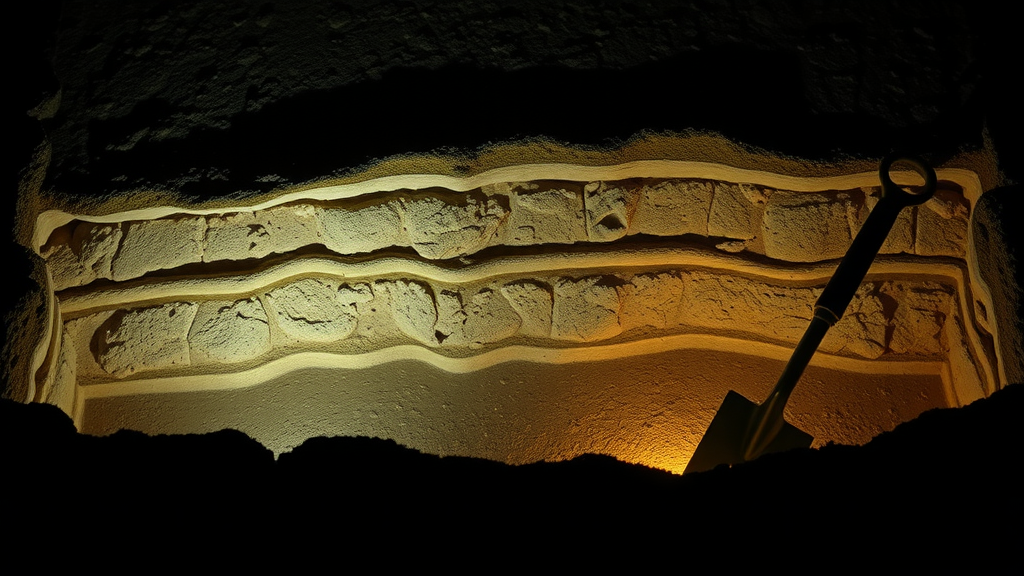
An archaeological excavation is often compared to reading a book by tearing out its pages one at a time. Every layer of soil that is removed is gone forever, and any information the excavator failed to record in the moment is lost with it. The problem becomes even more acute when two layers look almost identical to the human eye, because a trench wall of apparently uniform brown earth may in fact contain the traces of several distinct episodes of human activity, each with its own story to tell. Researchers from Aarhus University and Moesgaard Museum in Denmark have now developed a way to make those invisible differences glow into view before a single spadeful of soil leaves the ground, and they have done it with a technology that is deliberately cheap, portable and simple enough for everyday fieldwork.
The innovation is a multispectral imaging system built around light-emitting diodes. Instead of bathing an excavation section in ordinary white light, the prototype illuminates the soil with LEDs operating at sixteen different wavelengths, stretching from the near-ultraviolet through the visible spectrum and out into the near-infrared. The physical principle behind the technique is straightforward: different materials absorb and reflect light differently depending on the wavelength that hits them. Two deposits that both appear as rather similar dark brown or black soil under sunlight may respond very differently when photographed under ultraviolet or infrared illumination, revealing contrasts in mineral content, organic matter, moisture or burnt material that the naked eye simply cannot register.
“We wanted to make things faster, clearer and better in the field, and at a cost that makes sense for archaeology. One way of doing that is simply to rethink the light,” says Associate Professor Søren Munch Kristiansen from the Department of Geoscience at Aarhus University. That rethinking has produced a system the researchers call LEDMSI, short for LED multispectral imaging, which is roughly twenty times cheaper than the hyperspectral imaging rigs that have previously been used for similar archaeological purposes. The full study has been published in the Journal of Archaeological Science, and it documents both the construction of the device and its performance under genuinely difficult field conditions.
The researchers chose a demanding place for their first trial: Sorte Muld on the Danish island of Bornholm, a name that literally translates as Black Soil. The site is an archaeologically rich Iron Age settlement where centuries of human activity have built up more than a metre of dark cultural deposits. That richness creates a practical nightmare for excavators, because many of the layers are thin, irregular and almost identical in colour, making it extraordinarily difficult to determine where one deposit ends and the next begins. It was precisely the kind of environment in which a new way of seeing the soil could prove its worth, or fail visibly.
The LEDMSI prototype photographed the same section of the excavation repeatedly while the sixteen wavelengths were cycled in turn, producing a stack of images of the identical patch of soil under different lighting conditions. The resulting data were then processed with statistical methods that combine the spectral information across all sixteen channels and amplify the differences between materials. “The images looked almost psychedelic when we took them, and we only really saw what we had when we analysed them back at the computer,” says Kristiansen. “Then we could see new layers and changes in the fill that we simply could not see with the naked eye.” Among the features that emerged from the analysis was one that may represent an old ground surface, which would mark a break in activity at the site. The researchers are careful to stress that this interpretation still needs to be confirmed, but it demonstrates exactly what the system is designed to do: point the archaeologist towards differences that would otherwise go completely unnoticed.
The reason such differences matter so much is that archaeological soil rarely resembles a neat pile of pancakes. People dig pits and ditches, fill them in again, move earth from place to place and build on top of the traces of earlier generations. Two objects found in apparently separate layers may in fact be contemporary, while neighbouring deposits that sit side by side may represent events separated by centuries. Sorting out these relationships is the core intellectual work of stratigraphic excavation, and seeing the boundaries between deposits more clearly can improve both the documentation of the site and the decisions about where to take samples for radiocarbon dating and other laboratory analyses. In effect, the system gives archaeologists a second, more perceptive look at the stratigraphy while there is still time to act on what it shows.
The experiment at Sorte Muld revealed another genuinely unexpected capability. When the soil was illuminated with ultraviolet light, small fragments of bone fluoresced and stood out clearly against the surrounding matrix, becoming far easier to distinguish from the dark earth around them. Normally, fluorescence photography requires optical filters to separate the fluorescent glow from the reflected illumination, but the researchers demonstrated that useful information could be extracted even without such filtering, which simplifies the equipment that has to be carried and operated in the field. The finding is more than a curiosity. Previous research has linked fluorescence in archaeological bone to the preservation of collagen, the structural protein whose survival is a critical precondition for ancient DNA and protein analyses. The present study does not claim that LEDMSI can automatically select the best DNA samples, but it shows that fluorescent material worth investigating can be detected quickly and with comparatively simple equipment, which may eventually help excavators identify the most promising material for scientific sampling.
The technology has not stood still since the Bornholm trials. A second-generation prototype, equipped with a better camera and two separate LED units, has recently been tested at Fredbjerg in northern Jutland, where archaeologists are excavating a cemetery dating from the late Viking Age and the early Christian period. The preservation conditions there are poor, and in some graves very little skeletal material survives, with the bodies visible mainly as faint shadows in the soil. “We’re trying to see if there is information present in the graves that is not otherwise apparent,” says archaeologist David Stott from Moesgaard, one of the developers of the system. During the Fredbjerg excavation the multispectral data were used directly to guide decisions about where to take samples for further analysis, moving the technique from demonstration to practical decision support.
The pace of the system has also improved dramatically. The new version can acquire its full series of wavelength images in around thirty seconds, compared with up to roughly five minutes for the first prototype, and the researchers are now working towards processing the results on site almost immediately on a laptop, and eventually on a phone or other handheld field device. The next major ambition is to add machine-learning software that can learn the spectral signatures of different materials and help archaeologists work out what they are actually looking at in a trench wall. “The difficult part is teaching an algorithm what is what. At the moment, the archaeologist and I, as a geologist, basically have two settings: glasses on or glasses off. This gives us many more ways of seeing,” Kristiansen explains.
He does not expect algorithms to replace the trained archaeological eye, and the stated ambition of the project is explicitly modest in that respect: to give that eye some assistance. But the long-term vision is one of quiet ubiquity rather than spectacle. “I hope that in ten years, bringing a system like this to an excavation will be as normal as bringing a digital camera,” Kristiansen adds. If that hope is realised, the layered cake of the archaeological record may never again be eaten blindly, because before each slice is removed the excavator will have seen, in sixteen colours invisible to human vision, exactly where the layers begin, where they end, and which ones hide the bones and surfaces that matter most.
Subject of Research: LED multispectral imaging for non-destructive analysis of archaeological soil layers and materials during excavation
Article Title: LED lets archaeologists see the past in a new light
Article References: LED lets archaeologists see the past in a new light. (n.d.). Original publication
Image Credits: AI Generated
DOI: Not provided
Keywords: multispectral imaging, archaeology, LED technology, excavation, Sorte Muld, Bornholm, soil stratigraphy, bone fluorescence, ancient DNA sampling, Viking Age graves, Aarhus University, Journal of Archaeological Science
Cite Scienmag News
Courtney Benton. (September 12, 2026). LED Imaging System Reveals Hidden Archaeological Layers Before the Trowel Strikes. Scienmag. https://scienmag.com/led-imaging-system-reveals-hidden-archaeological-layers-before-the-trowel-strikes/
Courtney Benton. "LED Imaging System Reveals Hidden Archaeological Layers Before the Trowel Strikes." Scienmag, 12 September 2026, https://scienmag.com/led-imaging-system-reveals-hidden-archaeological-layers-before-the-trowel-strikes/. Accessed 4 October 2026.
Courtney Benton. "LED Imaging System Reveals Hidden Archaeological Layers Before the Trowel Strikes." Scienmag. September 12, 2026. https://scienmag.com/led-imaging-system-reveals-hidden-archaeological-layers-before-the-trowel-strikes/


